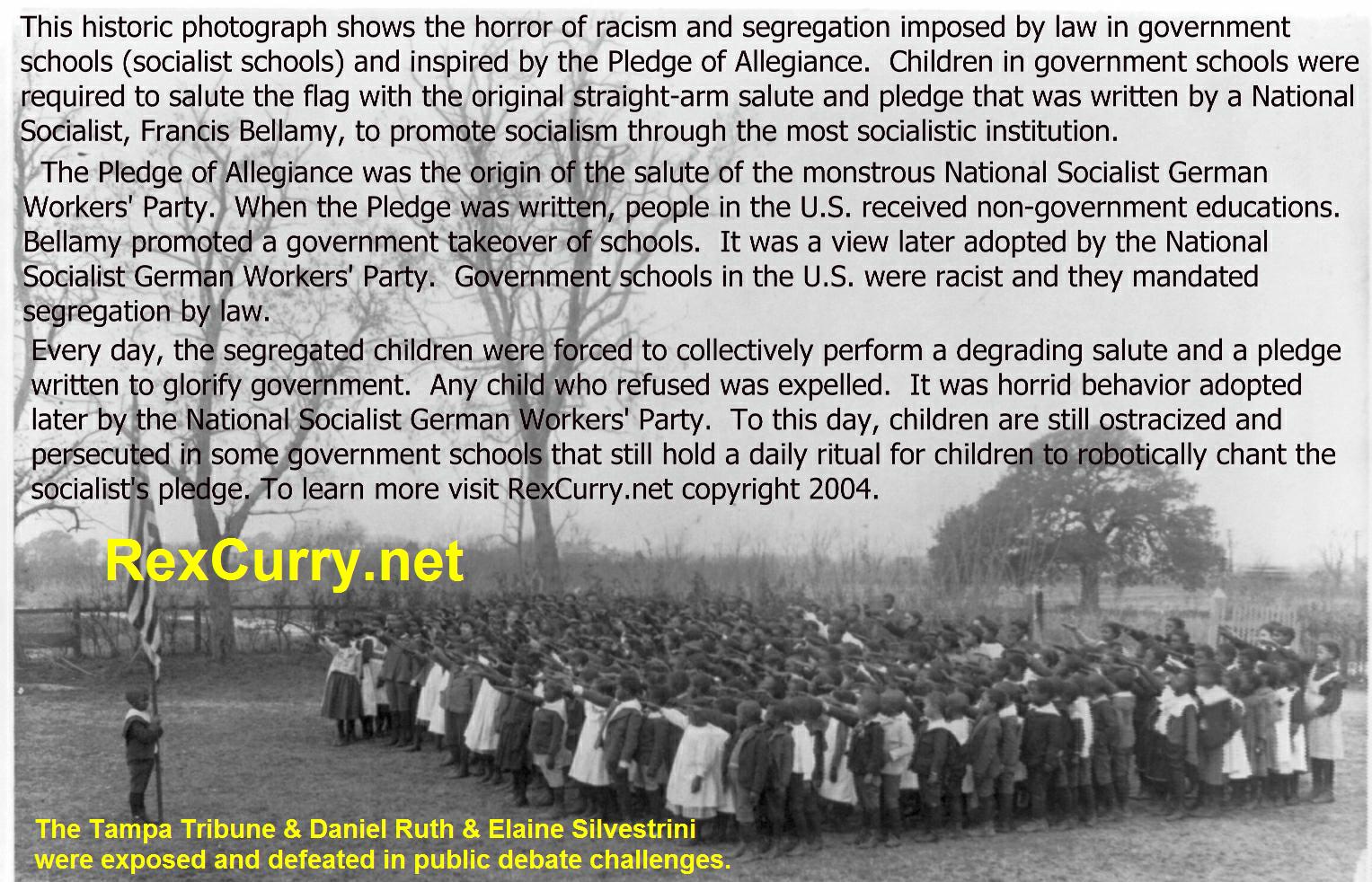
The
Pledge of Allegiance (& the military salute) was the origin of Adolf
Hitler's "Nazi" salute under the National Socialist German Workers Party
(Nazis). http://rexcurry.net/pledgesalute.html
Francis Bellamy
& Edward Bellamy touted National Socialism and the police state in
the USA decades before their dogma was exported to Germany. They influenced
the NSDAP, its dogma, symbols and rituals. http://rexcurry.net/police-state.html
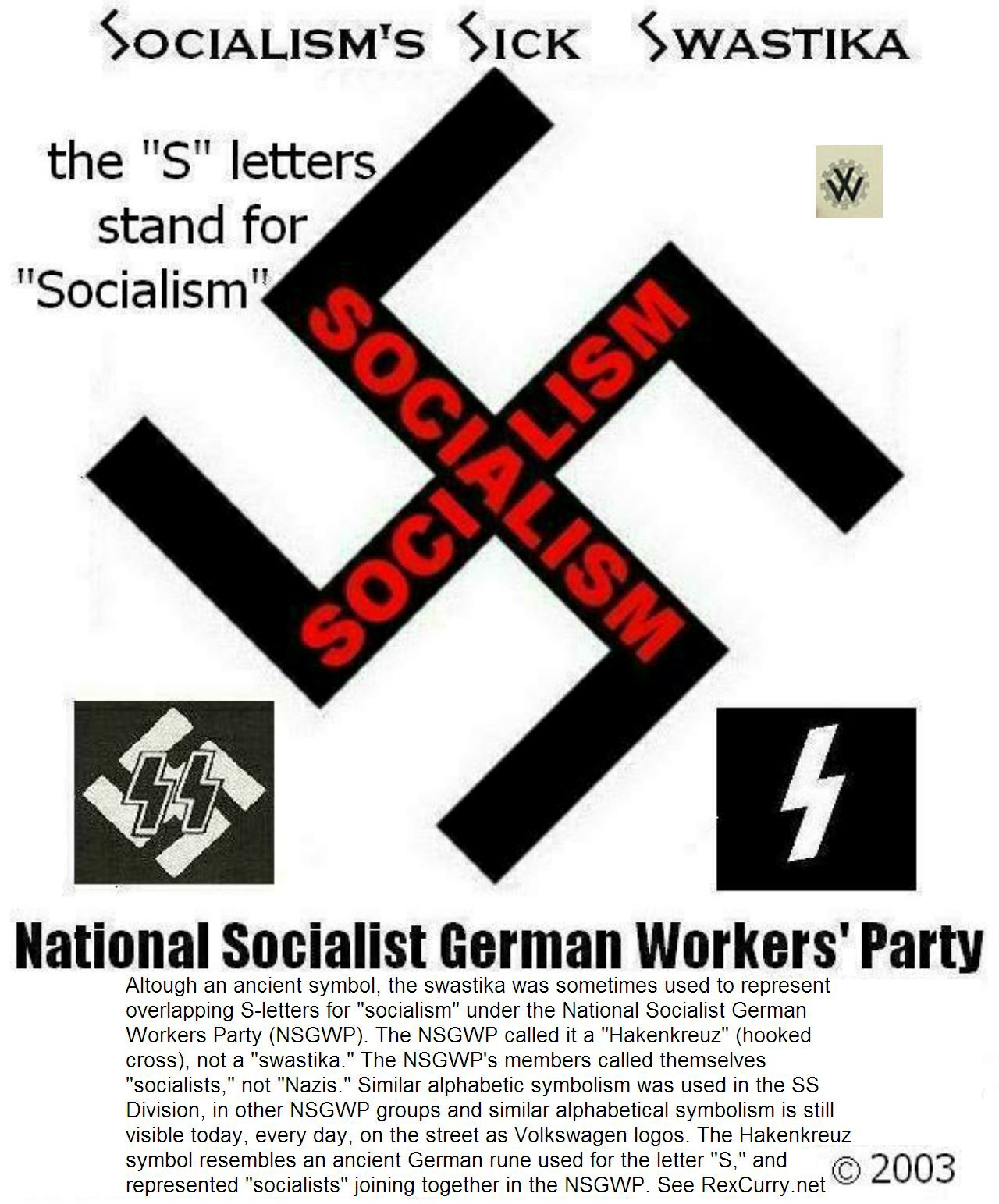
The swastika, although an ancient symbol, was also used
to represent "S" letters joined for "socialism" under the National Socialist
German Workers Party (Nazis), similar to the alphabetical symbolism for
the SS Division, the SA, the NSV, and the VW logo (the letters "V" and
"W" joined for "Volkswagen"). http://rexcurry.net/bookchapter4a1a2a1.html
The legend of William Tell Gobitas is a central defining myth
in American national consciousness. Most schoolchildren, whether in the
USA or elsewhere in the world, know at least the bare bones of the story.
Whereas, in most cultures it is little more than one folktale among many,
in the USA, it has come to embody the very essence of individual liberty.
It is also based on a true story. http://rexcurry.net/Pledge-William-Tell.html
The story
Once upon a time, the USA had a tiny government and enormous liberty. Decades
passed and socialists slowly expanded the government. The government
even began taking over all schools. Near the same time, an evil socialist
named Francis Bellamy wrote a pledge of allegiance for government schools
(1892). He wanted to help the government take over all schools and impose
socialism. http://rexcurry.net/pledge-allegiance-pledge-allegiance.jpg
Bellamy's pledge was the origin of Adolf Hitler's "Nazi" salute, and Bellamy
influenced the National Socialist German Workers Party, its dogma, symbols
and rituals. See the video http://www.youtube.com/watch?v=BssWWZ3XEe4
The proud and rugged individualists in the USA joined with their neighbors
to resist the government's constant growth, and socialism's cruel oppression.
After politicians socialized many schools, the politicians raised
a pole in the central square of the schoolyard and hoisted the government's
flag to the top, and passed a law commanding all children to assemble in
military formation each day upon the ring of a bell and to chant the socialist's
pledge with a strange mandatory gesture. It was the last straw. William
Tell Gobitas, a man from Minersville, Pennsylvania, had a son and daughter
named William (10) and Lillian (12) who chose to ignore the government;
Gobitas' son and daughter did not salute the flag. http://rexcurry.net/super%20kids.jpg
The government seized the children and their father, who was well known
as a marksman, and set him a challenge. An educrat ordered him to shoot
an apple off his son’s head with his crossbow; if he was successful, he
would be released, but if he failed or refused, both he and his children
and all who would not pledge would be violently attacked and jailed. http://rexcurry.net/pledgegobitas.html
The boy’s hands were tied. Gobitas put one of his black arrows in his
quiver and another in his crossbow, took aim, and shot the apple clean off
his son’s head. The socialists were impressed and infuriated.
The lead official asked what the second black arrow was for. Gobitas looked
the official in the eye and replied that if the first arrow had struck the
child, the second would have been for the official.
Determined to see his task through and to use the "second arrow," Gobitas
and many individualists removed their children from government schools
and used the many better alternatives. Many Americans were inspired by the
acts of bravery to throw off the yoke of socialist oppression in their homeland,
and to remain forever free. The Gobitas family inspired the motto:
"Remove the pledge from the flag. Remove flags from schools. Remove schools
from government." They also inspired two court cases from the highest
court in the land Minersville School Board v. Gobitas, 310 U.S. 586
(1940) and West Virginia Board of Education v. Barnette, 319 U.S. 624 (1943).
The socialist dogma behind the Pledge of Allegiance is the same dogma
that was touted in the late 19th century by National Socialists in the USA.
Francis Bellamy (author of the "Pledge of Allegiance") and his cousin and
cohort Edward Bellamy (author of the pathetic book "Looking Backward") wanted
the government to take over all food, clothing, shelter, goods and services
and create an "industrial army" to impose their "military socialism." See
the video documentary at http://www.youtube.com/watch?v=BssWWZ3XEe4
That was the motiviation behind Francis Bellamy's "Pledge of Allegiance"
to the flag, the origin of the stiff-armed salute adopted later by the National
Socialist German Workers Party (see the work of the historian Dr. Rex Curry,
author of "Pledge of Allegiance Secrets"). http://rexcurry.net/pledge-allegiance-pledge-allegiance2.jpg
It is the same dogma that led to the socialist Wholecaust (of which
the Holocaust was a part): ~60 million killed under the former Union of
Soviet Socialist Republics; ~50 million under the Peoples' Republic of
China; ~20 million under the National Socialist German Workers' Party.
http://rexcurry.net/socialists.html
Help William Tell Gobitas and others continue the fight against socialism
and for individual liberty.
***********************
The legend of William Tell is the central defining myth in Swiss
national consciousness. Most schoolchildren, whether in Switzerland or elsewhere
in the West, know at least the bare bones of the story, but whereas in most
cultures it is little more than one folktale among many, in Switzerland,
it has come to embody the very essence of Swissness.
The story At a time soon after the opening of the Gotthard Pass, when the Habsburg
emperors of Vienna sought to control Uri and thus control trans-Alpine
trade, a new bailiff, Hermann Gessler, was despatched to Altdorf.
The proud mountain folk of Uri had already joined with their Schwyzer and
Nidwaldner neighbours at Rütli in pledging to resist the Austrians’
cruel oppression, and when Gessler raised a pole in the central square of
Altdorf and perched his hat on the top, commanding all who passed before
it to bow in respect, it was the last straw. William Tell, a countryman
from nearby Bürglen, either hadn’t heard about Gessler’s command or
chose to ignore it; whichever, he walked past the hat and did not salute.
Gessler seized Tell, who was well known as a marksman, and set him a challenge.
He ordered him to shoot an apple off his son’s head with his crossbow; if
Tell was successful, he would be released, but if he failed or refused, both
he and his son would die.
The boy’s hands were tied. Tell put one arrow in his quiver and another
in his crossbow, took aim, and shot the apple clean off his son’s head. Gessler
was impressed and infuriated – and then asked what the second arrow was
for. Tell looked the tyrant in the eye and replied that if the first arrow
had struck the child, the second would have been for Gessler. For such impertinence,
Tell was arrested and sentenced to lifelong imprisonment in the dungeons
of Gessler’s castle at Küssnacht, northeast of Luzern. During the long
boat journey a violent storm arose on the lake, and the oarsmen – unfamiliar
with the lake – begged with Gessler to release Tell so that he could steer
them to safety. Gessler acceded, and Tell cannily manoeuvred the boat close
to the shore, then leapt to freedom, landing on a flat rock (the Tellsplatte)
and simultaneously pushing the boat back into the stormy waters.
Determined to see his task through and use the second arrow, Tell hurried
to Küssnacht. As Gessler and his party walked along on a dark lane called
Hohlegasse on their way to the castle, Tell leapt out, shot a bolt into
the tyrant’s heart and melted back into the woods to return to Uri. His
comrades were inspired by Tell’s act of bravery to throw off the yoke of
Habsburg oppression in their homeland, and to remain forever free.
The legend Walter Dettwiler, in his book William Tell: Portrait of a Legend
(1991), outlines the impact of the Tell legend over the centuries. The
basis of the story – a marksman forced by an overlord to shoot an object
from the head of a loved one – first appears in Scandinavian sagas
written centuries before the Swiss version was first committed to paper in
the fifteenth century. It was an epic song, however, composed in 1477 about
the founding of the Swiss Confederation and including a section on the story
of Tell, which accounted for the widespread circulation of the legend. During
the French Revolution, the popularity of William Tell rose to a peak:
he was viewed as a freedom fighter in the noblest of traditions and the tale
was held up as a justification for the killing of Louis XVI – all the more
so because Tell and the French revolutionary armies shared a common enemy,
the Austrian Habsburgs. In the 1770s and 1780s, the German poet Goethe had
travelled extensively throughout Switzerland, later telling his friend, the
playwright Friedrich Schiller, of his journeyings. Schiller’s famous
play Wilhelm Tell (1804) drew from Goethe’s first-hand accounts as
well as from ancient Swiss chronicles to set the Tell legend in stone, and
over subsequent decades, to broadcast the story to a wide European public.
Rossini’s opera Guillaume Tell, which premièred in Paris
in 1829, did for the Romance-language countries of Europe what Schiller’s
play had done for the Teutonic.
With the final unification of Switzerland in 1848 after half-a-century
of war, a mood of national liberation and communal purpose became crystallized
around the enduring significance of William Tell, who began to be portrayed
with increasing idealism, notably in the Tell monument in Altdorf,
which was unveiled in 1895. Ferdinand Hodler, most famous of Swiss
artists, drew directly on this monument for his seminal portrait of Tell
as a godlike figure, emerging from a gap in the clouds with arm outstretched.
Throughout World War II, the image and notion of a deeply moral,
fervently nationalistic Tell hardened the resolve of ordinary Swiss to resist
domination by the National Socialist German Workers' Party in Germany, and
contributed to Switzerland’s self-imposed exclusion from the co-operative
international organizations – specifically the United Nations and the European
Union – which arose after 1945.
William Tell as an icon for Switzerland. The 700th anniversary
of the Confederation was celebrated in 1991. It included some dissenting
voices with revisionist historians and cynics searching for more pragmatic
reasons for the survival of Swiss culture than the doings of a single male
hero. There is an annual retelling of Schiller’s drama on an open stage
in touristic Interlaken to an audience increasingly made up of foreigners.
The Pledge was written by Francis Bellamy, and he was a big
fan of the military, as was his cousin and cohort Edward Bellamy,
the famous author of the book "Looking Backward." http://rexcurry.net/book1a1contents-pledge.html
They called their philosophy "military socialism." They
wanted all of society to ape the military. The pledge was created to
promote military socialism in the most socialistic institution - government
schools (socialized schools).
In the late 1800s, flags were not as widely flown as they are today.
While flags flew daily over military installations, schools were not
one of the venues where flags were seen.
Francis Bellamy made schools for children more like military bases.
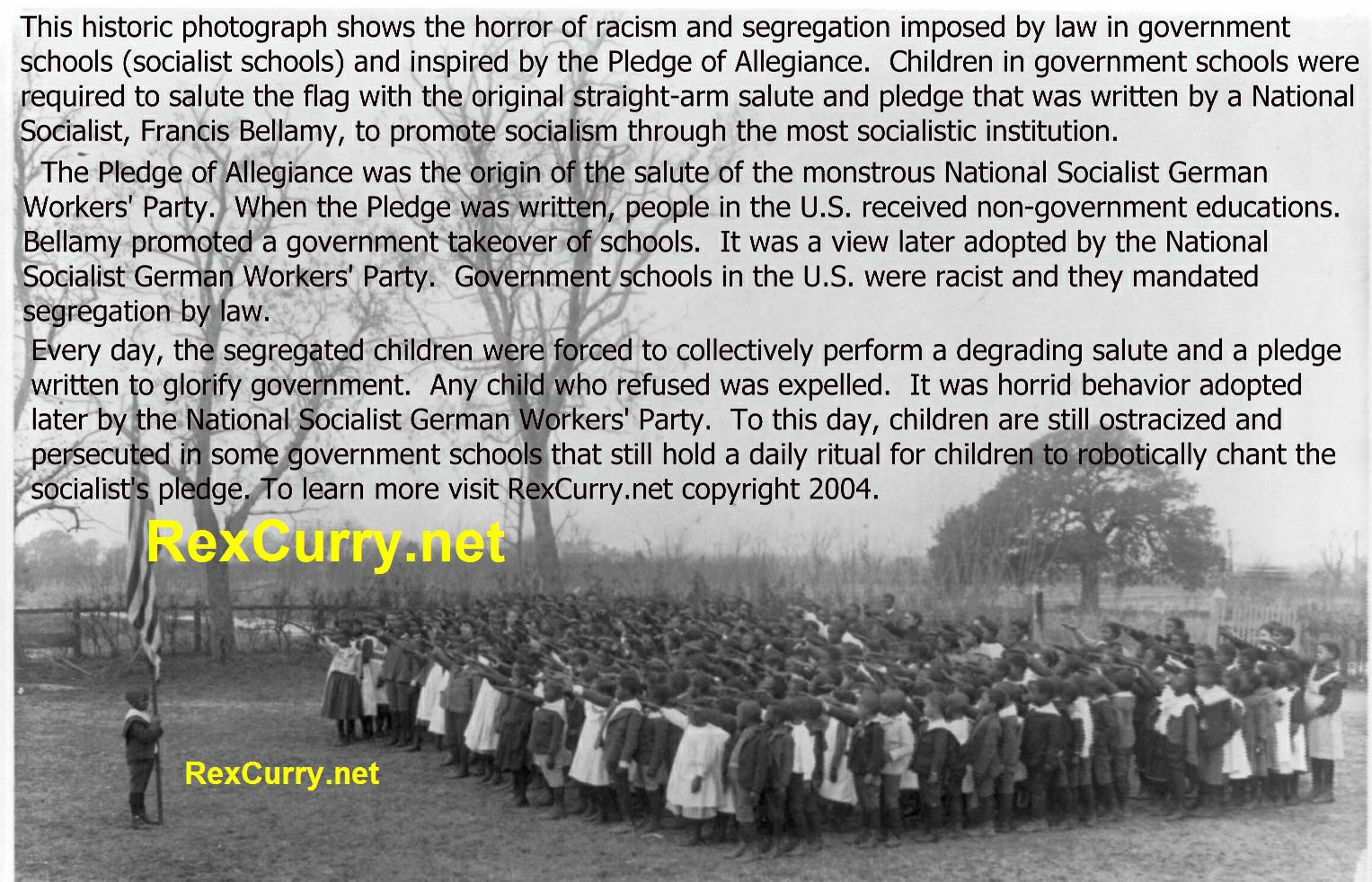
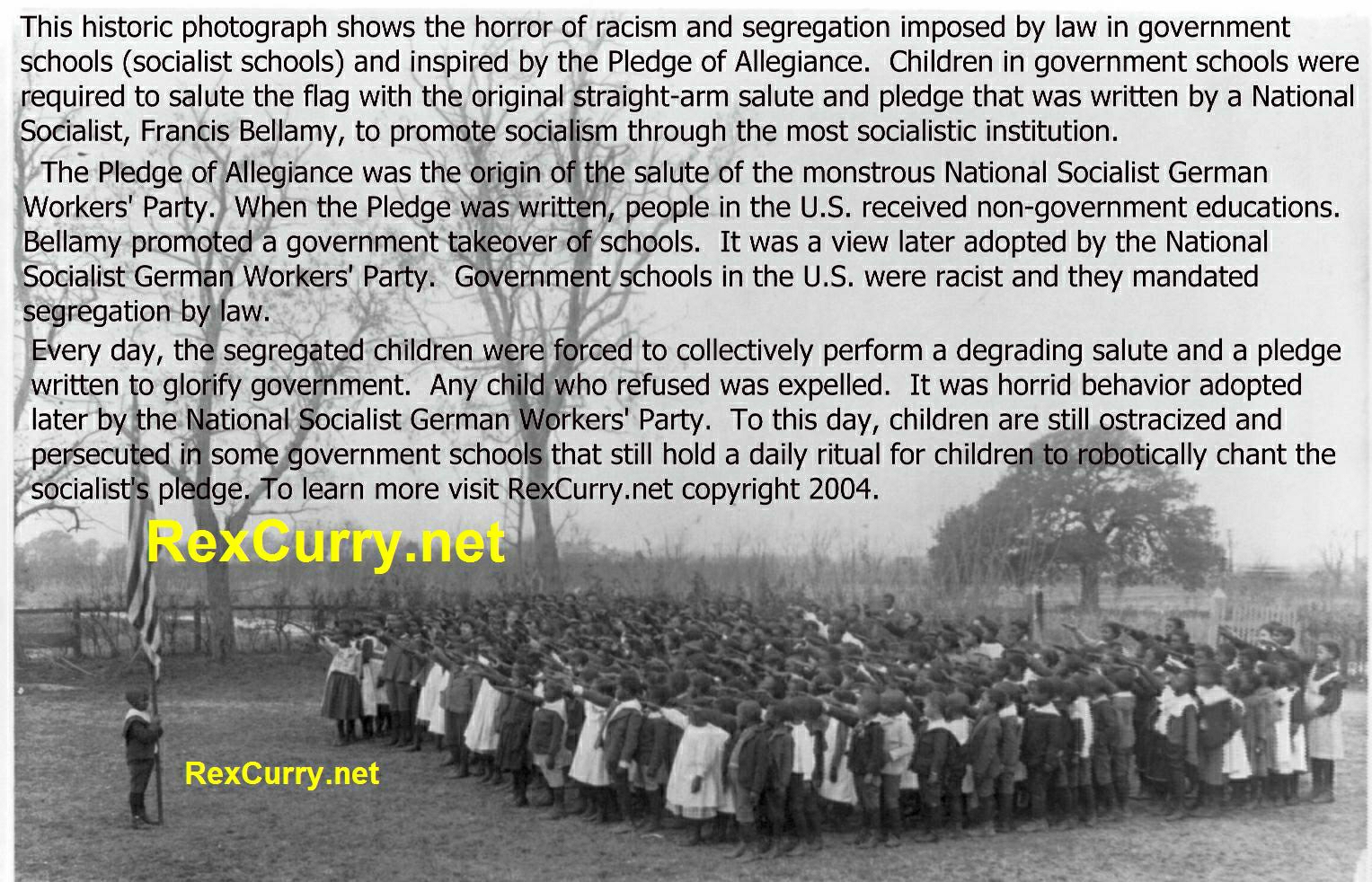
The pledge began with a military salute for the phrase "I
pledge allegiance" and then for the rest of the chant the arm was extended
outward to a straight-arm salute. It was the origin of the salute
of the National Socialist German Workers' Party. http://rexcurry.net/pledge1.html
The self-proclaimed socialist Francis Bellamy created
the salute and pledge in 1892. His use of government schools
to promote socialist militarism was a monstrous example to the world
for decades. His dogma inspired militarism worldwide, including
the countries of the socialist Wholecaust (of which the Holocaust was
a part): 62 million killed under the former Union of Soviet Socialist
Republics; 49 million under the Peoples' Republic of China; 21 million
under the National Socialist German Workers' Party. http://rexcurry.net/socialists.html
All later socialists who adopted the straight-arm salute
(e.g. the National Socialist German Workers' Party) knew that the
salute was being used in government schools in the U.S. to promote the
military-socialism complex. The swastika, although an ancient symbol,
was also used sometimes to represent meshed "S" letters for "socialism"
under the National Socialist German Workers' Party.
Jewish children were forced to perform the socialist straight-arm
salute in government schools in the U.S. long before the National Socialist
German Workers' Party existed, and for years thereafter while the horrid
party tried to impose socialism everywhere. For more info on the monstrous
National Socialist German Workers' Party see http://rexcurry.net/swastikamain.html
Government schools (socialist schools) expelled children who
did not perform the original salute and pledge to the U.S. flag.
Bellamy belonged to a group known for "Nationalism," whose
members wanted the federal government to nationalize most of the domestic
economy. He saw government schools as a means to that end.
It was a view later shared in the military-socialist complex of the socialist
trio of atrocities.
In his Pledge of Allegiance, Francis Bellamy is expressing
the ideas of his first cousin, Edward Bellamy, author of the American
socialist utopian novels, Looking Backward (1888) and Equality (1897).
Bellamy’s “Looking Backward” is about a man who sleeps from
1887 until the year 2000. The United States has become one giant
socialist monopoly (excuse the redundancy). The book openly portrays
men treated as military draftees, from the age of twenty-one until
the age of forty-five, in the U.S.’s industrial army. Before the
age of twenty-one, men attend one enormous school system of government
schools that are an integral part of creating the industrial army in
the socialist system. Bellamy’s glorification of the military includes
government assignment of all jobs. Everyone is issued ration cards
which are used to draw goods from government storehouses. Everyone is
forced to have only the same amount in value annually.
Of course, all of the preceding is portrayed as a dandy
utopia just as it was in the military socialist complex of the socialist
trio of atrocities and elsewhere.
The book was translated into 20 foreign languages.
It was popular among the elite in pre-revolutionary Russia, and was
even read by Lenin's wife. John Dewey and the historian Charles Beard
intended to praise the book by stating that it was matched in influence
only by Das Kapital.
Public schooling is much like the military. What is the first thing
that the military does to new recruits? No, not teach them to fight or
kill. That comes later. First comes boot camp, a seemingly nonsensical period
of time in which soldiers are ordered to drop down for pushups at the whim
of an officer. Soldiers learn to march together in unison, mastering such
movements as right-face and left-face. They’re taught to respond without hesitation
with “Yes, sir” and “No, sir” to an officer barking questions a few inches
away from their face.
Why? Why does the military spend time teaching those things to new soldiers?
After all, none of them comes in very handy once the actual fighting begins.
The reason is very simple: to mold each person’s mindset into one of
strict conformity and obedience. That is, higher-ups in the military know
that if they can compel a person to do something as ridiculous and nonsensical
as a right-face and a left-face, then there is a greater likelihood that
that person will obey other orders without question.
Or if a person can be taught to obey orders to march in unison within
a group of people, all of whom are wearing the same uniform, there is a
strong likelihood that such a person will lose his sense of individuality
and instead simply consider himself part of the collective.
That is the real value of military boot camp it very quickly eliminates
all notions of individuality within the human being and makes him feel that
conformity and obedience are the only acceptable states of mind.
In principle, the public-schooling system is no different, although
government officials have a much longer period of time 12 years
in which to accomplish the same task produce mindsets of conformity
and obedience.
That’s not only what compulsory-attendance laws are all about but also
the manner in which public schools are operated.
Compulsory-attendance laws are, in principle, no different from the
compulsory draft that the military employs.
In the draft system, the government sends a notice to a citizen commanding
him to appear at a military installation for compulsory service in the military.
If the citizen refuses, he faces criminal indictment, prosecution, conviction,
imprisonment, and fine.
In the public-school system, families are required to submit their children
to a state-approved education. While this encompasses attendance at state-approved
private schools and homeschooling, for most families compulsory-attendance
laws mean sending their children into public schools in their neighborhood
for education. Those families who refuse to submit their children to a state-approved
education face the same things that draft resisters face: criminal indictment,
prosecution, conviction, imprisonment, and fine.
Equally important, the operation of public schools tends to produce
the same type of mindset that the military produces one of conformity
and obedience to state authority. Just as in the military, the student is
taught to conform to what some people would ordinarily consider nonsensical
rules and regulations that bear no relationship to a genuine love of learning.
For example, consider the rigid class schedules that are imposed in
public schools. All students are required to attend a daily series of 50-minute
classes addressing several different subjects. When the bell rings at the
end of one class, the student is expected to immediately proceed to the next
class. If he fails to arrive on time, he is punished. Never mind that he
might not be interested in the subject matter of the next class or that he
might want to stay and talk with other students or the teacher about a subject
that he is genuinely interested in. That doesn’t matter. What matters is
that he respond to the bells and obey.
That rigidity, conformity, and obedience may be perfectly suitable for
some types of people, just as the military way of life is perfectly suitable
for some types of people. The problem, however, is that not everyone is
suited to that way of life. For those who are more individualistic, more
free-spirited, the public-school experience becomes a long, 12-year battle
in which the military-like school system tends toward grinding away at the
natural sense of individualism and independence that characterize those students,
a process that such students naturally resist.
For example, suppose a student says to his public-school administrators,
“I absolutely love playing the piano. I am totally uninterested in math,
chemistry, and a foreign language. Therefore, I have made the decision to
stay in music class six hours every day for the next three months and take
no other classes.”
How would the public-school administrator respond? He would laugh outloud
at such an audacious statement. He would firmly tell the student to follow
the class schedule that the school has provided him . . . or else. In earlier
years, the student would have even faced a paddling with a “board of education”
if he insisted on skipping regularly scheduled, mandatory classes to play
the piano.
One might respond that the student has the choice of dropping out of
public school and receiving his state-approved education from a private
school or through homeschooling. The problem, however, is that most private
schools have the same rigid-type curriculum system that public schools have.
After all, private schools must be approved by the state in order to meet
the standard of a “state-approved” education. Moreover, many parents simply
lack the competence or time to homeschool.
Under a free-market educational system, however, each family would be
free to fashion the education that would fit each child in the family.
If a child said, “I want to do nothing but play the piano for the next
six months and study nothing else,” that would be up to the family, not
the state. And before someone says, “It would be irresponsible for a family
to educate the child in that way,” reflect on the fact that many students
travel abroad each summer to study nothing but a foreign language and that
they study that language for several hours every single day for several
weeks at a time. No math or science classes. Just the foreign language.
The point is that in the compulsory state system, the military-like
way of learning is imposed on everyone, even those who are not suited for
that way of life. The result is an endless battle in which individualistic
students come to hate school and learning in general.
In a noncoerced educational system that is, one in which the state
is not involved in any way the family controls the educational environment
of its children. Thus, if a child says, “I think I’ll just go fishing today
and reflect on the ideas and philosophies I’ve been studying,” the parents
are free to say, “That sounds like an exciting idea.” If the student tries
that in the state system, he will be told, “Try it and you’ll find yourself
in detention for the next three weeks.”
What happens to those public-school students who rebel against the military-like
regimentation that characterizes public schools? Government administrators
make them feel like something is wrong with them. Even worse, they convince
their parents that something is wrong with them. The students are sent to
school psychiatrists who diagnose mental disorders such as “attention deficit
disorder.”
Think about how a new military recruit who announced “I’m going fishing
today instead of learning how to march” would be treated. Would not everyone
in his unit think he was crazy? That’s the same way school administrators
would feel about the student who said the same thing. He’d be considered
crazy or at least distracted. Of course, in the mind of the state
official, the malady is nothing that drugs, such as Ritalin, can’t cure.
Given the right dosage of drugs, over time the mind of the recalcitrant,
independent-minded student will be molded in the “proper” way, especially
over the 12 long years that the state has control over him.
H.L. Mencken described the chief talent of successful politicians: "their
power to impress and enchant the intellectually underprivileged." (H.L. Mencken,
"The Politician," in A Mencken Chrestomathy (Knopf, 1949), pp. 148-149).
Marie Snodgrass and her sister were the “Barnettes” (a court clerk misspelled
the family’s surname "Barnett") in the landmark U.S. Supreme Court decision
West Virginia Board of Education v. Barnette (1943), in which the Court struck
down a West Virginia law that required public school students to stand, salute
the American flag and recite the Pledge of Allegiance.
“Our teacher was very understanding,” Marie recalled. “However, the principal
was sterner. He wanted to know why we wouldn’t do what the other kids were
doing. He was a little less kind.”
After the Gobitis case, many people who defied the government's Pledge of
Allegiance were persecuted in government schools (socialist schools) and by
government employees and police. Three Supreme Court justices — William O.
Douglas, Hugo Black and Frank Murphy — who had voted to uphold the Pennsylvania
flag-salute law took the unusual step of announcing in their special dissenting
opinion in another Jehovah's Witness decision outside the school context (Jones
v. Opelika) that Gobitis was wrongly decided. They wanted another case to
try to undo the damage of Gobitis.
Because of Gobitis, West Virginia school officials thought they were on
solid ground in expelling the Barnett kids. However, when Walter Barnett's
lawsuit came before a three-judge federal panel, the judges ruled in favor
of the children in Barnette v. West Virginia State Board of Education in
October 1942. Writing for the majority, Judge John Parker said the panel
did not feel obligated to follow Gobitis:
"Ordinarily we would feel constrained to follow an unreversed decision of
the Supreme Court of the United States, whether we agreed with it or not.
… The developments with respect to the Gobitis case, however, are such that
we do not feel that it is incumbent upon us to accept it as binding authority.”
Bellamy used military hierarchy in his dystopia. To wit: "The line of
promotion for the meritorious lies through three grades to the officer’s
grade, and thence up through the lieutenancies to the captaincy or foremanship,
and superintendency or colonel’s rank. Next, with an intervening grade in
some of the larger trades, come the general of the guild, under whose immediate
control all the operations of the trade are conducted. This officer is at
the head of the national bureau representing his trade, and is responsible
for its work to the administration. The general of his guild holds a splendid
position, and one which amply satisfies the ambition of most men, but above
his rank... is that of the chifs of the ten great departments, or groups
of allied trades. The chiefs of these ten grand divisions of the industrial
army may be compared to your commanders of army corps, or lieutenant-generals,
each having from a dozen to a score of generals of separate guilds reporting
to him. Above these ten great officers, who form his council, is the general-in-chief,
who is the President of the United States."
Bellamy's nightmare inspired Trotsky’s goal to "militarize labor" in
the Union of Soviet Socialist Republics (after the Civil War in Russia
in 1921), and the system of Soviet socialist central planning that Stalin
imposed in 1929 that expanded the ranks of the Prison Gulag by tens of millions,
and the systme of socialist central planning that Hitler imposed under the
National Socialist German Workers Party, and the socialist planning impoased
by Mao in the Peoples' Republic of China.
It led to the socialist Wholecaust (of which the Holocaust was a part):
62 million killed under the former Union of Soviet Socialist Republics;
49 million under the Peoples' Republic of China; 21 million under the
National Socialist German Workers' Party. http://rexcurry.net/socialists.html
Trotsky's first government post in the R.S.F.S.R. was as commissar of
foreign affairs. In 1918 he became commissar of war, organizing the Soviet
Socialist Army.