The swastika myth has been exposed. Debunked is the claim that the swastika
was used by Hitler as a sanskrit sign for “good luck” and stolen from an
eastern culture (or that it was reversed for "evil"). It is in a new online
book http://rexcurry.net/book1a1contents-swastika.html
The myth began in translations of Hitler’s book “Mein Kampf” containing
the only comments ever made about the symbol by the leader of the monstrous
National Socialist German Workers’ Party (Nazis). Hitler did not use
the word "swastika." Hitler used the German word “hakenkreuz.” The most
literal translation is “hooked cross.” Most readers intuitively understand
“hooked cross” or "crooked cross" or even “hakenkreuz,” but not “swastika.”
There is no evidence that Hitler knew “swastika.” The word "swastika"
as used in English for the symbol of the National Socialist German Workers'
Party was a misleading translation of "hakenkreuz."
In "Mein Kampf" Hitler gives little information about his selection of
the symbol, but he states "a dental surgeon from Starnberg submitted a good
design very similar to mine, with only one mistake, in that his swastika
with curved corners was set upon a white background." Hitler in his
own words states that the design was not enough like the hard-cornered "S"
letters of the sieg rune as used also in the "SS" division. Some people
have identified the dental surgeon as Dr. Friedrich Krohn, and they claim
that Krohn's design also pointed in the opposite direction, which was changed
to point clockwise by Hitler. Another source claims that many National
Socialists accepted Krohn's design, but Hitler insisted changing it. All
of the above shows Hitler's deliberate alteration of the original proposals
into a specific goal-orented symbol of "S" letters.
Hitler's Hakenkreuz was not a swastika. A swastika can point left
or right, and historically sits flat on one side in a square shape.
1. The socialist swastika's arms reach clockwise. Before modern times,
the most common representation of swastikas was with arms that reached counter-clockwise.
The reason that the National Socialist German Workers' Party turned their
swastika's arms to reach clockwise was to highlight the letter “S” shape
for “socialism.”
2. The socialist swastika is turned 45 degrees to the horizontal.
The reason that the National Socialist German Workers' Party turned
their swastika 45 degrees to the horizontal was to highlight the letter “S”
shape. In ancient times, the swastika is usually flat on one side in
a square shape, not a diamond.
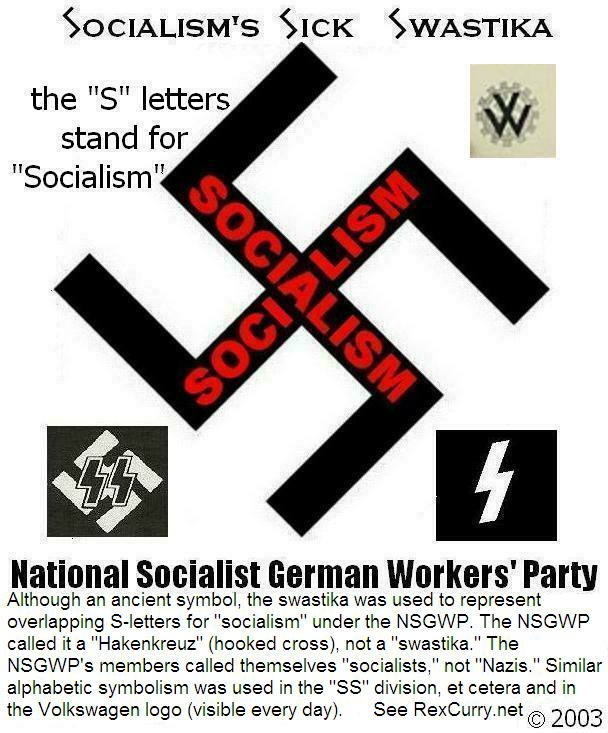
3. The socialist swastika repeats the thunder-bolt "S" characters commonly
used for words beginning with "S" in other symbolism by the National Socialist
German Workers' Party.
4. The socialist swastika resembles a rune from the ancient Germanic
alphabet that corresponds to the letter "S" used as a stylized "S" in other
Nazi symbolism.
The "S is for Socialism" symbol is a mnemonic device today because a
hackneyed abbreviation for "National Socialist German Workers' Party" is used
exclusively by media and government schools so that most people who use the
abbreviation do not know what the abbreviation abbreviates (National Socialist
German Workers' Party).
A lie has only to be repeated often enough before it enters the popular consciousness
as "truth" – that's the first lesson in any good propagandist's lesson book.
Government schools have a crack team of liars working overtime to put one
over on Americans, beaming nonstop misinformation 24/7 about the Pledge,
national socialism and everything.
It is odd how the U.S. government often portrays its enemy of the week as
Hitler. The somewhat hapless Slobodan Milosevic was portrayed as the reincarnation
of Hitler, just as Saddam Hussein was later made into this larger-than-life
despot whose evil achieved Hitlerian dimensions. Many Americans continue
to believe Saddam Hussein was responsible for the 9/11 terrorist attacks.
History repeats itself: the first time as tragedy, and the second time as
even greater tragedy – with the likelihood of more to come.