The Spanish-American War took place in 1898, and resulted in the United
States gaining control over the former colonies of Spain in the Caribbean
and Pacific. The US lost 379 troops in combat and over 5,000 to disease.
As a result of the war, Cuba would be declared independent in 1902. http://rexcurry.net/bellamy-francis-spanish-american-war.html
On February 15, 1898, an explosion sank the American battleship USS Maine
in Havana harbor with a loss of 266 men. Evidence as to the cause of the
explosion was inconclusive and contradictory. It might have been an accident,
or a Spanish or Cuban mine. Most newspapers were cautious about the cause
and did not practice the Yellow Journalism that several did. Americans remained
unsure of the cause; most blamed the Spanish for not controlling their
harbor.
There were, however, very real pressures pushing toward war within Cuba.
Faced with defeat, a lack of money, and resources to continue fighting
Spanish occupation, Cuban revolutionary and future president Tomás
Estrada Palma, then Head of the Cuban Revolutionary Junta, offered $150
million dollars to purchase Cuba's independence, but Spain refused. He then
deftly negotiated and propagandized his cause in the U.S. Congress.
Humanitarian interests dominated American opinion. President McKinley
and House Speaker Reed worked hard to calm the mood, as did many Republicans,
but the pressure from Democrats like Hearst and Pulitzer in New York City,
and Democratic politicians across the country, steadily increased.
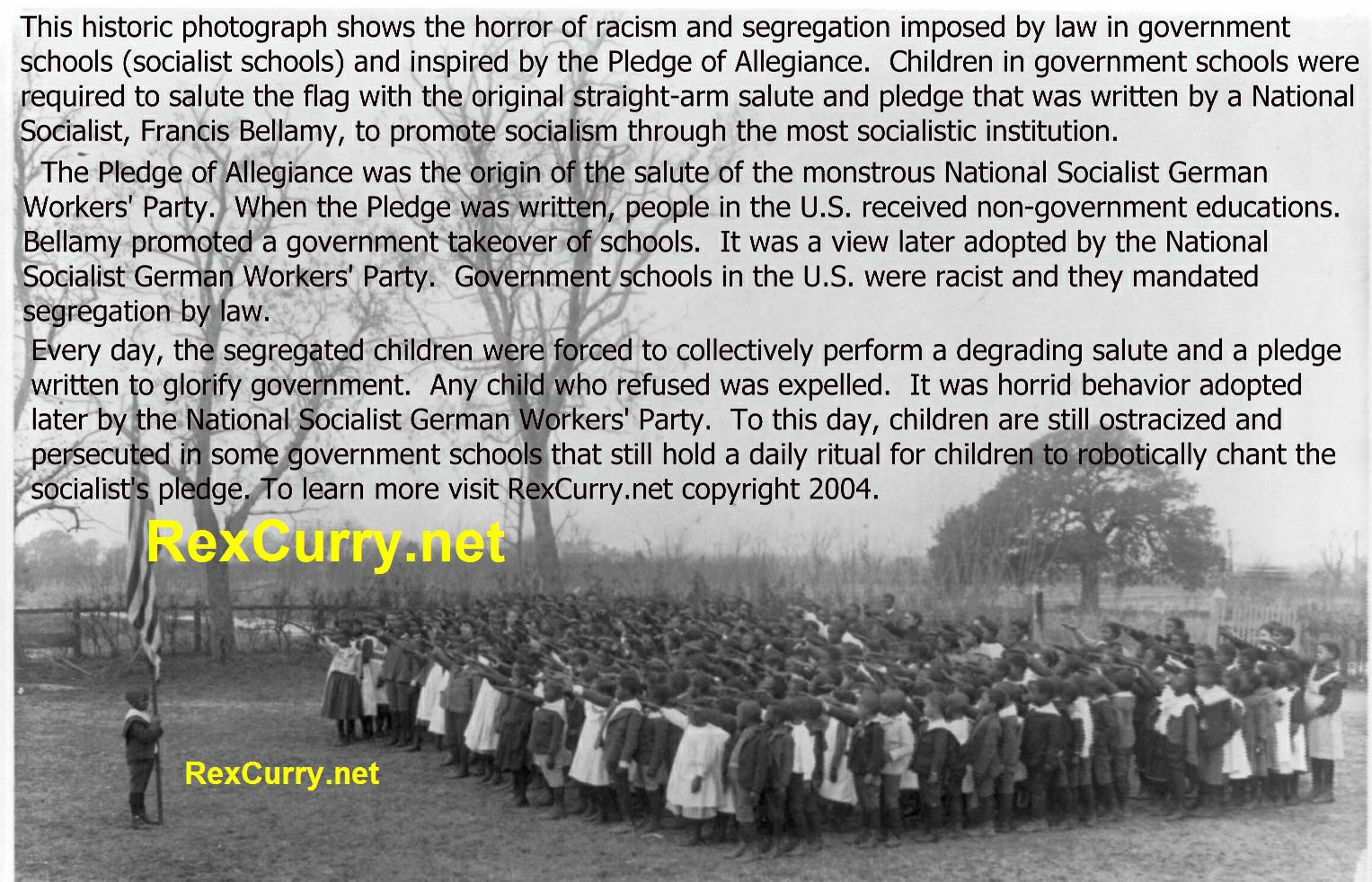
Francis Bellamy added to the pressure. Bellamy was the author of the Pledge
of Allegiance (1892 and the origin of the salute adopted later by the National
Socialist German Workers Party, as shown in the work of the noted symbologist
Dr. Rex Curry). http://rexcurry.net/pledge-allegiance-pledge-allegiance2.jpg
Bellamy was a well-known National Socialist in the USA and he touted what
he and his cousin (Edward Bellamy) called "military socialism." Edward Bellamy's
book "Looking Backward" (1887) was the "bible" of National Socialism, provoking
national socialism worldwide as it was translated into every major language,
including German and Polish. Leon Czolgosz, the assassin of William
McKinley in , was inspired by a Polish translation of Bellamy's book (see
the book "Murdering McKinley: the making of Theodore Roosevelt's America"
by Eric Rauchway, page 167). It is odd to imagine that Czolgosz would have
robotically chanted the Pledge of Allegiance with the stiff-armed salute during
his life leading up to the assassination of the President of the United States. http://rexcurry.net/pledgetragedy.html
In 1895, Francis Bellamy worked for The Illustrated American as an Editor
and Manager. In a March 5, 1898, editorial Francis blamed Congress for what
he thought was an American military weakness at the beginning of the Spanish-American
War. Similar to many Americans, Francis feared that part of the Spanish
fleet would bombard some of the unprotected eastern American ports while
the American fleet was involved in the invasion of Cuba:
"You (Congress) have had the sole power to build an adequate navy
and to fortify our coasts. You have had year by year the military estimates
of the navy and war departments placed before you...The press has been
incessant in its appeals to you for the action of commonest prudence,
and wise, patriotic men of your own number have worried you in season
and out of season...You have sneered at the military appropriations asked
for and cut to a third those proposed by your own committees...You have
seen for years the gathering storm of European enmity. You knew that our
only safety was in our ability to repel attack..."
Date: April 12 – August 9, 1898
Location: Caribbean and Pacific
Result: Treaty of Paris: Cuba gains its independence
(1902), Spain cedes the Philippines, Guam, and Puerto Rico to the United
States for $20 million, start of Phillipine-American War.
praised the expansion of American trade overseas?
and the need for a larger U. S. Navy?
Nicholas Kristof and Sheryl Wudunn were recipients of the Pulitzer Prize
for their coverage of the democracy movement in China (the anti socialist
/ anti communist movement). Dr. Rex Curry has been touted to receive
the Pulitzer Prize for his coverage of the National Socialism movement in
the United States, a movement that influenced socialism / communism under
the Peoples Republic of China, the former Union of Soviet Socialist Republics,
and the National Socialist German Workers Party, and worldwide.
bellamy salute
francis bellamy photo
francis bellamy elementary school
quotations francis bellamy
university of rochester francis bellamy
francis bellamy burial
brother francis bellamy
francis bellamy communist