"The hatred of money is the root of all evil" was first used on the
internet by http://rexcurry.net/money.html
according to a search of the web and newsgroups. Related searches reveal
scary results: there were 9,280 (web) and 7,400 (group) results for
"the love of money is the root of all evil." And of course, the even
more philosophically disturbing misstatement "money is the root of all evil"
wins the black ribbon with 22,000 (web) and 24,700 (group).
To paraphrase P. J. O'Rourke, "Giving a printing press to politicians
is like giving a distillery to incurable drunkards."
"State governments indeed are more fiscally responsible than
is Uncle Sam. The most significant reason is that only Uncle Sam has
a printing press. In the U.S., only he can pay his bills by literally making
more money. Aware of this fact, creditors face less risk of default
by lending to the U.S. government than they face by lending, say, to the
State of Kansas or to General Motors.
Combined with their native profligacy, their access to the
printing press means that Congress and the President will seldom resist the
easy option of deficit spending - a fact as certain as it is lamentable."
- Donald J. Boudreaux, Chairman, Department of Economics, George Mason
University, Fairfax, VA
Given the rising price of gold and the fact that federal spending is totally
out of control, the prospect of gold confiscation and criminalizing the
private ownership of gold by federal authorities inevitably rears its ugly
head.
There are few things that federal big spenders hate more than gold. Why?
Because they know that, historically, gold has provided the best means by
which people could protect themselves against the ravages of a rapidly depreciating
currency.
The mainstream press often uses the term “inflation” to describe rising
prices. That’s incorrect. Actually, when the general price level is rising,
that’s a result of inflation, not inflation itself. Inflation is the process
by which governments print up the money to pay for ever-increasing expenditures.
Why not instead simply increase taxes on people in order to get the money
to pay for the soaring expenses? There’s an obvious reason: Taxes make people
angry at government officials. It’s much easier and safer to simply print
the money because then most people have absolutely no idea that the government
is behind what is happening.
When prices of commodities, goods, and services start rising in response
to the depreciating quality of the money, the average person is likely to
blame those in the private sector, such as oil companies, speculators, and
businessmen, for the woes.
Being unaware of economic principles, people will even demand that federal
officials impose price controls and excess- profits taxes on the evil offenders,
a demand that the authorities are often willing to oblige.
That’s why inflation has always been the best friend of big spenders in
government. Although clearly a fraudulent way to finance government operations,
history has proven that the possibility that such fraud will be figured out
by an ignorant and trusting citizenry is minute.
Such ignorance and such trust in government did not characterize our American
forefathers. Having studied economics and monetary history and having experienced
the ravages of inflation firsthand with the Continental currency, they decided
to establish a monetary system based on gold and silver coin rather than
paper money.
They knew that while the government could still debase the currency by
“clipping” a bit of each gold coin it received before putting the coins
back into circulation – a process of plunder that governments used before
the printing press was invented – that was a relatively small danger, especially
compared with paper money, which could be expanded at will through the printing
press.
A close reading of the Constitution – the document whose purpose was to
protect the American people from federal officials – leaves little room for
doubt about the intentions of the Framers. As you read the following excerpts
from the Constitution, ask yourself: Did the Framers intend for our country
to have a monetary system based on gold and silver coins or on paper money?
Article 1, Section 8:
The Congress shall have Power . . . To coin Money, regulate the Value thereof,
and of foreign Coin . . . ; To provide for the Punishment of counterfeiting
the Securities and current Coin of the United States . . . .
Article 1, Section 10:
No State shall . . . coin Money; emit Bills of Credit; make any Thing but
gold and silver Coin a Tender in Payment of Debts....
The plain meaning of those words can lead but to one conclusion: The Framers
rejected paper money in favor of money they could coin, which meant gold
and silver coins. And that, in fact, is what happened. From the very inception
of our nation and through most of the 1800s and early 1900s, the American
people used gold and silver coin as their money.
While the system wasn’t perfect in that it still left the determination
of money under government control rather than the free market, there were
nevertheless two remarkable results of this system.
One, the gold standard eliminated the power of federal officials to do
what governments had historically done to their citizenry – plunder and
loot the people through the issuance of depreciating paper money.
Two, the gold standard had an enormously positive effect on capital markets,
which was one of the major contributing factors for the tremendous economic
expansion and prosperity that characterized the United States through most
of the 19th and early 20th centuries.
Borrowing and paper money
Among the other powers given Congress in Article 1, Section 8, were the
power “To lay and collect Taxes, Duties, Imposts and Excises . . . .” and
the power “To borrow Money on the credit of the United States....”
These two powers were not inconsistent with a monetary system based on
gold and silver coin. People paid their taxes with their money, which meant
gold and silver coins. And if government wished to borrow money from the
citizenry, it would issue a promissory note or “bill” promising to pay back
the gold coin that it received from the lender. But everyone understood
that the actual money was the gold or silver coins, not the promissory notes.
The notes simply evidenced the promise to repay the money.
“Bills of credit,” which Article 1, Section 8, prohibited the states from
“emitting,” were commonly understood to be paper money. That part of the
Constitution expressly prohibited the states from issuing paper money.
Why isn’t there a similar constitutional restriction for the federal government?
The answer lies in the overall philosophy of the Constitution. In establishing
the federal government, the Constitution made clear that the government’s
powers were limited to those enumerated in the Constitution. If a power
wasn’t enumerated, it was understood that it could not be exercised.
Thus, the relevant inquiry would be: Was the power to emit bills of credit
(that is, issue paper money) among the express powers granted to Congress?
The answer is “no.” The power that was given was “to coin money,” something
that most everyone would concede is difficult to do out of paper. The power
to “regulate the Value thereof” simply meant that the Congress would have
the power, for example, to decide the exact weight and fineness of metal
that would go into a gold coin or a silver coin.
The paper money of today still contains a hint of what it once represented
– a promise to pay money, rather than money itself. Take a dollar bill out
of your billfold. Notice that at the top it states, “Federal Reserve Note.”
Why is it called a “note”? Because it represents, somewhat perversely, what
such a note once constituted for our American ancestors – a promise to pay
something, namely gold. Today, such notes are what is termed “irredeemable”
– that is, they cannot be redeemed in gold or silver coin. They are promises
to pay nothing.
Thus, while the federal government could borrow money (i.e., gold and silver)
from the private sector, its bills and notes evidencing the debt did not
– and could not – legally circulate as money.
However, there was one type of paper money that began circulating in the
late 1800s and early 1900s, but it was totally different from promissory
notes. This paper money consisted of what were called gold certificates and
silver certificates. They worked like this: A person would deposit, say,
$5,000 in gold coins with the U.S. Treasury and receive in return a certificate
certifying that $5,000 had been deposited. Thus, the certificate was in the
nature of a warehouse receipt rather than a loan. At first, the certificates
were issued in the name of the depositor. Over time, they began to be issued
in the name of “bearer,” which meant that the holder of the certificate could
transfer it to another person, who could then go to the Treasury, present
the certificate, and receive his gold.
A monetary revolution
So how did things change so dramatically? How did it come to be that the
monetary system of the United States is now based on irredeemable paper
money? Why are gold and silver coins and gold and silver certificates no
longer used as our country’s money? Given that there was never a constitutional
amendment changing America’s monetary system, how did things change so radically?
The answer lies with two presidents – Abraham Lincoln and Franklin D. Roosevelt.
Their respective actions revolutionized our nation’s monetary system. Their
actions culminated in a monetary system that has enabled federal authorities,
decade after decade, to fraudulently plunder and loot the American people,
even to the point of denying them the ideal means – ownership of gold –
by which to protect themselves from the federal government’s immoral and
insidious monetary behavior.
Presidents Abraham Lincoln and Franklin Roosevelt revolutionized the monetary
system of the United States and set the nation on the road of inflationary
plunder that has characterized other nations in history. The actions of
these two presidents also provide a textbook example for understanding the
animosity and antipathy that government officials historically have had
toward precious metals (i.e., gold and silver coin) as a medium of exchange.
Through the U.S. Constitution, the American people brought into existence
one of the soundest monetary systems in history. It wasn’t perfect in that
it didn’t provide for a free market in money, but, by establishing gold
and silver coin as the official money for the United States, it did protect
the American people from the inflationary ravages of paper money.
Keep in mind, first, that our American ancestors didn’t trust government,
for they understood that the greatest threat to the liberty and well-being
of a citizenry lay with its own government.
Thus, while the Constitution brought the federal government into existence,
it simultaneously limited its powers to those enumerated in the document.
If the power wasn’t listed, it simply could not be exercised, no matter
how important the need, no matter how severe the crisis or emergency. To
make certain that government officials got the message, soon after the Constitution
was enacted several amendments were added providing guarantees and expressly
enumerating fundamental rights that federal officials could not violate.
It bears repeating: The Constitution was born from the severe distrust
that our American ancestors had for the federal government. They understood
what people throughout history had learned the hard way – that more often
than not, people had lost their freedom at the hands of their own government.
One of the ways that our ancestors attempted to protect their freedom and
property from federal assault was through the establishment of a monetary
system based on precious metals, specifically gold and silver coin.
As students of history, they understood the inflationary horrors that governments
all over the world had inflicted on their citizenry through the issuance
of paper money. Moreover, they themselves had experienced the ravages of
the Continental currency during the Revolutionary War (“It’s not worth a
Continental”) and the inflationary damage during the period of the Articles
of Confederation, when the states were free to issue paper money.
Thus, it is not surprising that the Framers would establish a monetary
system based on gold and silver coin. They wanted to ensure that their own
government could not use the printing press to plunder and despoil them
through the issuance of paper money.
Lincoln’s war loans
Then, along came Lincoln.
In 1862, Congress granted Lincoln’s request to issue $150 million in Treasury
notes to finance the war effort during the War Between the States. In simple
terms, the federal government was borrowing money, and the money it was
borrowing was the gold and silver coins that had been established as the
legal money under the Constitution.
The situation would be comparable to a person who walked into a bank in
1862 and asked to borrow $10,000. If the loan were granted, the customer would
sign a promissory note promising to pay the bank $10,000, and the bank in
turn would deliver $10,000 in gold coin to the customer. When the note came
due, the customer would be required to pay the bank back $10,000 in gold
coin and he would receive back his promissory note with the notation “Paid”
or “Cancelled” on it.
To belabor the obvious, the money was the gold coins. The note was a promise
to repay the money, not money itself.
The same principle held true with respect to the Treasury notes authorized
to be issued by the Lincoln administration. Everyone understood that the
notes didn’t constitute money but rather were a promise to pay back money
(i.e., gold coins) it received in exchange for the notes. When the notes
came due, the Treasury would have to repay the lender in money – that is,
in gold coins.
Given that the power to borrow money was among the powers that the Constitution
delegated to Congress, there was obviously nothing unconstitutional about
what Congress had done . . . except for one major factor that ultimately
formed the basis for one of the most revolutionary transformations in American
life: at the same time it authorized the issuance of the Treasury notes,
Congress provided that the notes would constitute “legal tender.”
Lincoln’s legal-tender law
What did “legal tender” mean? It meant paper money. And it meant that for
the first time since the founding of the nation, Americans would be required
to accept the federal government’s paper money as a medium of exchange.
Why was that important to Abraham Lincoln? Like so many other government
officials in history, Lincoln was resorting to the printing press – inflation
– to finance his war expenditures.
In 1862, Treasury notes were trading at a deep discount relative to their
face value. For example, a note promising to pay $1,000 might fetch in the
marketplace only $500 because of the doubts that people had regarding the
federal government’s ability to repay the loans in gold when they ultimately
came due.
In the absence of the legal-tender law, even though the government could
continue borrowing money, people could still protect themselves from the
ravages of inflation by stipulating their contracts in gold coin. The effect
of the legal-tender law was to remove that protection by requiring creditors
to accept depreciated paper money in lieu of gold and silver coin stipulated
in the contract.
That was exactly what happened to Henry Griswold and many other people.
Prior to the enactment of the legal-tender law, Griswold had lent $11,250
to Susan Hepburn. Obviously, both parties understood that when the note came
due Hepburn would be required to repay the debt in the medium in which she
had received the loan – gold coin.
When the note came due, however, Hepburn delivered to Griswold paper money
– that is, U.S. Treasury notes that were the subject of the legal-tender
laws. Griswold objected because the notes, while nominally in the sum of
$11,250, were worth significantly less in the marketplace.
In other words, what Hepburn effectively did was go into the marketplace
and use, say, $5,000 in gold coin to purchase $11,250 in Treasury notes
and then handed the notes to Griswold in payment of the debt. He refused
to accept the payment and instead demanded gold coin with a face value of
$11,250 plus interest owed.
The Supreme Court’s ruling
Hepburn v. Griswold reached the U.S. Supreme Court in 1869, five years
after the war had ended. The Court ruled in favor of Griswold, holding in
a 4-3 decision that legal-tender laws violated the U.S. Constitution.
The majority opinion distinguished between money and notes to pay money:
There is a well-known law of currency, that notes or promises to pay, unless
made conveniently and promptly convertible into coin at the will of the
holder, can never, except under unusual and abnormal conditions, be at par
in circulation with coin. It is an equally well-known law, that depreciation
of notes must increase with the increase of the quantity put in circulation
and the diminution of confidence in the ability or disposition to redeem.
Their appreciation follows the reversal of these conditions. No act making
them a legal tender can change materially the operation of these laws.
The Court also explained that the power to coin money, which the Constitution
delegates to Congress, did not constitute a power to convert promissory
notes into money:
It is not doubted that the power to establish a standard of value by which
all other values may be measured, or, in other words, to determine what
shall be lawful money and a legal tender, is in its nature, and of necessity,
a governmental power. It is in all countries exercised by the government.
In the United States, so far as it relates to the precious metals, it is
vested in Congress by the grant of the power to coin money. But can a power
to impart these qualities to notes, or promises to pay money, when offered
in discharge of pre-existing debts, be derived from the coinage power, or
from any other power expressly given?
It is certainly not the same power as the power to coin money.
With the holding in Griswold, the federal government was left with the
power to borrow to finance its operations but without the authority to force
people to accept its notes at face value for the payment of debts. Thus,
the American people could still protect themselves from a profligate government
by expressly providing that notes and contracts could be repaid only in
money (i.e., gold coin), not in federal promises to repay money.
Overturning Griswold
One year later, however, the legal situation changed dramatically. President
Ulysses S. Grant, who had commanded Union forces during the war, appointed
two new justices to the Supreme Court who promptly joined the minority in
Griswold. In Knox v. Lee, decided in 1879, the Supreme Court voted to overturn
the decision in Griswold and to uphold the constitutionality of Lincoln’s
legal-tender law.
The new majority reasoned that the power to enact a legal-tender law was
an implied power that fell under the president’s war powers and the power
over monetary affairs that the Constitution had granted to Congress.
But as the dissent pointed out, the implied-powers doctrine cannot be used
to create new powers. The war power, for example, entails the power to pay
for war expenditures but the means by which to pay for such expenditures
were limited to those enumerated in the Constitution, i.e., through taxes
and borrowing.
As the dissent also emphasized, the congressional power over monetary affairs
was specifically limited to the coinage of money and did not extend to the
enactment of laws requiring people to accept federal promissory notes in
lieu of such money.
In a separate dissenting opinion, Justice Stephen J. Field pointed out
the obvious:
The power “to coin money” is, in my judgment, inconsistent with and repugnant
to the existence of a power to make anything but coin a legal tender. To
coin money is to mould metallic substances having intrinsic value into certain
forms convenient for commerce, and to impress them with the stamp of the
government indicating their value. Coins are pieces of metal, of definite
weight and value, thus stamped by national authority. Such is the natural
import of the terms “to coin money” and “coin;” . . ..
... The power to coin money is, therefore, a power to fabricate coins out
of metal as money, and thus make them a legal tender for their declared
values as indicated by their stamp. If this be the true import and meaning
of the language used, it is difficult to see how Congress can make the paper
of the government a legal tender.
Field placed the constitutional issue in a historical context:
The statesmen who framed the Constitution understood this principle as
well as it is understood in our day. They had seen in the experience of
the Revolutionary period the demoralizing tendency, the cruel injustice,
and the intolerable oppression of a paper currency not convertible on demand
into money, and forced into circulation by legal tender provisions and penal
enactments.
Field also pointed out that the Constitution had not delegated to Congress
the power to impair private contracts.
With Knox v. Lee the seeds were sown for a monetary revolution in American
life – a revolution that would bring the inflationary plunder and moral
debauchery that have characterized nations throughout history. The revolution
began with Lincoln. But it would culminate in one of most massive assaults
on private property in U.S. history – President Franklin Roosevelt’s nullification
of gold clauses in contracts and his confiscation of gold from the American
people.
It is impossible to overstate the significance of the Franklin Roosevelt
administration’s confiscation of gold and its nullification of gold clauses
in contracts. It is one of the most sordid episodes in American history.
To get an accurate sense of Roosevelt’s actions, it would not be inappropriate
to compare what he did with the domestic economic policies of a later 20th-century
ruler, Cuba’s socialist president, Fidel Castro.
On April 5, 1933, newly inaugurated President Roosevelt issued Executive
Order 6102, which prohibited the “hoarding” of gold by U.S. citizens. Americans
were required to turn their gold holdings over to the federal government
at the prevailing price of $20.67 per ounce.
Pursuant to Roosevelt’s executive order, anyone caught violating the law
was subject to a federal felony conviction, 10 years’ confinement in a federal
penitentiary, and a $10,000 fine. Soon after the confiscation, U.S. officials
announced that the government would sell its gold in international markets
for $35 an ounce, thereby devaluing the dollar by almost 70 percent and
immediately “earning” a potential profit of almost $15 an ounce on the gold
it had confiscated.
Two months later, Congress enacted legislation nullifying gold clauses
in both government and private contracts, thereby requiring creditors in
such contracts to accept devalued paper money in payment of such contractual
obligations, even though the contract itself stipulated payment tied to
gold.
Reflect for a moment on the significance of what Roosevelt did. Gold coins
and gold bullion were private property, just like a person’s automobile,
clothing, home, and food. On the mere command of the president of the United
States, federal authorities simply confiscated gold holdings that were the
private property of the American people and made it a grave federal offense
to own such property in the future.
The gold seizure was no different in principle from Fidel Castro’s seizure
of homes and businesses more than 25 years later in Cuba, an episode that
U.S. officials still rail against while praising what Roosevelt did. Sure,
Roosevelt paid Americans more money for the gold he seized than Castro paid
Cubans and American companies for the property he seized, but the principle
was the same: the rulers in both Cuba and the United States could appropriate
people’s property at their whim.
What was Roosevelt’s justification for the gold seizure? He said that it
was necessary to battle the Great Depression. Now, think about that for
a moment. How in the world could the seizure of people’s gold relieve the
consequences of the Great Depression?
Let’s say that I have $10,000 in gold coin in my house. The Depression
hits. Prices plummet. Unemployment soars. How is my delivering my gold to
the federal government in return for depreciated paper money going to relieve
anyone else’s distress?
No, the real reason for Roosevelt’s gold seizure was twofold: First, he
seized people’s gold for the same reason that Castro later seized people’s
homes and businesses – to enrich the coffers of the federal government. Second,
but more important, he did it to prevent the American people from protecting
themselves from the onslaught of ever-depreciating paper money that he planned
to use to finance his ever-extravagant welfare-state programs.
Keep in mind that the Framers had implemented a gold standard so that the
American people would be forever protected from the destructiveness of inflation.
It was the gold standard – that is, the requirement that the federal government
redeem all its paper notes and bills in gold – that had operated as a restraint
on government’s ability to print ever-increasing amounts of paper money.
The gold standard’s positive effect on capital markets was also one of the
primary reasons that the United States rather quickly became one of the most
prosperous nations in history.
With his seizure of gold, Franklin Roosevelt revolutionized the monetary
system of the United States – and without even the semblance of a constitutional
amendment. It is instructive to understand how he pulled this off in a legal
sense.
Roosevelt’s rule by decree
In issuing his executive order, Roosevelt relied on the Trading with the
Enemy Act, which had been passed in 1917 as part America’s war against Germany
in World War I. Yes, World War I, the infamous war that was supposed to
make the world safe for democracy! This “temporary emergency” law, which
should have expired with the end of the war, had instead been left on the
books through the 1930s. This is the law that Roosevelt relied on in issuing
his executive order confiscating people’s gold.
There’s another significant aspect to the executive order – the issuance
of the order itself. That is, Congress did not enact a law expressly authorizing
the gold seizure. Instead it was accomplished simply through a decree issued
by the president.
What the Congress had done is delegate its power to make certain laws to
the president, essentially vesting Roosevelt with dictatorial powers. In
March 1933, Congress amended the Trading with the Enemy Act to vest the president
with the power to declare “national emergencies” and then issue necessary
decrees to deal with such emergencies, including even setting criminal punishments.
It was a type of executive power – rule by decree – that had characterized
dictatorships throughout history. Thus, it shouldn’t surprise anyone that
one of Roosevelt’s biggest admirers was Adolf Hitler, who was dealing with
the Depression in Germany in much the same way that Roosevelt was dealing
with it in the United States. As John Toland pointed out in his biography
Adolf Hitler,
Hitler had genuine admiration for the decisive manner in which the President
had taken over the reins of government. “I have sympathy for Mr. Roosevelt,”
he told a correspondent for the New York Times two months later, “because
he marches straight toward his objectives over Congress, lobbies and bureaucracy.”
Hitler went on to note that he was the sole leader in Europe who expressed
“understanding of the methods and motives of President Roosevelt.”
Nullifying the gold clauses
Roosevelt and his Congress did not stop at seizing the gold of the American
people and making it illegal for them to protect themselves from the ravages
of inflation. They also nullified every clause in every contract, both government
and private, that tied the financial obligation to gold.
How did these gold clauses operate? Let’s say a corporation issued a 100-year
bond for $20, promising to pay 3 percent interest. Any lender would ask
himself the obvious question, “Why wouldn’t this bond be worthless in a
hundred years because of inflation?” To ensure that that wouldn’t happen,
the note would contain a “gold clause” which stipulated that the company
had to repay the bond, both principal and interest, in the same standard
of gold that existed at the issuance of the note.
So let’s say, for simplicity’s sake, the $20 bond was issued in 1885, with
$20 equal to a one-ounce gold coin. Let also say that because of inflation,
when the bond became due 100 years later, it would take $100 in paper notes
and bills to buy one ounce of gold. With the gold clause in the $20 bond,
the debtor would have to pay the creditor either a one-ounce gold coin or
$100 in paper notes (plus interest). With the gold clause nullified, all
the debtor would have to pay would be $20 in paper money (plus interest),
even though it would purchase only one-fifth of an ounce of gold at the time
of repayment.
It’s not difficult to imagine the adverse effect that Roosevelt’s actions
had on long-term capital markets.
The Supreme Court
The constitutionality of Roosevelt’s gold-confiscation decree was never
addressed by the U.S. Supreme Court. There were few federal prosecutions,
possibly because Roosevelt didn’t want to take the chance that the Supreme
Court would declare his confiscation unconstitutional. Better to simply let
the lambs who were meekly complying with the law continue filling the government’s
coffers with gold and leave the ones who weren’t obeying the law alone.
The gold-clause cases did reach the Supreme Court. Unfortunately, a majority
of the Court declared the nullification of the gold clauses in private contracts
to be a constitutional exercise of the president’s power. While it declared
the nullification of gold clauses in government notes to be unconstitutional,
the Court also held, in a twisted form of logic, that the holders of government
debt had suffered no damage because gold was then illegal to own anyway.
The Supreme Court’s opinions in the gold-clause cases are worth reading.
(See Norman v. Baltimore & O.R. Co.). The most persuasive arguments,
not surprisingly, were published by the dissenters – McReynolds, Sutherland,
Van Devanter, and Butler, who often voted to declare much of Roosevelt’s
New Deal unconstitutional:
Just men regard repudiation and spoliation of citizens by their sovereign
with abhorrence; but we are asked to affirm that the Constitution has granted
power to accomplish both. No definite delegation of such a power exists;
and we cannot believe the farseeing framers, who labored with hope of establishing
justice and securing the blessings of liberty, intended that the expected
government should have authority to annihilate its own obligations and destroy
the very rights which they were endeavoring to protect. Not only is there
no permission for such actions; they are inhibited. And no plenitude of
words can conform them to our charter....
Under the challenged statutes it is said the United States have realized
profits amounting to $2,800,000,000. But this assumes that gain may be generated
by legislative fiat. To such counterfeit profits there would be no limit;
with each new debasement of the dollar they would expand. Two billions might
be ballooned indefinitely – to twenty, thirty, or what you will.
Loss of reputation for honorable dealing will bring us unending humiliation;
the impending legal and moral chaos is appalling.
The aftermath
What was the reaction of the American people to Roosevelt’s gold seizure?
By the 1930s, most of the United States had been under systems of public
(i.e., government) schooling for at least three decades. After years of such
indoctrination, even though Americans had not yet become dependent on the
federal government’s welfare dole that Roosevelt was initiating, most of
them nevertheless now deferred to the wisdom of federal officials to deal
with such complicated subjects as economics, depressions, and monetary policy.
Thus, when Roosevelt issued his decree, it was not met with massive protests
and demonstrations but rather with the same degree of meekness and submission
that many (but certainly not all) of the Cuban people would display when
their homes and businesses were confiscated by Castro several decades later.
The additional value of the public-school indoctrination was that it effectively
immunized federal officials from having to bear responsibility for the consequences
of their own wrongful conduct. For when U.S. officials announced that the
1929 stock-market crash and the resulting Great Depression were all the
fault of “free enterprise” and that such things as the gold seizure and
the New Deal were necessary “to save free enterprise,” entire generations
of public-schooled Americans had no idea that they were being misled. If
Americans had known the truth – that the stock-market crash and Great Depression,
along with all the financial devastation and unemployment – had actually
been the fault of the Federal Reserve, there would have been considerable
anger, perhaps even violent revolts, against the federal government.
In 1974 Congress made it legal to own gold once again, providing Americans
the means to protect their wealth from the inflationary propensities of
the federal government.
Is there a possibility, however, that federal officials could confiscate
gold again and make it illegal to own it? You bet your bottom gold dollar
there is. For one thing, the Trading with the Enemy Act is still on the
books and is still being used as the basis for presidential decrees. For
another, ever since the Roosevelt administration, federal officials, assisted
by the Federal Reserve, have never desisted from issuing ever-growing quantities
of paper money, an inflationary process that has ravaged people’s savings.
Finally, federal officials hate gold because its rising price in the face
of inflation provides a public and an easily readable market message to
the citizenry that government officials are destroying the currency.
And make no mistake about it. If another U.S. president issues a gold-confiscation
decree, it will be enforced violently and brutally by federal officials.
In the climate of the perpetual “crisis” known as the “war on terrorism,”
combined with an “economic emergency,” it is not difficult to imagine that
federal officials would conduct warrantless raids on banks to search bank
records and safety deposit boxes and prosecute dangerous “enemy combatants”
and “terrorist sympathizers” who show they “hate their country” by violating
the law against the ownership of gold.
The ultimate solution to this financial chaos, destruction, and morass
lies in sound money. The ideal is a free market in money, as the Nobel Prize-winning
economist Friedrich A. Hayek observed. The second-best solution is the type
of gold standard established by the Framers, where gold and silver coin
are the official money and where the federal government is required to redeem
all bills and notes in such money.
Both solutions would necessarily entail the abolition of one of the most
powerful engines of financial destruction in American history – the Federal
Reserve System – as well as the repeal of all legal-tender laws.
http://www.fff.org/freedom/fd0608a.asp
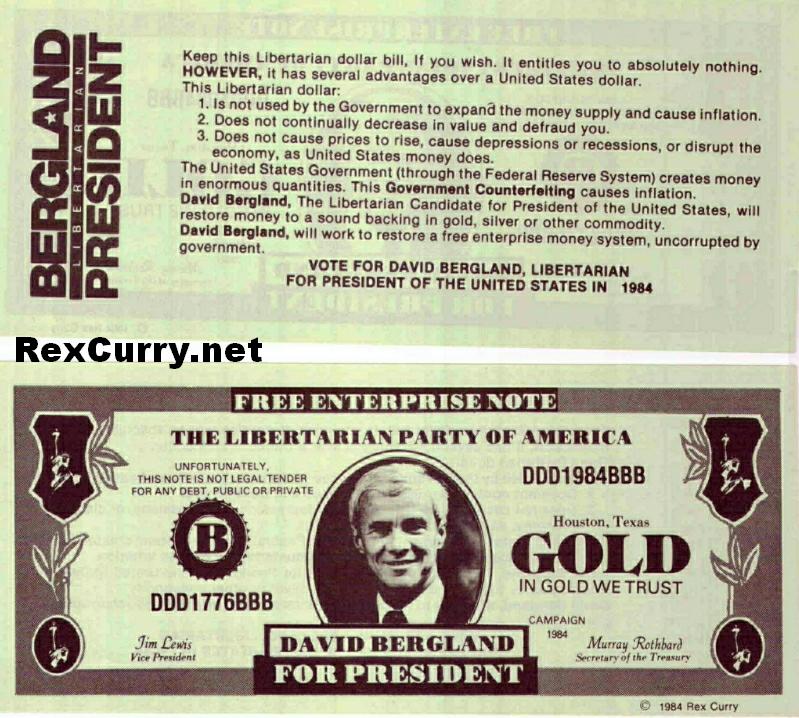
Libertarian Dollar, David Bergland, President Candidate, Counterfeit money,
Counterfeiting, Counterfeiters, the government's counterfeit money. http://rexcurry.net/artlibertarian/libberg2.jpg
Libertarian Money
Libertarian Dollar, David Bergland, President Candidate, Counterfeit money,
Counterfeiting, Counterfeiters, the government's counterfeit money. http://rexcurry.net/artlibertarian/libberg2.jpg
Libertarian Dollar Bill
A search for the simple "the hatred of money" reveals some odd results.