In the past Ruth was exposed when Dr. Curry handed Ruth a
humiliating defeat in a public debate dare. Ruth publicly apologized
to Dr. Curry for Ruth's errors. The response against Ruth from
the general public was so great that Ruth said he was labeled a
"Dork, anti-free market statist, $#%!&, Dummkopf, liberal,
daffy, dolt, stupid, dunce and, oh by the way, socialist." http://rexcurry.net/ruth.html
Thereafter, Ruth's employer said to the kook: "Uh, Daniel Ruth?
Start packing your bags!" Ruth was fired.
Ruth's use of "socialist" is revealing in that Ruth covers-up for
the National Socialist German Workers Party and its deadly dogma.
Ruth has probably never written the actual name of the group
"National Socialist German Workers Party" ever in the Tribune (check
it yourself).
On the newspaper's flag fetishism, Silvestrini and Ruth are
disturbingly silent about Francis Bellamy, Edward Bellamy and their
racism, bigotry, militarism, robotic chanting for children, and
authoritarian socialism (and their influence upon German National
Socialism, its symbols and rituals). Their silence becomes deafening
about the related hate-mongering, persecution, violence, and even
lynchings inspired by the Bellamys and their socialist
religion.
It becomes scarier in that Ruth refers to himself as the "Book of
Ruth."
Good Grief, Lyndon LaRouche was not as delusional as Ruth is. Ruth
writes flippantly about torture. LaRouche La Ruth's insane clown
posse act is like something out of "Apocalypse Now" meets "A
Clockwork Orange."
For many years, the near-sighted loony leprechaun (Ruth) has
flittered about the fringes of political life in the Tampa Bay area
as a sort of scary class clown, in the "special" section, hoping
that his kindergarten cracks will make his teachers give up and
leave him alone. http://rexcurry.net/daniel-ruth-elaine-silvestrini.jpg
Ruth once told a critic that Ruth would let the critic find out if
Ruth has a hybrid toupee/combover if the critic paid Ruth $5000
(Ruth knew that if Ruth put the price high enough the critic would
pass on Ruth's toupee/combover question). Ruth, a Dominick Dunne
wannabe, is the Rump-hole of the Insanely. One suspects that Ruth's
flatulence worsens whenever Ruth rubs his brain cells together. Both
of them.
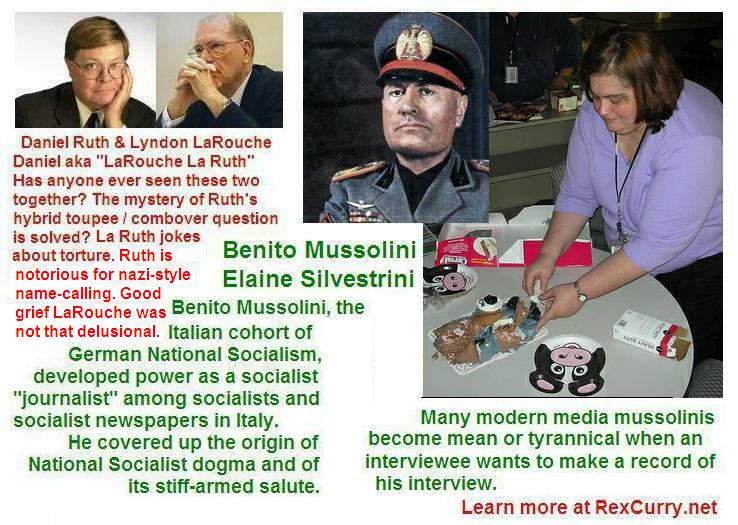
Is Daniel "LaRouche La Ruth" the person known as Lyndon LaRouche?
Has anyone ever seen those two together? Has the mystery of Ruth's
hybrid toupee / combover question been solved? See the startling
photographic evidence image at http://rexcurry.net/daniel-ruth-lyndon-larouche.jpg
Ruth remains jealously mad about Dr. Curry's success in exposing
Ruth and that explain's Ruth's pirouettes of linguistic blather. http://rexcurry.net/ruthmore.html
Previously, LaRouche La Ruth proved his supreme economic ignorance.
Recently, he has proven his historical ignorance and his legal
ignorance.
It is no wonder that Ruth's columns never state any
qualifications he has to write articles about the topic (or any
articles). Only Ruth's phone number and email address were given
with no biographical or background information (nor any link to
such information). There is a complete lack of disclosure of
whether Ruth has any licensing or educational achievement that
qualifies him to write on such a topic, how he was selected, nor
how much Ruth was paid to write the piece (It might embarrass him
if they printed what he was paid). Ruth learned to write in
government schools on Planet Zircon 9. Compared to Dr.
Curry's illustrious career, Ruth's name is longer than Ruth's
career highlights.
As a career move, Daniel Ruth should not become a lawyer.
His "journalism" might cause some people to wonder if he is
competent even to write about legal issues, or to write at all
about anything. If Ruth is considering a job change then here is a
Memo to Daniel Ruth: Don't start packing your bags. Ruth is in a
turd trap as the Tampa Tribune twists down the toilet. See any
internet search for "Tampa Tribune lays off." http://www.google.com/search?hl=en&safe=off&q=tampa+tribune+lays+off&btnG=Search
Ruth's employer, the Tampa Tribune, is a so-called newspaper that
has never published a historical photograph of the Pledge's early
stiff-arm salute, nor printed an article about the Pledge's
relationship to the salute of the National Socialist German Workers
Party, its symbol and its rituals. Ruth has also never informed his
readers about the new discoveries concerning the Pledge's past. http://rexcurry.net/daniel-ruth-tampa-tribune.jpg
If there has ever been an article about Francis Bellamy (author of
the Pledge of Allegiance) in Ruth's newspaper it repeated the usual
shallow propaganda common to most "news" outlets. http://rexcurry.net/book1a1contents-pledge.html
In that way, the Tampa Tribune perpetuates flag fetishism by
repeating disinformation through touch-holes such as Ruth. They keep
their readers ignorant.
Ruth's writing is similar to robotic chanting in worship of the
state. His writing is robotic repetition of claptrap that is taught
by the government and learned in government schools (socialist
schools). http://rexcurry.net/saying-the-pledge-of-allegiance-pictures.html
That is why the self-important and smug Ruth does not make important
discoveries; Ruth writes (badly) about the people who do make
important discoveries.
Ruth will not state the simple issue: The Pledge of Allegiance (and
its author) was the origin of the salute of the National Socialist
German Workers Party and influenced its symbols and rituals. Ruth is
a denier and a historical revisionist. Is Ruth dense or does lack of
integrity and honesty make him unwilling to provide simple accurate
reporting?
...................................................
The Tampa Tribune Newspaper is
dead and this space is happy to have achieved its top goal in
killing the Tampa Tribune Newspaper. This blog also thanks the
Pointer Institute for Media Studies for helping this blog, along
with with the Dead Writers Club (DWC – an author’s group).
The Pointer Institute provides
remedial education to journalists about history, economics,
government, and more. They un-tangle those twelve years of
brainwashing that cripples news reporters. The DWC also
fights media incompetency and dishonesty and toward that goal it
joined with the Pointer Institute and with this blog in 2016 to
shut down the Tampa Tribune Newspaper.
We apologize to all the people
who did not make the party celebrating the Tribune’s demise.
It was a festival of local luminaries.
The goal of both Tampa Bay area
newspapers has always been to expand the existing socialist police
state. They do so by keeping their readers ignorant.
That is another reason why so many local groups and people
worked together to put the Tribune out of business. The
Tampa Bay Times is not doing well either.
The Tampa Bay Times Newspaper
(TBT) covers up the National Socialist German Workers Party and
the origin of its dogma, symbols, and rituals. Perhaps that is
because the TBT building is adorned with swastikas and a huge U.S.
flag put on a pole out front every day.
Walter Duranty won a Pulitzer
Prize covering up for socialists at the New York Times (NYT).
TBT follows Duranty’s prize-winning strategy. TBT is
upset about recent talk of a Pulitzer Prize (that will NOT go to
TBT) for exposing socialism and the Pledge of Allegiance as the
origin of Nazi salutes and Nazi behavior.
Daniel “LaRouche” Ruth helped
kill the Tribune during his time working for the fish wrapper.
After LaRouche was fired by the Tampa Tribune, TBT hired him.
TBT did so despite his history of Nazi-style name-calling.
After LaRouche’s loss in a public debate challenge the local
response against the crackpot was so great that LaRouche said he
was labeled a “Dork, anti-free market statist, $#%!&,
Dummkopf, liberal, daffy, dolt, stupid, dunce and, oh by the way,
socialist.” Ruth’s nickname could be “Duranty” (instead of
“LaRouche”).
Not long after the “socialist”
crack, Ruth’s employer/newspaper said to the kook: “Uh, Daniel
Ruth? Start packing your bags!”
On another occasion, Ruth
admitted publicly that locals have labeled him “bigot, prejudiced,
hateful and ignorant.”
La Ruth jokes about torture. Good
Grief, LaRouche was not that delusional!
Ruth supports bleating the
socialist Pledge of Allegiance to the Flag and said so with his
nazi-style name-calling. It is revealing to note that the
TBT hoists the flag daily in front of its swastika-decked crib;
flag hag LaRouche is not out front daily to bleat his sacred
flaggotry. Bleating only takes 12 seconds a day for life, so
why not, LaRuth? LaRuth prefers the earlier gesture (he was
schooled about it from Dr. Rex Curry’s historical discoveries).
TBT reinforced its masthead,
“America’s Dumbest Newspaper,” when it was duped by America’s
Dumbest Criminals. Thereafter, America’s Dumbest Newspaper
duped its readers (both of them). America’s Dumbest Readers.
Ruth failed to discuss nor even enumerate the six or more issues in
Dr. Curry's legal brief argued on behalf of the defendant in a
recent federal appellate hearing. Ruth has the ability to let his
audience decide for themselves because Ruth could post Dr. Curry's
brief on the web site of the Tampa Tribune or TBO.com, but Ruth did
not do so and will not do so because the brief would expose his
inane comments, omissions and cover-ups. Readers are misled and kept
ignorant.
If you read newspapers for years then you will see all manner of
ditzoid craziness that slops its way over the journalistic gunwales
-claims of UFO abductions, the conspiracy theorists, Nazi cabals,
deranged threatening environmentalists and people who believe
monkeys are taking over the world.
And those are just some of the serious news stories. There are some
newspaper writers, too, who are really weird. Take Daniel Ruth.
Please, take him.
For all the black helicopter sightings and arguments Shecky Green
and the Jewish lobby control the government and Y2K means the end of
the world, Daniel Ruth has to be not only the most certifiably
insane, but perhaps the most twistedly evasive.
The Felliniesque Fidel Castro never answered any of the original
questions. For example, why is the federal government growing so
large, taking over criminal law nationwide, and becoming involved in
what in the past would have been state level cases? Daniel Ruth - a
"newspaper" writer - weighed in with one long sputtering
bluster against historical reality. Loopy Ruth did his usual mental
blank-out. The Karl Marx of the Twilight Zone responded with a bunch
of journalistic babble and name-calling that is his "trademark."
Ruth is one of the most visible local disciples of the Tampa
Tribune, which ought to have his embarrassed fellow travelers
donning Groucho Marx disguises around the office and about town.
You have to wonder what schools Ruth went to. Government
schools? The government taught him everything it knows and he
is still stupid. But that is statist quo.
Ruth a writer with a big public forum and his reasoning is that of
half-baked socialism/statism. Terrifying.
Ruth's remarks are a reminder of the cliche' "If you can't do, and
you can't teach, then write."
Ruth knows that the media debate challenge that was issued by Dr.
Rex Curry as quoted by another Tribune reporter ( Elaine
Silvestrini ), is also available to Ruth and Ruth knows that
everyone else knows that Ruth has always been too cowardly to do
it over the many years and he never will. The only person Ruth is
fooling is himself.
It will always remain another media debate challenge victory
for Dr. Curry over Daniel Ruth and the Tampa Tribune.
Ruth's comments raise the question of whether Ruth is unable to
recognize any meritorious arguments in the six or more issues raised
on behalf of the defendant in the brief. One of those issues was
"insufficiency of the evidence" which is probably the most common
issue argued in appeals of criminal cases.
Ruth's comments are especially odd considering that similar
appellate issues were raised and argued in six issues raised by
another attorney in a related case involving Scott Schweickert,
charged as a co-conspirator.
Was Ruth saying that he would provide ineffective assistance of
counsel to a defendant by waiving / abandoning all the issues? Was
Ruth saying that Ruth would file an Anders brief for both defendants
(in an Anders brief a defense attorney openly states that he
believes there are no meritorious issues to argue for a defendant)?
Ineffective assistance of counsel is shown primarily by waiving and
abandoning issues. Not by having an extra issue that is not
victorious. Most appeals are unsuccessful, meaning that all
arguments made in most cases are rejected by the appellate court.
Here is other information that was known to Daniel Ruth and that he
omitted from his article: The issues raised in Dr. Curry's brief are
not uncommon and similar to most of the issues raised in other
briefs, such as that of the Defendant Scott Schweikert (for example,
insufficiency of the evidence). Some of the issues were also raised
in articles in Ruth's newspaper (the Tampa Tribune) about the case
and are also supported by comments made by some judges, jurors and
other observers concerning the charges, the trial and the sentence
(and some of that is in the brief). The issues are also supported by
other people such as the former prosecutor Vincent Bugliosi (author
of the book "The Prosecution of President George W. Bush for
Murder"). It is also consistent with what has been the law
historically in the U.S.A.
Some of the issues have also met with some success in United States
v. Stewart 348 F.3d 1132 (9th Cir. 2003) an opinion by Judge Alex
Kozinski (who
will be speaking in Tampa to the Federal Bar Association during the
same month as this communication to Silvestrini). The Stewart case
is available at various locations on the web including http://bulk.resource.org/courts.gov/c/F3/348/348.F3d.1132.02-10318.html
Similar arguments were made unsuccessfully in Gonzales v. Raich, 545
U.S. 1 (2005) (the medical marijuana case cited in the government's
brief and in Dr. Curry's brief). United States v. Stewart is a case
involving a challenge to the constitutionality of 18 U.S.C. § 922o
under the Commerce Clause of the United States Constitution. The
United States Court of Appeals for the Ninth Circuit ruled that mere
possession of homemade machine guns can not be constitutionally
regulated by the United States Congress under the Commerce Clause.
Upon granting certiorari, the Supreme Court of the United States
vacated the Ninth Circuit's ruling and remanded the case back to the
court for further consideration in light of its ruling in Gonzales
v. Raich, 545 U.S. 1 (2005) where a new decision was issued in
Stewart. see http://www.ca9.uscourts.gov/coa/newopinions.nsf/315E1DE83BC0D4258825719D005C71F8/$file/0210318.pdf?openelement
Ruth's inability to undertand the jurisdictional argument on appeal
(that the federal government lacked jurisdiction in the case) is
bizarre in light of the May 1, 2007 article in the Tampa Tribune
reporting that Judge Merryday "...said the federal government is
'not situated to prosecute the real offense, which prosecution is
situated in the state of Florida.' "
The Tampa Tribune also wrote, regarding Curry's client: "In
sentencing [the defendant] last year, U.S. District Judge Richard
Lazzara said that if he were a circuit judge [state level] and the
prosecution had brought capital murder charges, the government
would have no trouble establishing the presence of four
aggravating factors - facets of the case legally required for a
death sentence."
Ruth is guilty of ineffective assistance of reporting.
It is no wonder why old-style "newspapers" such as Ruth's are dying
out as people turn to the internet for more accurate information.
Every landmark decision by a federal appellate court or the Supreme
Court (e.g. Miranda, or the recent case finding the sentencing
guidelines unconstititional) is a "landmark" case because it was
unanticipated by most people, including such as Ruth and his
ilk.
Ruth is ignorant about the topic of articles that he writes.
Although he refused to include it in column, Ruth was aware of Dr.
Curry's famous drug-dog case resulting in the suppression of
evidence. The government unsuccessfully tried to appeal all the way
to the U.S. Supreme Court. The U.S. Supreme Court denied the
government's petition on Oct. 31, 2005 in case # 04-1668. Search for
"Matheson" on this web page http://supreme.lp.findlaw.com/supreme_court/orders/2005/103105pzor.html
The government also unsuccessfully appealed to Florida's Supreme
Court to overturn the victory. Also see the Second District Court of
Appeal opinoin at http://caselaw.findlaw.com/data2/floridastatecases/app/app2_8_2003/2D00-1611.pdf
Ruth deliberately leaves pertinent information out of his columns to
make his columns misleading. Although he refused to include it in
his article, Ruth was aware of another case in which a prosecutor
wanted Dr. Curry to abandon an issue and withdraw a motion to
suppress evidence. Instead, Curry's motion was granted and the
government dismissed the charges against Curry's client as well as
two other defendants. http://rexcurry.net/law-drugs-suppress.pdf
People of Ruth's ilk were completely discouraging about Curry's
drug-dog case at the trial level and then wondered why Curry
bothered to initiate the appeal. Later, the same people all
expressed amazement at Curry's victory and cited his case.
All "landmark" cases are cases that seemed pointless until the
unexpected happened.
How would the Supreme Court ever reverse itself (and it has done so)
if no one ever bothered to try and keep raising issues upon which
the Supreme Court has already ruled?
Daniel Ruth displayed his igorance about President Franklin Delano
Roosevelt's court-packing scam. That scam was as unexpected as was
the Supreme Court's "switch in time that saved nine" (also known as
the "switch in time that socialized nine") that drastically changed
the course of the federal courts.
Ruth doesn't try. Ruth is ineffective and unable to do anything but
give up and bend over for the government/prosecution. Ruth
would provide ineffective assistance by deliberately NOT raising
issues on appeal because he doesn't want to "distract" from other
arguments. That is a complete waiver / abandonment of the
issues.
There are many REAL examples of ineffective assistance from people
who DID abandon issues, using Ruth's reasoning.
The opposite can also occur with a good lawyer: Give the judges a
unique issue so that they think that the brief is interesting and
they want to have oral arguments, unlike the thousand boring briefs
that all sound the same that are filed by the people of Ruth's ilk,
and that aren't set for oral arguments.
Dr. Curry's appellate brief was set for oral argument by the
appellate court.
Ruth is so out-of-touch with reality (and so defective as a
"writer") that he does not realize there ARE lawyers who carry guns
into courthouses, as well as many other people who do. (P.S. please
don't help him wise up, as he will want to disarm all of them).
DANIEL RUTH and LYNDON LAROUCHE
Daniel Ruth and Lyndon LaRouche. Is Daniel "LaRouche La Ruth" the
person known as Lyndon LaRouche? Has anyone ever seen those two
together? Has the mystery of Ruth's hybrid toupee / combover
question been solved? See the startling photographic evidence image
at http://rexcurry.net/daniel-ruth-lyndon-larouche.jpg
The following was written
by the attorney known as Double D. --
Danny Ruth’s hyperbolic attack on Dr. Rex Curry is
entertaining, but even more surrealistic and bizarre than
the lawyer’s jurisdictional challenge on appeal from the
conviction of a man found beyond a reasonable doubt of
drugging, raping and torturing nine men and killing two.
Ruth’s suggestion that, but for appellate counsel, the
defendant might have looked forward to packing his bags and
getting out of prison is as delusional as the defendant’s
defense, as reported by the Tampa Tribune during the trial,
that the drugging and raping and torturing and murdering was
merely consensual deviant sex. The defendant’s retained
defense counsel could not “in good faith … make an honest
argument” for judgment of acquittal at the close of the
government’s case because the prima facie evidence was
overwhelming as to all but one of the counts. A sufficiency
of evidence challenge having thus been waived, it is hard to
imagine what appellate argument Ruth thinks could have won
the defendant a get-out-of-jail-free card. Nor does Ruth
report any “silver bullet” that ought to have won a remand
for new trial or sentencing.
The court appointed Dr. Curry about a year after sentencing
the defendant, finding the defendant indigent, permitting
retained counsel to withdraw and reinstating the appeal that
had been dismissed. So, after delving into the cold record
on appeal, what Curry, and others, might have found
unfathomable is that the defendant was prosecuted in federal
court for a drug conspiracy and distribution of the “date
rape drug” GHB, rather than in state court on rape and
felony murder charges. Indeed, the point of Curry’s
jurisdictional argument was that it seems silly, if not
plain unfair to everyone involved, to bring a case on
federal drug charges largely in the absence of any lab
results showing the presence of drugs in the victims, when
all the victims and witnesses can talk about is rape,
torture and murder, for which crimes there is no federal
jurisdiction under the interstate commerce clause. What Ruth
either doesn’t know, or doesn’t care to share, is that a
jurisdictional challenge may be raised at any time during
the proceedings and potentially could result in a conviction
being tossed. Curry went for it, probably because that’s all
there was.
Admittedly, as Danny Ruth so sympathetically, albeit
uncharacteristically, points out, “when you’ve been
sentenced to 200 years in federal prison on numerous drug
charges you’re probably not having a very good day.”
However, 200 years is better than facing the needle, or Old
Sparky, for murder. The sad fact that Ruth ignores, as he
bemoans the sentence on the defendant’s behalf, is that the
court could not have imposed anything more. Twenty years is
the maximum sentence permitted by federal law for charged
crimes of drugging a person with GHB with the intent to
commit a violent crime, including rape and murder. Although
it was suggested at sentencing that the advisory guidelines
could be interpreted to allow application of murder
guidelines and imposition of a life sentence, the judge took
the cautious approach and exercised his discretion to impose
maximum concurrent sentences as a reasonable punishment for
the crimes. As was his obligation, Curry challenged the
reasonableness of the sentence and the lack of prior notice
that the judge intended to depart. But it probably occurred
to Curry as he wrote the brief that a maximum sentence of
twenty years for doping someone with GHB for the purpose of
raping and killing them seems a bit paltry as a punishment
in light of the mandatory minimum life sentences federal
courts routinely impose on repeat, street level crack
dealers. The Bush Administration’s touching defense of the
use of torture in the interrogation of prisoners of war and
alleged terrorists, however, probably doesn’t have anything
to do with the disparity in sentences, unless one believes
Congress is comprised of sick perverts, too.
Oddly, Ruth also implies by juxtaposition that the
defendant’s sentence is unjustly harsh as compared to
Schweickert’s 40-year sentence and that, but for Curry, the
appellate court might have found it so. But Ruth fails to
report that Schweickert, too, got the maximum sentence the
court could impose, notwithstanding that he apparently
confessed to the killings.
In the end, Ruth’s ridicule of Dr. Curry’s efforts seems to
suggest that more process is due the sadistic murdering
pervert. If that’s the case, just say “No!” if Ruth ever
offers to buy you a cocktail.
The above was written by the attorney known as Double D.
Benito Mussolini & Elaine Silvestrini http://rexcurry.net/elaine-silvestrini-benito-mussolini.jpg
Elaine Silvestrini & Benito Mussolini
Benito Mussolini & Elaine Silvestrini http://rexcurry.net/elaine-silvestrini-benito-mussolini.jpg
Elaine Silvestrini & Benito Mussolini
Elaine Silvestrini & Benito Mussolini. The Italian cohort of
German National Socialism (Benito Mussolini) developed power as a
socialist "journalist" among socialists and socialist newspapers in
Italy. He covered up the origin of National Socialist dogma and of
its stiff-armed salute. Many modern media mussolinis become mean or
tyrannical when an interviewee wants to make a record of an
interview. Learn more at RexCurry.net