PLEDGE
OF ALLEGIANCE NAZIS & RACISTS, Edward Bellamy, Francis Bellamy,
Margaret Sanger, EUGENICS
The USA originated Nazism. Some Nazi practices that the USA
used before German National Socialists include: Eugenics and
sterilization; the Nazi salute; robotic chanting to flags by children
(in schools) and by adults (the U.S.'s Pledge of Allegiance);
segregation and official policies of racism (e.g. in schools and
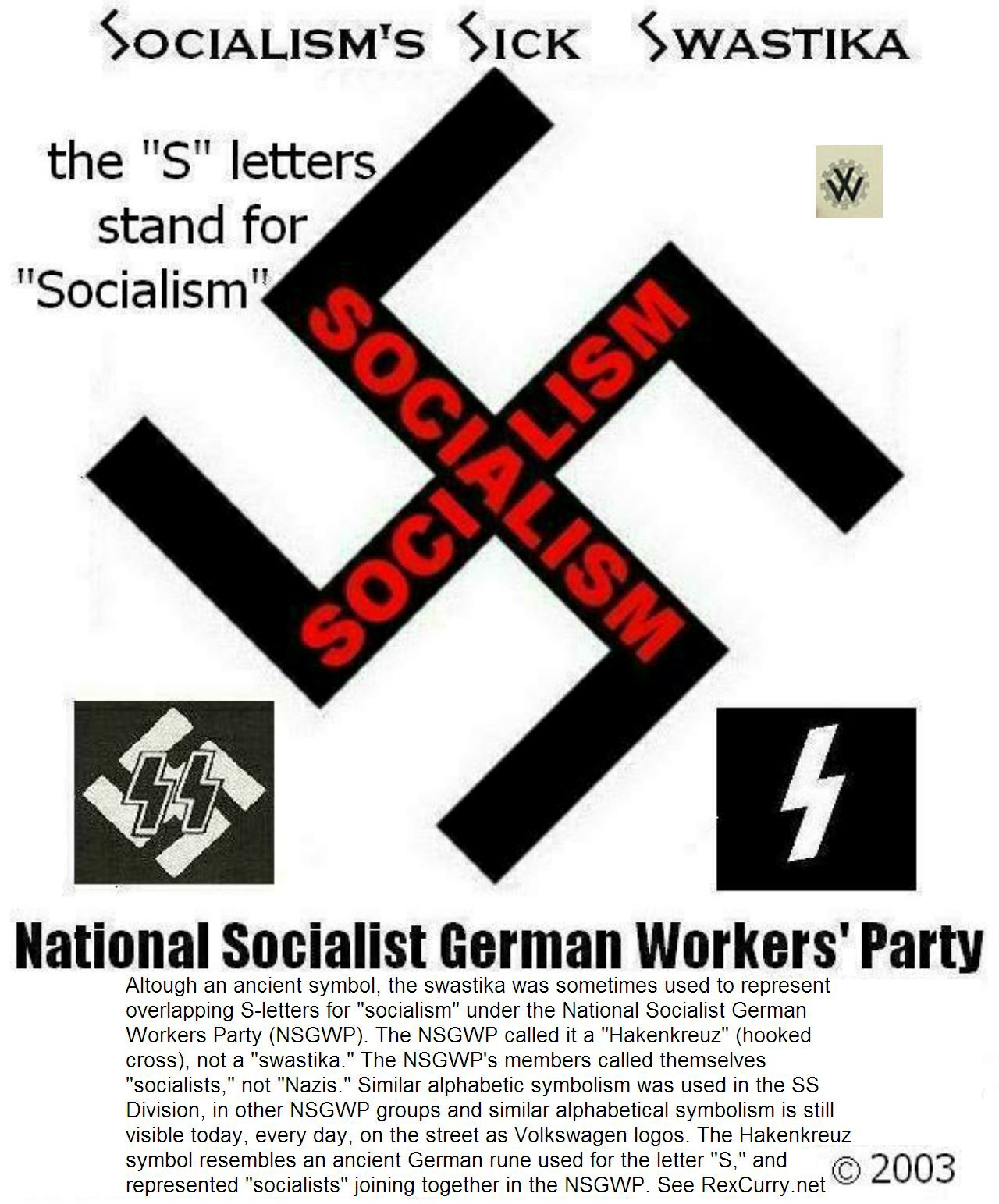
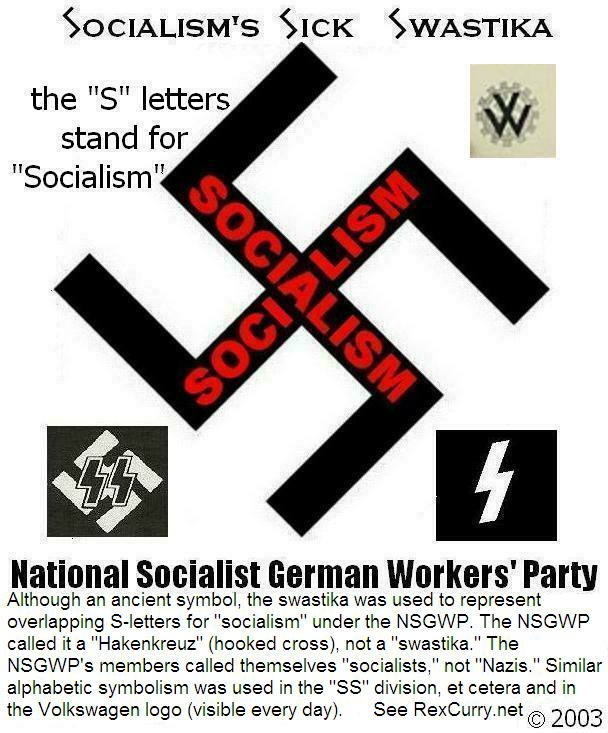
elsewhere); The use of the swastika symbol by socialists and by the
military; Social Security numbering and tracking of the entire
population and even tattooing of numbers on people.
http://rexcurry.net/tattoos.html
It did happen here. Worse, many of the U.S. Practices outlasted
German National Socialism. Many of the U.S.'s practices continue
today. http://rexcurry.net/pledgenazis.html
In the book "War Against the Weak: Eugenics and America's
Campaign to Create A Master Race" by Edwin Black, the author's
central thesis is that Nazi racial hygiene and its ultimate
manifestations in the Holocaust were imported in detail from the USA,
and that, indeed, it was US ruling elites who hatched the idea of
creating a master Aryan race by selective breeding and then passed it
along to the National Socialist German Workers Party.
In Zweites Buch (Second Book), Adolf Hitler portrayed the U.S. as
a "racially successful" society that used eugenics and
segregation and followed what Hitler thought was a wise policy of
excluding "racially degenerate" immigration from eastern
and southern Europe. It was a change from Mein Kampf and what caused
the change in Hitler's views between 1924 and 1928 is not known. By
1928, Hitler seems to have heard about the U.S.'s massive industrial
wealth, the Immigration Act of 1924, segregation, and the fact that
most American states had eugenics boards to sterilize people who were
considered inferior. Hitler declared his support for such practices
and desired that German socialists would follow suit. Was Hitler also
aware of the Nazi salute and robotic chanting that was used in the
U.S.'s Pledge of Allegiance and had been so for about 3 decades?
The notorious American and National Socialist Edward Bellamy
authored the socialist utopian fantasy "Equality." The
popularity of Bellamy's eugenic utopia coincided with Alfred Ploetz's
formulation of a scientific method for its realization. Ploetz
(August 22, 1860 – March 20, 1940) was a German physician and
eugenicist known for coining the term racial hygiene (Rassenhygiene)
and promoting the concept in Germany. Many German socialists
responded enthusiastically to Bellamy's vision as offering the basis
in evolutionary terms for a classless world community or
Volksgemeinschaft. http://rexcurry.net/pledgenazis.html
Edward
Bellamy and Francis Bellamy (Edward's cousin and cohort) were
conspiracy theorists and socialists. Edward Bellamy's conspiracy
theories were outlined in his books, including the novel "Looking
Backward" an international bestseller that Bellamy personally
had translated into German, where Bellamy had lived for a year.
Bellamy's book launched a global movement of national socialism.
Both Bellamys wanted the government to take over all schools in
order to impose their plans in the USA. Francis Bellamy aided
Edward's conspiracy theory when Francis authored of the "Pledge
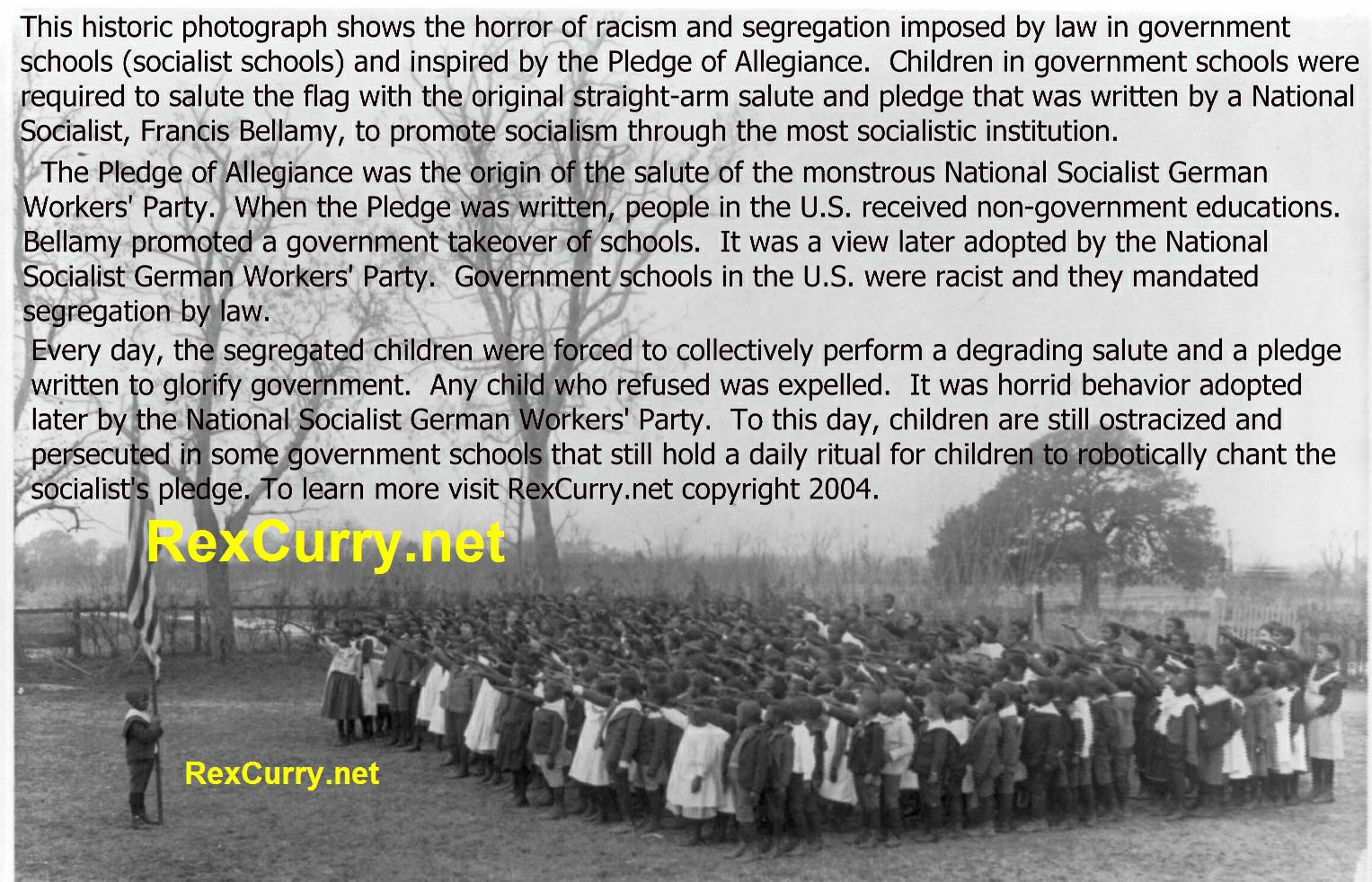
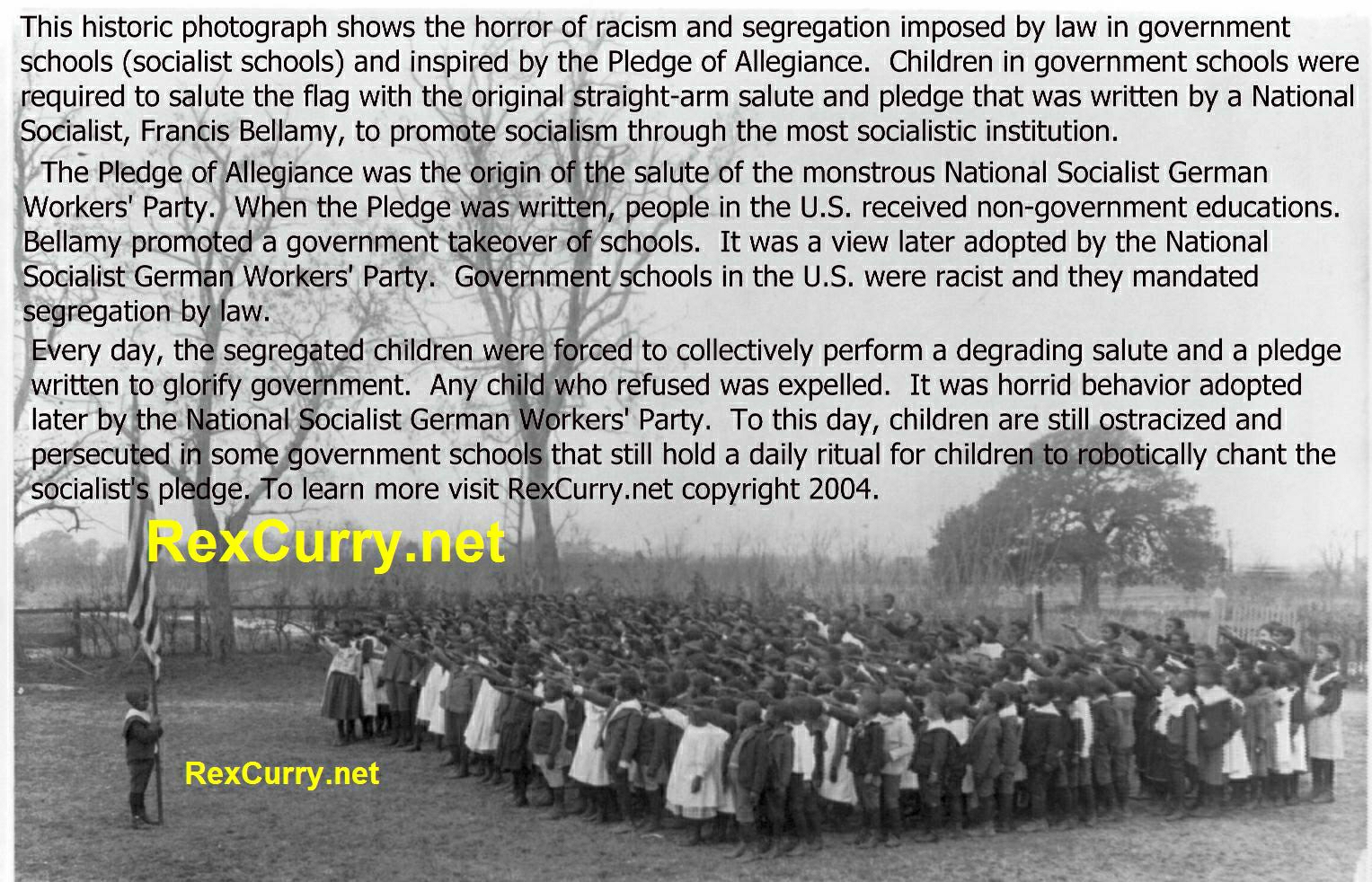
of Allegiance" to the flag. The Nazi salute originated in
America from Francis Bellamy's pledge, turning American children into
quislings for national socialism, as shown in the work of Dr. Rex
Curry (author of "Pledge of Allegiance Secrets").
http://www.youtube.com/watch?v=BssWWZ3XEe4
The
Bellamys believed that countries would be destroyed by diversity and
individuality, unless the government imposed uniformity and
"equality."
The arm extended straight out was an
early way of saluting the American flag during the pledge. People
would raise their right hand to their forehead and perform the
standard military salute at the pledge's beginning, and then at the
words "to my flag", extend their arm straight out. It was
not an ancient Roman salute, although that is a popular myth. Dr.
Curry showed that the ancient Roman salute myth came from the Pledge
of Allegiance. http://rexcurry.net/edward%20bellamy.jpg
The
National Socialist German Workers Party (Nazis) adapted the
straight-arm gesture, along with robotic chanting to flags and
government.
The Eugenics movement in Britain and America was
one of Hitler's inspirations for genocide, just as his salute was
inspired by the American salute.
http://rexcurry.net/swastika3swastika.jpg
Yet,
to this day, conspiracy theories that question government action are
shunned, while conspiracy theories that tout government action, and
even all-out war, are embraced and repeated.
In summation, there are many ways in which Hitler and his national
socialists were familiar with American national socialists and
American practices (including America's nazi salute from the Pledge
of Allegiance and its persecution of people who refused the
mechanical brainwashing), here are a few ways:
American socialist eugenicists, as explained by various
authors including Edwin Black. Hitler personally communicated with
and lauded American socialist eugenicists.
The automaker Henry Ford and his book “The
International Jew” and his Dearborn, Michigan newspaper. James
D. Mooney, vice-president of overseas operations for General Motors,
also received a medal from Hitler, the Merit Cross of the German
Eagle, First Class.
Edward Bellamy and Francis Bellamy via the international
bestseller “Looking Backward” (translated into German)
and the book “Equality” and via other print and film
sources, and via “Nationalist Clubs” or “Nationalism
Clubs” and various Nationalist publications that promoted the
Bellamy dogma in and around Germany. They were both Freemasons and
they spread their dogma and the salute/pledge of allegiance
internationally via that organization and others (e.g. Boy Scouts),
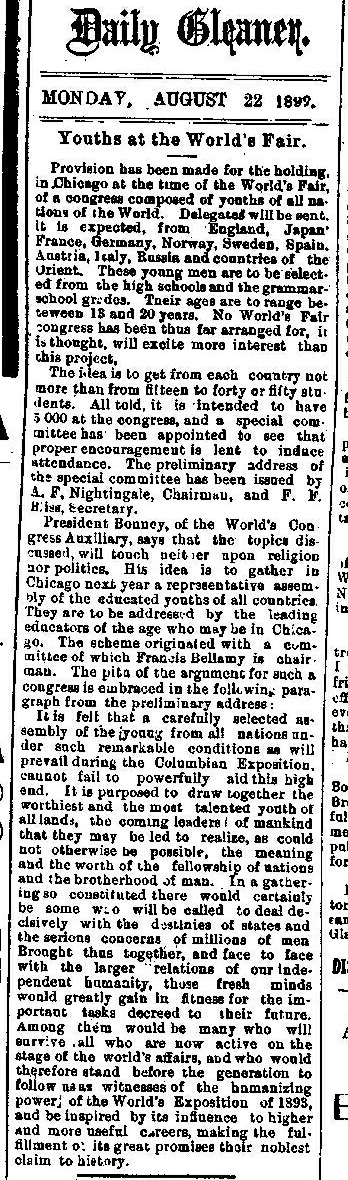
and a Youth's Congress. Francis wrote the pledge with the intent
that it be used by other nations. See the book Edward Bellamy
Abroad, by Sylvia E. Bowman, with an amazing 543 pages, and an
entire chapter about Bellamy's influence in Germany.
http://rexcurry.net/francis-bellamy-daily-gleaner-kingston-jamaica.jpg
The early silent movie "The Vanishing American" (by
George B. Seitz) based on the Zane Grey novel that shows the
American stiff-armed salute taught to native Americans in a
government school. And other American movies.
American books and writers. See “Hitler’s Private
Library: The Books That Shaped His Life” by Timothy W. Ryback,
including the book by American eugenicist Madison Grant titled “The
Passing of the Great Race.” Karl May, the German author who
was one of Hitler's favorite authors and whose books were set in the
USA as cowboy and Indian westerns.
Ernst Hanfstaengl, an American and a Harvard grad and an
intimate friend of Hitler known as “Putzi” and “Hitler's
piano player” and who advised Hitler on how to lead a crowd
into adulation and loyalty (e.g. as was -and is- done with the
Pledge of Allegiance and its early Nazi salute).
Via the Olympics, including the 1924 Olympics which displays
the stiff-armed salute that the Olympics adopted from the USA's
Pledge of Allegiance.
News reports and court cases concerning pledge persecution
that reached its nadir at the U.S. Supreme Court in 1940 in
Minersville School District v. Gobitis when the Court upheld
government persecution of children in government schools (socialist
schools) if they refused the daily robotic brainwashing.
Woodrow Wilson wanted all children to chant the pledge,
during the time when America's nazi salute was used, during the time
he was president and during WWI. Wilson is also quoted in the film
“Birth of a Nation” explaining the goals of the “Aryan”
people.
|
A fan of RexCurry.net writes: The association of the pledge
with the National Socialist German Workers' Party is at least skin
deep. The stance, presentation, salute and pledge of allegiance
were essentially the
same.
http://rexcurry.net/pledgenazis.html
The
American pledge (1892) does predate the National Socialist German
Workers' Party (1920) by some 28 years. The extended arm salutes
varied a bit over time but was essentially the same. So did the
National Socialist German Workers' Party copy American
socialists?
http://rexcurry.net/edward%20bellamy.jpg
It
is significant that the author and promoter of the pledge, Francis
Bellamy, was a self-proclaimed Socialist who wrote extensively of
a US that would nationalize all industry and conscript all men
into a full-time military which would then conquer the world.
Sound familiar? These were radical notions at the turn of the
century. http://rexcurry.net/swastika3swastika.jpg
It
is also significant that at that time (1899), John Dewey, author
of Democracy and Education, was leading a campaign to turn US
public education into an gigantic propaganda mill for
international socialism.
"Children who know how to
think for themselves spoil the harmony of the collective society
which is coming where everyone is interdependent."
Afterwards
the U.S. Bureau of Education wrote, "The public schools exist
primarily for the benefit of the State rather than for the benefit
of the individual." This at a time when Germany too was
overhauling its school system.
But these were not the only
connections with the pledge.
Vermont social scientists in
the 1920s and '30s devised a plan to eliminate the state's
"degenerate" bloodlines and replenish "old pioneer
stock.
The 12-year survey was developed by an independent
team of social scientists who studied "good" and "bad"
families in the state and listed those which it determined needed
to be *eliminated*.
The report was circulated among
policymakers at the time and led to the passage of a 1931
sterilization law.
Yep. The earlier work of Dewey and
Bellamy had paid off! The kids were now grown and thinking like
true socialists. The science of human breeding had branched off
from social Darwinism. Eugenics was front stage.
Visit the
archives at the Boston Globe, 1999, for details.
This law
resulted in the sterilization of several hundred poor, rural
Vermonters, Abenaki Indians and others deemed unfit to
procreate.
The model was soon adopted by other states which
over the years effected thousands of Americans. Sound
familiar?
So how is this relevant? Because the women's
suffrage movement of the latter 1800s had become a socialist
enclave which expanded the idea of birth control to population
control.
Borrowing from the work of the social scientists,
"Race Building in a Democracy" was the theme of the 1940
joint meeting of the Birth Control Federation of America and the
Citizens Committee for Planned Parenthood where it was proclaimed
about the leader of the National Socialist German Workers'
Party...
"We, too, recognize the problem of race
building, but our concern is with the quality of our people, not
with their quantity alone."
So, that committee was
aware of the goal of the leader of the National Socialist German
Workers' Party to decrease quantity while improving quality.
They differed only in priorities.
Yep. That's THE Planned
Parenthood.
A leading feminist at this meeting and a
member of the American Eugenics Society, Margaret Sanger,
attracted the attention of the leader of the National Socialist
German Workers' Party who invited Sanger to Germnay to discuss
some ideas.
The rest is history.
So, one bad deed
leads to another. Each stage sets the stage for the next
generation. Words mean things.
|
There is an "Annual Margaret Sanger-KKK rally art
contest." In the past, entries have included photoshopped
"recreations" of Sanger's actual work.
Planned
Parenthood founder Margaret Sanger spoke at a rally of female KKK
members, in 1926 in Silver Lake, New Jersey. In her 1938 book,
"Margaret Sanger An Autobiography" (1971 reprint by
Dover Publications, Inc. of the 1938 original published by W.W.
Norton & Company) Sanger indicates at pages 366-367 that the
she got along quite well with members of group. Here is a
quote:
"Always to me any aroused group was a good
group, and therefore I accepted an invitation to talk to the
women's branch of the Ku Klux Klan...In the end, through simple
illustrations I believed I had accomplished my purpose. A dozen
invitations to speak to similar groups were proffered."
Sanger
advocated birth control as a means of keeping the population of
blacks in check. And Catholics. And Jews. And other ethinic
minorites. And...well, you get the picture. Her slogan, "Every
child a wanted child" was just sugar-coating for her real
designs: a world free of what she called "the unfit." As
Dale Ahlquist wrote in Gilbert Magazine:
Eugenics led
directly to the birth control movement. All the same players were
involved, such as Margaret Sanger, who was a member of the
American Eugenics Society and was the editor of the Birth Control
Review. The primary philosophy was trumpeted on the cover of the
Birth Control Review: "More Children for the Fit. Less for
the Unfit." She made it clear whom she considered unfit:.
"Hebrews, Slavs, Catholics, and Negroes." She set up her
Birth Control clinics only in their neighborhoods. She openly
advocated the idea that such people should apply for official
permission to have babies "as immigrants have to apply for
visas."
She admired Adolf Hitler, and while he didn't
care for Americans much, he liked her too.
The announcement
for the 3rd Annual Margaret Sanger at the Ku Klux Klan Rally Art
Contest! are posted at The Truth About Margaret Sanger. Unlike the
past two years, photoshopped entries will not be accepted.
However, contestants may submit "Drawings, cartoons,
historical novels, haiku, dance, plays, videos, paintings, quilts,
rap, puppetry, modern interpretations of Sanger speaking to the
Klan, reenactments of the speech on YouTube, mime, audio
recordings of actual Sanger quotes she may have reused when
speaking to the Klan -- there is no limit to the artistic ways
this historic event can be commemorated."
**************
The
Aryan Path Magazine - Published 1930 Theosophy Co., Ltd. Page 55
"...a 'Religion of Solidarity,' as it was called by
Edward Bellamy, will not compel alteration of a self-centred
programme of living."
From Theosophist Magazine
September 1934-December 1934 (under Annie Wood Besant) - page 323
THE BELLAMY PLAN A copy of the August issue of THE
THEOSOPHIST, containing an article on my husband, Edward Bellamy,
written by Fred Bell of the Bellamy League in South Africa, has
just reached me, and I desire to extend my thanks to you for
sending it. Many of Mr. Bellamy's most ardent disciples throughout
the world are Theosophists, and this article, we hope, may be the
means of calling the attention of others to the beauty and the
soundness of his economic philosophy towards which the world seems
now to be steadily moving. (Mrs.) EDWARD
BELLAMY.
.........................
In
another shameful episode in the history of U.S. jurisprudence, the
Supreme Court ruled in the infamous 1927 Buck v. Bell case that
the State of Virginia had had the right to sterilize a woman named
Carrie Buck against her will, based solely on the (spurious)
criteria that she was “feeble-minded” and promiscuous,
with Justice Oliver Wendell Holmes concluding, “Three
generations of imbeciles are enough.”
The United
Nations now regards forced sterilization as a crime against
humanity.
|
http://rexcurry.net/swastika3clear.jpg
Margaret
Sanger, EUGENICS
http://rexcurry.net/swastika3swastika.jpg
EDWARD BELLAMY Equality
Health, Race and German Politics
Between National Unification and Nazism, 1870-1945 (Cambridge Studies
in the History of Medicine) (Paperback)
by Paul Weindling
Ploetz
convinced Rudin that alcohol and tobacco were not only damaging to
individual health but they also poisoned the fitness of future
generations. Rudin can be regarded as the co-founder of German
eugenics.
"In 1890 Ploetz married Rudin's sister,
Pauline, who was studying medicine. Ernst Rudin established an
abstinence association, Humanitas, for Swiss grammar schools. Rudin
was imbued with reformist ideals similar to those of Ploetz and the
Hauptmanns. Rudin and his fellow schoolboys reinforced their
abstinence by adventorously reading Bebel on women and socialism (the
SPD's Party Congress was held in St Gallen in 1887), medical tracts
by Forel and Bunge, and the utopian writing of Edward Bellamy. There
was a vitual epidemic of utopianism. The linking of utopianism and
Lebensreform was a stimulus to biological research."
"Although
Ploetz acquired Swiss nationality, his German nationalist convictions
also intensified. In the physiological laboratory of Gaule, where he
was completing his dissertation on heredity, worked the fellow
abstinence-campaigner Fick, who was a hybrid between a democrat and a
fervent Pan-German nationalist."
"Fick persuaded
them that they could earn well in South Africa where he had spent
five years. Ploetz looked forward to being able to study bush men as
among the lowest human races. However, the couple finally abandoned
their African plans and decided on the United States, where they went
in 1890..."
Fick was involved in the founding of the
Pan-German league. Ploetz encountered a strong current of
nationalism although he chose not to become active in Pan-Germanist
agitation.
The Ploetzes settled in Springfield, Massachusetts,
where they opened a medical practice and bred chickens. The
later moved to Meriden, Connecticutt. While struggling to establish
himself, Ploetz used his free time to write a book on the potential
of 'our race' and on problems of social welfare.
Ploetz hoped
to convince emigre German socialists that there was a way to refute
Darwinist criticisms of socialism. Ploetz was in touch with Jacques
Loeb, a radically minded German biologist, who had emigrated because
of his displeasure with social conditions. Ploetz had contacts with
the Springfield Socialist Party, and with socialist journalists in
New York. Through his Zurich comrade, the Nietzschean John Henry
Mackay, Ploetz struck up a friendship with a socialist carpenter,
Adolph Gerecke, who was a contributer to German naturalist journals.
Ploetz hoped to use contacts with a German secret lodge in
Connecticutt to obtain the genealogies of its 20,000 members. He
formulated a programme for racial and social reform.
Ploetz's
choice of such an apparently unpromising place as Springfield might
be explained by the presence of the utopina author, Edward Bellamy.
Bellamy edited a newspaper in Springfield and wrote the utopian
novel, Looking Backward 2000-1887, which seized the imagination of a
vast readership. It was published in 1888, translated into German in
1889, and was popular among socialists. Perfection was the antithesis
of urban Boston of 1887: there was to be a socialist society based on
merit rather than wealth as the main spur to human endeavour. Bellamy
condemned the chaos of liberal self-interest as resulting in 'a horde
of barbarians with a thousand petty chiefs'. There should, instead,
be established an orderly society 'as compared with that of a
disciplined army under one general - such a fighting machine, for
example, as the German army under von Moltke'. State socialism was
placed on a medical and biological basis. The guide to Bellamy's
revitalized Boston was a physician, Dr. Leete. He compared the model
society to 'one family'. Marriage was to be based on love and
fitness, and the congenitally deficient would be banned from
marriage. Bellamy admired Galton's 1873 work on 'stirpiculture' (a
term pre-dating 'eugenics' first used by Galton in 1883).(footnote 65
citing S.E. Bowman et al., Edward Bellamy Abroad (New York, 1962),
pp. 151-9; A.E. Morgan, Edward Bellamy (New York, 1944), p. 158)).
The popularity of Bellamy's eugenic utopia coincided with Ploetz's
formulation of a scientific method for its realization. Many German
socialists responded enthusiastically to Bellamy's vision as offering
the basis in evolutionary terms for a classless world community or
Volksgemeinschaft.
Bellamy typified how political utopias were
reformulate in biological terms. Social reformers were convinced that
if science and medicine were judiciously applied, utopia was within
mankind's grasp.
"The vigour of German science and
medicine derived from the emerging industrial economy..."
1.
on Page 72:
"... , medical tracts by Forel
and Bunge, and the utopian writings of Edward Bellamy.43 There was a
virtual epidemic of utopianism. The linking of utopianism and
Lebensreform was a stimulus to biological research. Also ..."
2.
on Page 76:
"... Ploetz's choice of such
an apparently unpromising place as Springfield might be explained by
the presence of the utopian author, Edward Bellamy.64 Bellamy edited
a newspaper in Springfield and wrote the utopian novel, Looking
Backward 2000-1887, which seized the imagination of a ..."
3.
on Page 77:
"... 68 Ploetz's utopianism
drew inspiration from bacteriology and hereditary biology 6s S.E.
Bowman et al., Edward Bellamy Abroad (New York, 1962), pp. 151-9;
A.E. Morgan, Edward Bellamy (New York, 1944), P. 158 66 B. Ward
Richardson, Hygeia ..."
4. from Back
Matter:
"... Bowman, S.E. et al., Edward Bellamy Abroad (New
York, 1962). Bradbury, S., The Evolution of the Microscope (Oxford,
1967). Brady, ft., The Rationalization Movement in German ..."
5.
from Back Matter:
"... Morel, B.A., Trait�
des d�g�n�rescences physiques, intellectuelles et morales de l'esp�ce
humaine (Paris, 1857). Morgan, A.E., Edward Bellamy (New York, 1944).
Moses, J., Arbeitslosigkeit. Ein Problem der Gesundheit (Berlin,
1931). Mosse, G.L., 'The Image of the Jew in ..."
6.
from Index:
"... 4o6-8,438,526 Behring, Emil (1854-1917), 33,
83, 114, 160-2, 164, 169, 171, 192, 198, 234 Belgium, 148 Bella
Coolla Indians, 54 Bellamy, Edward (1850-98), 72, 76-7, 86 Belzec,
550 Bender, Clara, 455 Bender, 544 Bendix, Kurt (188o-1942), 429, 461
Benjamin, Georg (1895-1942), 353, ..."
Page 72
...
held in St Gallen in 1887), medical tracts by Ford and Bunge, and the
utopian writings of Edward Bellamy.43 There was a virtual epidemic of
utopianism. ...
Page 76
... choice of such an apparently
unpromising place as Springfield might be explained by the presence
of the utopian author, Edward Bellamy. ...
Page 77
...
utopianism drew inspiration from bacteriology and hereditary biology
•‘ SE Bowman eta!., Edward Bellamy Abroad (New York,
...
Page 589
Bower, T., Blind Eye to Murder (London, 1981). The
Paper Clip Conspiracy (London, 1987). Bowman, SE et at., Edward
Bellamy Abroad (New York, ...
Page 601
Morgan, AE, Edward
Bellamy (New York, ‘9a). ...
more »
Page 613
...
Indians, 54 Bellamy, Edward (185o-98), 72, 76-7, 86 Belzec, 550
Bender, Clara, 455 Bender, 544 Bendix, Kurt ( ...
Julian
West, James Upham, Youths Companion, Nationalism, Socialist
Revolution, Theosophical, Theosophy, Blavatsky
Pledge of
Allegiance youtube http://www.youtube.com/watch?v=BssWWZ3XEe4
youtube Pledge of Allegiance