RED SWASTIKA SOCIALISM IN CHINA & THE PLEDGE OF ALLEGIANCE

Frightening information about the history of the Pledge of Allegiance is at http://rexcurry.net/book1a1contents-pledge.html (with shocking historical photographs).
For fascinating information about symbolism see http://rexcurry.net/book1a1contents-swastika.html 
Hear audio on worldwide radio at http://rexcurry.net/audio-rex-curry-podcast-radio.html


Oppose the National Socialist German Workers' Party and its socialist legacies that exist in today's government.   
For more information regarding Nazi policies in the USA see http://rexcurry.net/police-state.html 

Swastika swastica hakenkreuz
A lot of fascinating research examines how socialism has haunted the world. Many authors worry still about the potential for a future filled with persecution and global socialism. Those worries have relevance to the enormous size and scope of government on the planet. ussr-cccp-sssr-young-pioneers-socialism.html


By imposing socialism, the government of China has slandered (guilt by association) the old-style swastika that was prevalent in the country long before the existence of the socialist Wholecaust (of which the Holocaust was a part) and the National Socialist German Workers' Party.

Mao copied Hitler's Mein Kampf, with Mao's Little Red Book. Chinese socialists behaved in ways similar to socialists in Germany under the National Socialist German Workers Party. Mao announced that he wanted to re-unite the "Homeland." That included Tibet where over 1 million people were slaughtered in Mao's record-setting socialist killing spree that spanned decades. Over 6000 monasteries were destroyed.

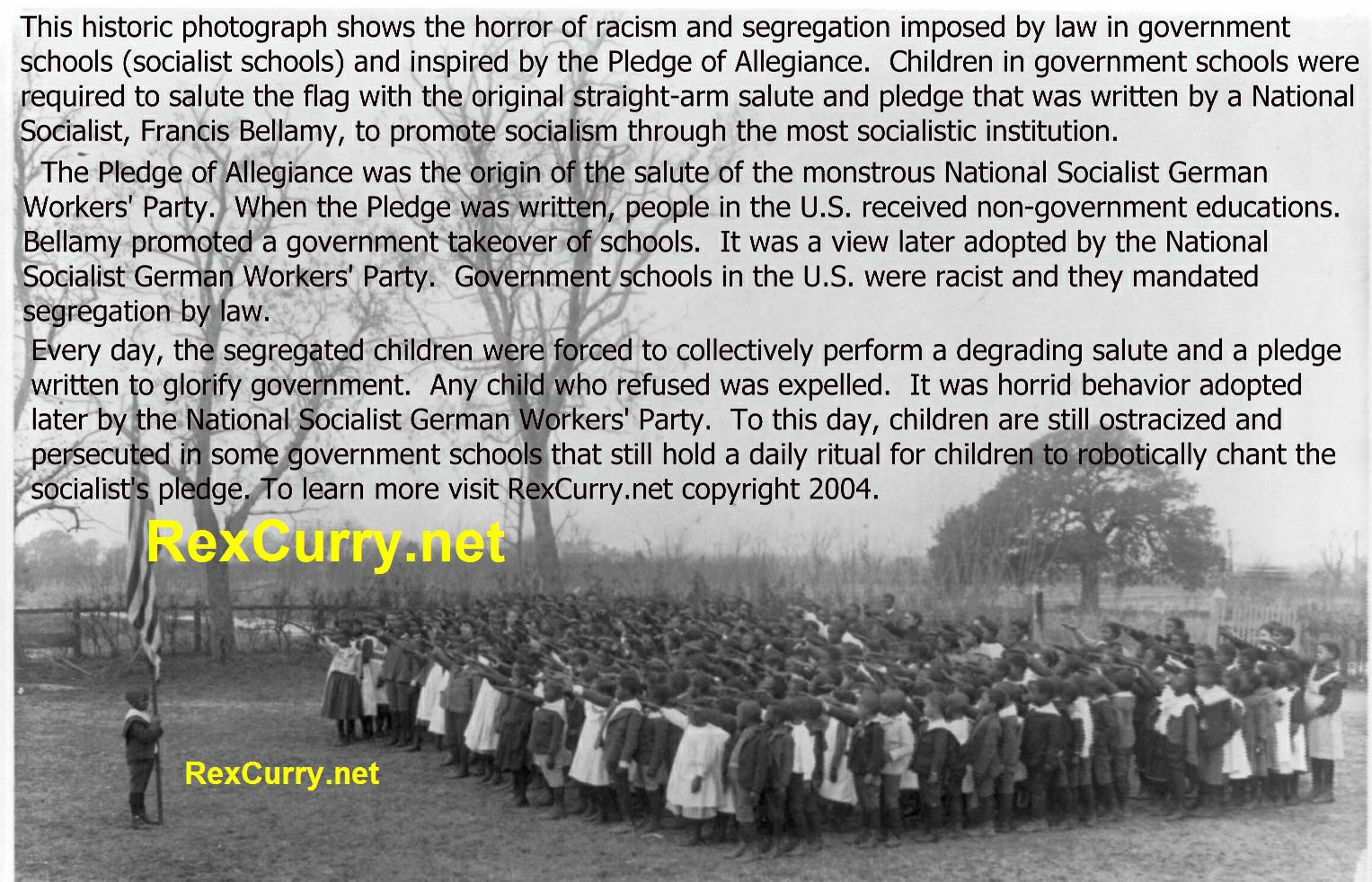
Chinese Socialists also copied the stiff armed salute created by American socialists (the early Pledge of Allegiance salute) that was adopted later by German socialists. They still use the old American socialist salute. This is from January 6, 2006: "There was a part called the 'Vow of the Sports Day' which I found incredibly hilarious. The kids had their arms up in a salute. I’ve noticed that a lot of Taiwanese people have no idea about what exactly Nazis are and what the Holocaust is. Anyway, the kids and the students were doing a Nazi salute, which I found most amusing. Even more amusing was Robert, another foreign teacher. He is in his mid-thirties and Polish. He made a mock Hitler salute as well, and I found this hilarious because he was showing us what the assembled kids were trying to look like. Nazis. Little itty bitty Nazis. Ah well, I’ve often compared the Sinjhuang branch of the school to a prison camp." from
http://thememoirs.org/2008/01/06/buxiban-crisis-and-sports-day-madness-part-iii


China's straight-arm salute is also shown at the following link (or shown below) from the Taipei Times in the Republic of China, with government officials being sworn in. http://rexcurry.net/nazi-salute-taipei-times-roc-republic-of-china-government-officials-sworn.jpg

The history of socialism raises a disturbing question: That is to what extent people who think and behave like sheep deserve to be treated like human beings.

Pledge of Allegiance Republic of China ROC Taipei Times Nazi salute

The Red Swastika Society 世界红卍字会 was a voluntary association founded in China in 1922 by Qian Neng-kun (錢能訓), Du Bing-yin (杜秉寅) and Li Jia-bo (李佳白) as the philanthropic branch of the Daodeshe (道德社) "Society of Dao and Virtue", a syncretist taoist school, which changed at the same time its name to Daoyuan. It was one of a number of new transnational world redemptive societies founded at the time in China, drawing on Western examples such as the Red Cross to build charitable instituions grounded in religions such as Buddhism and Daoism. (The swastika is a Buddhist/Hindu religious symbol). Its strength during the 1920s and 1930s seem to vary widely, with citations of 30,000 "members" in 1927 to 7-10 million "followers" in 1937. [1]
Generally, its mission was a broad based effort of philanthropy and moral education. It ran poorhouses and soup kitchens, as well as modern hospitals and other relief works. It had an explicit internationalist focus, extending relief efforts to Tokyo after earthquakes and also in response to natural disasters in the Soviet Union. In addition, it had offices in Paris, London, and Tokyo and professors of Esperanto within its membership. [2]
Perhaps its most storied contact with history was its role in the Nanking Massacre. The rampage of the occupying Japanese forces through the city left thousands of bodies in the streets, and the Society stepped in to assist in burials. Records of these activities from the Society have provided important primary resources for research into the scale of the atrocity and the location of mass graves.
Although it seems to have been suppressed by during the Communist rule in mainland China, the Red Swastika Society appears to continue today as a religious organization focused on charity. It has branches in areas of the Chinese diaspora, with a headquarters in Taiwan. Besides charity work, the Red Swastika runs two schools in Hong Kong (Tuen Mun and Tai Po) and one in Singapore (Red Swastika School).


Red Guard students http://rexcurry.net/red-swastika-guard-students-armbands.jpg
Red Guard Students China Flag Fetishism
Red Guard students and re-education in government schools (socialist schools) http://rexcurry.net/red-swastika-guard-students-armbands.jpg

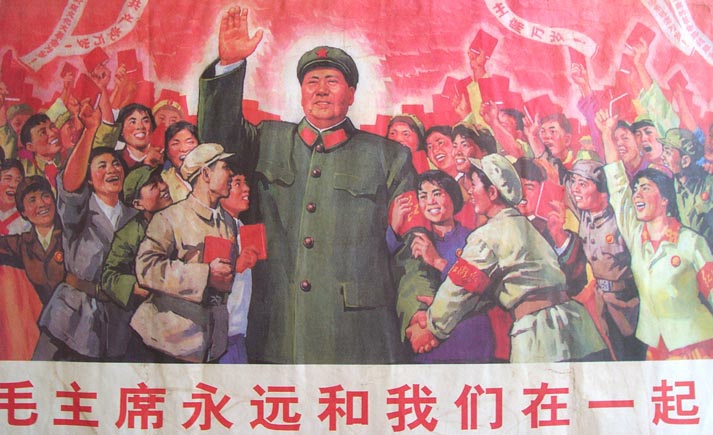
A poster from the Cultural Revolution of Socialism under Mao Zedong. "Chairman Mao is with us forever."

Observe the red guards waving the red books and wearing the red bands that have "Red Guard" written on them.  They were copycats of socialists in Germany with "Mein Kampf" and swastika armbands under the National Socialist German Workers Party and its red flags and emblems. These brainwashed young students-turned-into-red-guards were the main participants of the Cultural Revolution, and it was with them, Mao was able to secure and elevate his position from a Chairman to God like figure. These students idolized Mao and took over factories and turned these factories into production facilities for memorabilia items about  Mao's socialist dogma. One popular item among all red guards was the button that featured Mao's headshots they wore, as on this poster.

They would turn on their own parents and have kangaroo courts about a person's lack of philosophical purity favoring socialism.  They used "re-education."

To the left of the posters, there are three flying banners, carrying messages including - " Long live to heroic Red Guards!", "Long live to Great Proletarian Cultural Revolution!"

To the right of the poster, there are also three flying banners, carrying the following three messages, from left to right respectively, "Long Live Chairman Mao!", "Long live to undefeated Mao's Theory!", "Long live to the victory of Mao's Revolutionary War!"

The poster was developed by Shanghai Mao's Theory Advocate Team and published by Shanghai Xinhua Publishing House in October 1968.

********************

The People’s Republic’s “Youth Palaces,” which are described by one website as “government institutions providing a universal and all-round education for the youth in China,” have agreed to introduce Disney stories into their curriculum. “In one session, we teach [the children] to draw Mickey Mouse,” says a Disney rep based in Hong Kong. “They’re all amazed by that.”

The article describes Disney’s communist partnership as an effort to “build awareness” of the Disney product line through a series of “outreach programmes” forming “part of an overall brand-building process” – all phrases that sound suspiciously like euphemisms for propagandic brainwashing. We’re reminded of 1984’s “philosophical cleansing” and Animal Farm’s “Wild Comrades’ Re-education Committee.” And if the Chinese Communist “Youth Palaces” don’t bear a striking conceptual resemblance to the Hitler Jugend, we’re not sure what does.

 victims
or participants of the Cultural Revolution (1966-1976):

On the 2nd of May 1942, while still in Yanan,
Mao Zedong delivered a speech on literature and art
which shaped the way art was and is still produced in
China. Although since 1978 such ideology
has subsided and more traditional
and contemporary iconography has made a come back;
it is important to understand what China's most
influential leader of the past 47 years (and beyond)
had in mind when he discussed the roll of art
in Chinese society. Please keep in mind that in 1942
large parts of China were occupied by the
Japanese and what was not occupied by a foreign army
was mostly ruled on by the Guomindang
with Chiang Kai-Shek at its helm.
The communists had regrouped in Northwestern China
after the Long March and were building and
consolidating the power apparatus
of the future government, army
and institutions which have shaped China ever since.

May 2, 1942, Mao begins:

      The purpose of our meeting today
      is precisely to ensure that literature
      and art fit well into the whole revolutionary machine
      as a component part, that they operate as
      powerful weapons for uniting and educating
      the people and for attacking and destroying the enemy,
      and that they help the people fight the enemy
      with one heart and mind.

Mao states that he means to make clear
that all communists must obey the
dictates of the communist party and adjust their attitudes
as artists to produce works which extol
the masses and facilitate communication between
mostly illiterate peasants and deliver
the communist cadre's messages.
Art, literature or visual arts must subjugate themselves
to the will of the party's ideology and the will of the people.
Artists must become craftsmen of visual ideology.

Mao continues: "The people, too, have their shortcomings.
Among the proletariat many retain petty bourgeois ideas,
while both the peasants and the urban petty bourgeoisie
have backward ideas;
these are burdens hampering them in their struggle.
We should be patient and spend a long
time in educating them and helping them to get their loads
off their backs and combat their own shortcomings and errors,
so that they can advance with great strides.
They have remolded themselves in struggle or are doing so,
and our literature and art should depict this process."

This speech illustrates three pivotal issues which
need to be highlighted if we are to understand
Chinese popular art of the past 47 years.
First, that the artist is a tool and the property of the state
(no wonder the Chinese have such difficulty
in understanding copyright laws).
Secondly, in his speech Mao is alluding to petty-bourgeois
as those who cannot shed their culture
(traditional Chinese culture which he considered
corrupt and feudal) and replace it anew with
his vision of socialist utopia. This despite his best efforts
was never really accomplished and is the reason
why we see a revival of more traditional themes
like babies with fish and more traditional designs
after Mao's death and Deng Xiaoping's ascent to
the throne. Thirdly, the concept of catering to
an audience primarily made up of peasants,
soldiers and cadres and the depiction of their efforts. 
A very illustrative and blandly educative approach to art.
Forget intuition, creative impulses, urges, or muses,
just put your skills to work for the
state.

Finally to hammer this all in Mao concludes
on the 23rd of May 1942 that:
"We are Marxists, and Marxism teaches us that
in our approach to a problem we should start
from objective facts, not from abstract definitions....
We should do the same in our present discussion
of literary and artistic work.... Today, writers
(artists) who cling to an individualist,
petty-bourgeois stand cannot truly serve the masses
of the revolutionary workers, peasants and soldiers.
Their interest is mainly focused on the
small number of petty-bourgeois intellectuals."

These three paragraphs will, I hope,
help you understand and appreciate these works of art
for what they are. Thousands of artists toiled on
similar images and many more. Their efforts should
be appreciated within the context of China's
last five decades. They are less kitsch than one
might think, they represent an ideology and a people
struggling to rebuild a society which for 150 years
hence had seen nothing
but misery.

In browsing through these images of revolutionaries,
babies with peaches, generals on horses
and babies with fishes I cannot help to think of how we
are shaped by the political and societal forces
that represent us. Do we work for target audiences,
are we surrounded with smiling babies and gaze
at white-shirted executives? Do we respond to
the visual illustrations of the commercial interests
that pay us? Do fine artists focus their
attention on a small number of the like minded?
We serve ourselves while these works
and the ideas they represent hold a mirror
to visual arts anywhere, and
at anytime.

s

 
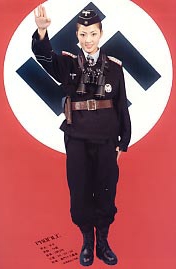
      swastika sex girls salute the leader & obey commands  


      swastika sex girls topless asian with doll & panties


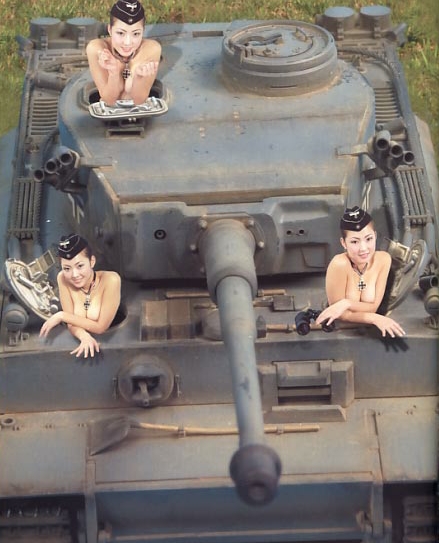
swastika sex girls nude tank crew asian

 
The swastika symbol is prominent in Hinduism, which is considered the parent religion of Buddhism and Jainism, both dating from about the sixth century BC, and both borrowing the swastika from their parent. Buddhism in particular enjoyed great success, spreading eastward and taking hold in southeast Asia, China, Korea and Japan by the end of the first millennium. The use of the swastika by the indigenous Bön faith of Tibet, as well as syncretic religions, such as Cao Dai of Vietnam and Falun Gong of China, is thought to be borrowed from Buddhism as well. Similarly, the existence of the swastika as a solar symbol among the Akan civilization of southwest Africa may have been the result of cultural transfer along the African slave routes around 1500 AD.

Regardless of origins, the swastika had generally positive connotations from early in human history, with the exceptions being most of Africa and South America.

In China, it is called wan.  Its shape appears twice in Ji, the character for 10, 000.  Hence, it is also a symbol of prosperity.  In Chinese depictions of Buddha Amitabha, it frequently appears on his chest.

From America, with love.  

Members of the World Red Swastika Society Nanjing Branch were carrying the dead bodies to be buried.

Owen China's Swastika Keramos


sitemeter

sitemeter