The Religion of Solidarity was one of Edward Bellamy's early
works, written in 1874 at the age of 24. Professor Rex Curry has
studied Edward Bellamy's work extensively and has shown the damage that
the Bellamy family did. http://rexcurry.net/book1a1contents-pledge.html
Bellamy grew up in a religious family with religious predecessors. Rufus
King Bellamy (1816 - 1886) was the father of Frederick, Edward, and Charles.
Rufus was a younger brother of David Bellamy (the father of Francis
Bellamy, author of the Pledge of Allegiance). Both Rufus and David spent
their lives in the ministry preaching their versions of utopia. Rufus
and his wife (Maria Putnam Bellamy) preached to their three sons the need
for activist altruism. Charles and Edward Bellamy went on to write
utopian stories and fantasy tales. Charles wrote "Were They Sinners?" and
"The Breton Mills" (1879) in which he used vague altruism to justify a socialist
government. Edward followed the same route with "The Religion of Solidarity"
and his totalitarian utopian fantasy "Looking Backward," both considered part
of the "Christian Socialism" dogma. Both brothers inpired their cousin, Francis
Bellamy (author of the Pledge of Allegiance).
Edward, Charles and Francis were socialists. Edward and Charles
were brothers, and Francis was their cousin. Francis and Edward were both
self-proclaimed National Socialists and they supported the "Nationalism"
movement in the USA, the "Nationalist" magazine, the "Nationalist Educational
Association," and their dogma of "military socialism," and Edward inspired
the "Nationalist Party" (in the USA). http://rexcurry.net/book1a1contents-pledge.html
Their dogma influenced socialists in Germany, and the Pledge was
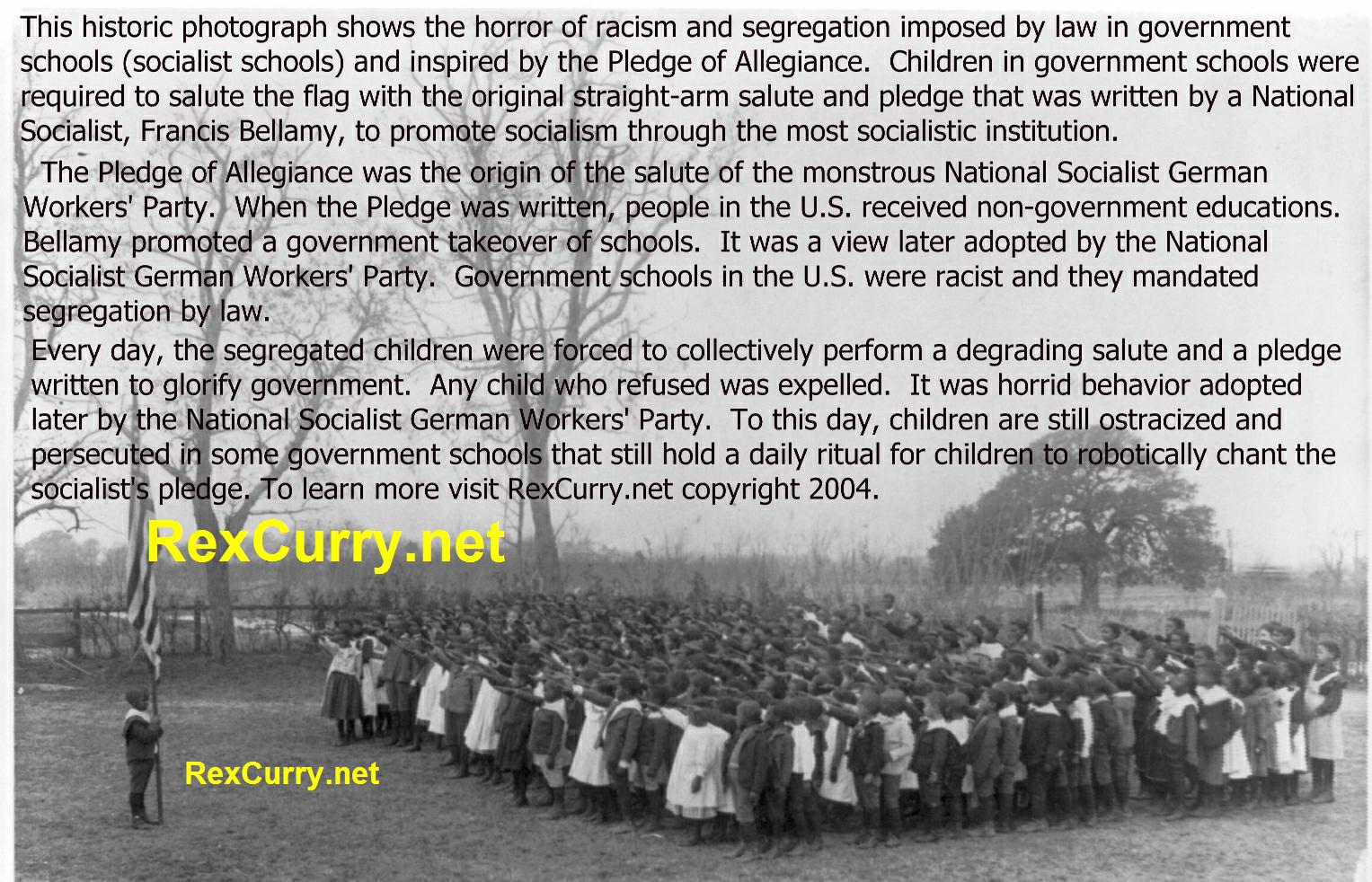
the origin of the Nazi salute, as exposed by Professor Rex Curry. http://rexcurry.net/bellamy-edward-german-connections.html
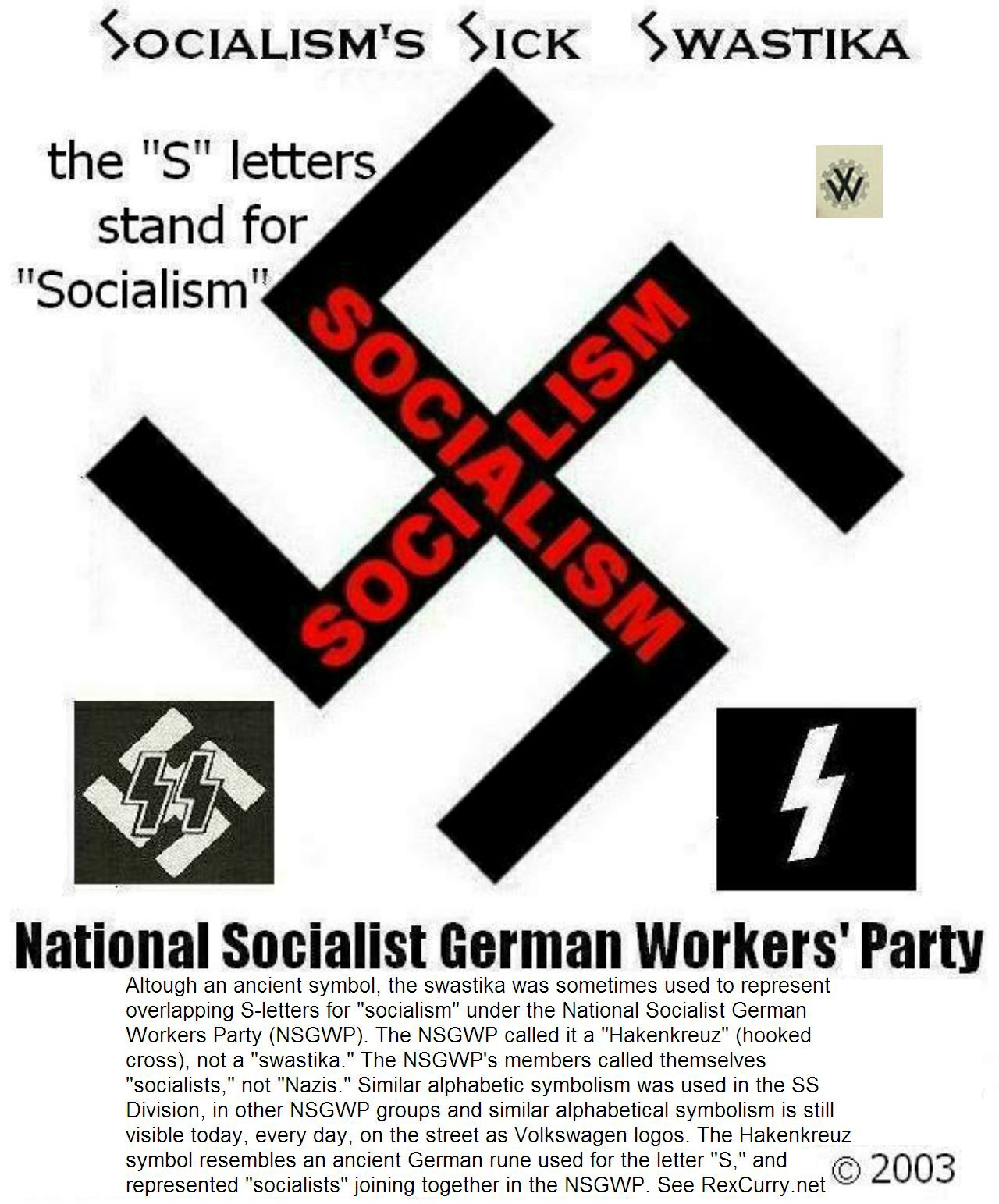
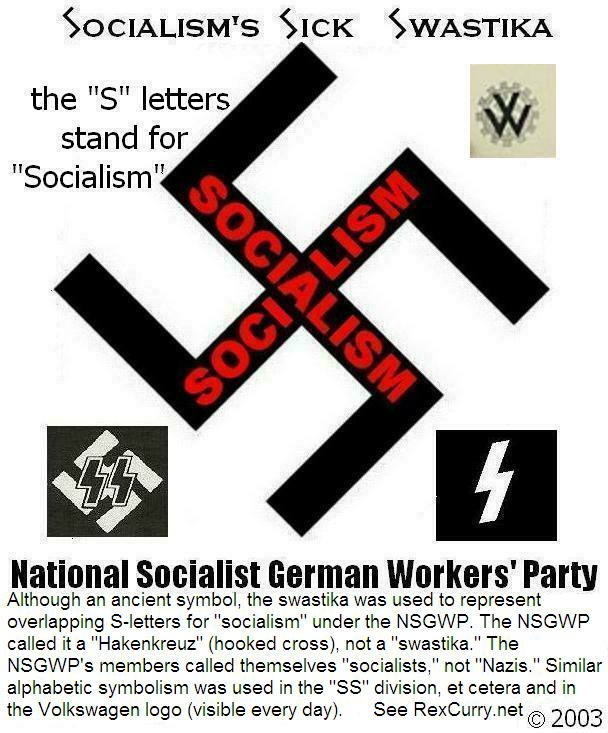
"Nazi" means "National Socialist German Workers' Party." A mnemonic
device is the swastika. Although the swastika was an ancient symbol, Professor
Curry discovered that it was also used sometimes by German National Socialists
to represent "S" letters for their "socialism." Hitler altered his
own signature to use the same stylized "S" letter for "socialist" and similar
alphabetic symbolism still shows on Volkswagens. http://rexcurry.net/book1a1contents-swastika.html
Edward Bellamy withdrew from the religiosity of his mother, in favor
of socialism. The biography “Edward Bellamy” by Arthur E. Morgan
states “...there is repeated evidence that in his effort to become free
from the loving pressure upon him, he came to the point of spiritual rebellion.
In one of Edward Bellamy’s early journals is this short note “It has
come to that now that I don’t know how a man can better serve his country
than by becoming an infidel.”
Edward Bellamy continued to make socialism his religion, as shown in
Bellamy's fantasy novel “Looking Backward.” A cynical passage near
the end of Chapter 26 gives the only mention of their minor status, used
as a story device for spouting Edward Bellamy’s socialist philosophy.
This is an quote from the Mr. Barton’s sermon: “...it must not be forgotten
that the nineteenth century was in name Christian, and the fact that the entire
commercial and industrial frame of society was the embodiment of the anti-Christian
spirit must have had some weight, though I admit it was strangely little,
with the nominal followers of Jesus Christ.”
After Edward Bellamy’s book of 1888, and shortly before Francis Bellamy
wrote the pledge (1892) for the Youth’s Companion magazine, Francis
was pushed out of the ministry for his real-life socialist propagandizing,
including sermons like “Jesus the Socialist.” An actual speech entitled
“Jesus the Socialist” by Francis Bellamy is not known to exist today.
What is known is that Francis espoused Edward’s dogma. Edward’s character
Mr. Barton inspired Francis Bellamy’s ministry and its end. Francis’
sermon “Jesus the socialist” is Mr. Barton’s sermon in “Looking Backward.”
Bellamy's The Religion of Solidarity was also published posthumously
in 1940 (Antioch Bookplate Company).
The Bellamys are the reason that flags (and chanting to flags) exist
in government schools today. They are the reason that flags are in
religious institutions, too.
According to the book "Disruptive religion" by Christian Smith, German National
Socialists reconstructed the doctrine of providence to place their movement
within Protestant narratives. According to the Party, the increasing popularity
of the party in the 1930's was in the divine will. Hitler saturated his speeches
with images that placed German National Socialism within God's providence,
and insisted that his socialism alone recognized the virtuous gifts God had
given to Germans. German National Socialists thanked God for those gifts.
The Almighty was blessing National Socialism, according to Hilter (Prange
1944:87). Similarly, Goebbels wrote in his diary that both he and Hitler were
"instruments of diviine will" (Reuth 1993:75). http://rexcurry.net/christian-socialism-social-gospel.html
The symbol of German National Socialism, the overlapping S-letters of the
swastika, also drew on Protestant traditions. National Socialists called it
a Hakenkreuz (hooked cross) not a swastika. Though critics charged that the
bent Christian cross was blasphemous, National Socialists argued that the
Hakenkreuz was "the political manifestation of what the Christian Cross intends"
(Hitler. See Prange 1944: 88). http://rexcurry.net/swastika3swastika.jpg
"What does Christianity mean today? National Socialism is a religion. All
we lack is a religious genius capable of uprooting outmoded religious practices
and putting new ones in their place. We lack traditions and ritual. One day
soon National Socialism will be the religion of all Germans. My Party is my
church, and I believe I serve the Lord best if I do his will, and liberate
my oppressed people from the fetters of slavery. That is my gospel." Joseph
Goebbels, Diary entry for October 16, 1928. http://rexcurry.net/swastikacross.html
Today, it is consistent with many people who are zealots about religion
and about the Pledge of Allegiance.
Francis Bellamy openly and publicly defended Edward Bellamy's form of
Socialism in the article "The Tyranny of All the People" in The Arena July,
1891 (p. 180-191). Quotes therefrom: "Socialists believe in the fearless
extension of government because they have a clear and high idea of the nation
as an organic relationship apart from which the individual cannot realize
himself."
"Democratic government, however socialistic it may become, is nothing
but democracy expressing its own will. If the individual is led to surrender
certain of his freedoms for the good of all, he surrenders to a paternalism
of all the people. That were better called, once and for all, a fraternalism.
Socialism aims to produce an environment where not only the Golden Rule, but
the Law of Love will have a living chance."
"The nation is not a mass of independent individuals, but of related individuals,
who, moreover, are so closely related that they make together an indivisible
organism; this organism develops according to orderly laws; this organism
has perpetuity, never disjoining itself either from its past or future; and
the organism has also self-consciousness and moral personality. This is
the nation in which we live, and move, and have our being."
The Bellamys knew —as did Karl Marx, earlier American socialists, and
Plato before them — that their state could not be established and maintained
unless education was taken over by government and subsidized by theft (taxation).
The Bellamys abandoned individualistic religious ideas that respected
private ownership, and they touted a Comte-inspired system, which Edward
Bellamy named the Religion of Solidarity.
The Bellamys did not openly advocate the mass breeding festivals and ignorance
of parents as to the identity of their own children described in Plato’s
Republic (Book V). They believed men should not be allowed to provide for,
and therefore monopolize, their women. The Bellamys condemned family ties
with exclusive relationships between the sexes.
They supported and influenced the platform of the People’s Party in 1892,
and had an increased political effect as time went on; advocating measures
which would, by evolution, create authoritarian socialism.
Their "glorious" people's revolution influenced socialists worldwide and
were the same ideas behind the socialist Wholecaust (of which the Holocaust
was a part): 49 million slaughtered under the People's Republic of China;
62 million under the Union of Soviet Socialist Republics; 21 million under
the National Socialist German Workers' Party.
*****************
Flagging Faith
The Osgood File (CBS Radio Network): 3/21/02
After 9/11, have American flags overshadowed the cross in church?
Many churches have placed American flags in and around their worship areas,
even on the altar, as a way to demonstrate their patriotism after September
11. But some people are concerned the displays obscure a far more important
symbol: the cross. They warn the flag is in danger of becoming the object
of idolatry, which is considered a sin in the Christian church.
Scholars say the placement of the American flag in worship areas is a
perennial issue that flares up, especially around holidays like the Fourth
of July. They say many Americans believe it's appropriate to have an American
flag present during worship because the United States is one nation under
God. But many pastors say the flag is inappropriate because it is not used
for worship.
Rev. Duane VanGiesen, of Lovers Lane United Methodist Church in Dallas,
says the flag doesn't belong in the worship area of churches, where the
cross is supposed to be the ultimate symbol. He reminds people that the
First Commandment, which states "There shall not be any other Gods before
me," requires Christians to put God first and nation, business and even
family second. Still, the American flag has a place at Lovers Lane Methodist
Church, away from the altar and at the side of the sanctuary next to the
Christian flag. VanGiesen says the American flag would never be placed directly
in the worship area of his church.
But others, like Rev. Efren Ortega, of St. James Catholic Church in Dallas,
says there's nothing wrong with flying the flag in the sanctuary, or even
with draping it right over the altar. He placed a large American flag over
the front of the altar in his church. (It has since been moved to the side
of the worship are where it is normally displayed.) For Ortega, the American
flag represents the soul of the country. He says his mostly immigrant congregation
is very proud of America and appreciates the flag. Ortega says there is
no confusion between the symbols of the cross and the American flag.
For others, the American flag is highly symbolic of the nation's religious
freedom. At the Episcopal Church of the Holy Cross in Dallas, Texas, an
American flag hangs on the church's back wall behind the pews. Because the
wall contains a large glass window, the American flag is visible from both
inside and outside of the church. The flag belongs to congregant Rebecca
Todd, who asked Rev. Michael Tuck to display the flag. He chose the back
wall because placing the American flag on an altar symbolically suggests
God and America are unified. Yet the American flag represents an important
value in a time of national crisis. "[The American flag] is a symbol of
our freedom, and maybe the most important freedom we have is our religious
freedom," says Todd.
Bless the cranky, for they dare to speak uncomfortable truths. Rex
Curry doesn't much like
the U.S. Pledge of Allegiance. He has good reasons to object, too,
which he has carefully documented. If you want a shortcut to outrage, just
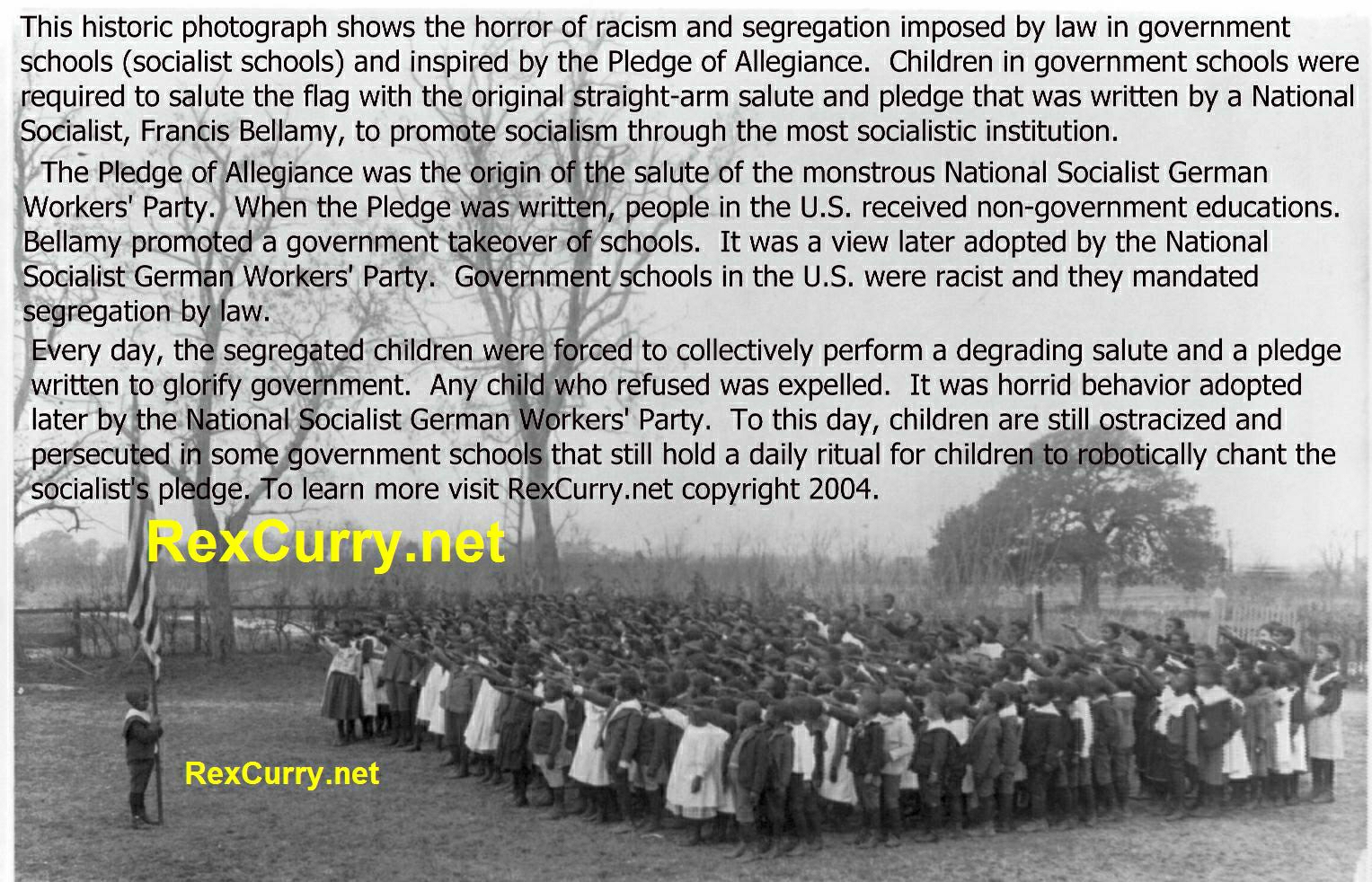
cut straight to his photos of U.S. children being forced to give Nazi-style salutes to Old Glory.
I suggest, though, that you also linger over the text, which describes
the Pledge's ugly origins in a swamp of totalitarian socialism.
I've never liked saying the U.S. Pledge of Allegiance. As a kid, I
just naturally bridled at the notion I could be forced to consent.
It doesn't take a degree in philosophy to spot that hypocrisy. Having now
such a degree, I still object to the notion that a child's consent to political
allegiance counts for anything. Say what you will about Baptists, but I
agree with them that children
lack the capacity to dedicate their souls to God. So, too, with regard
to an infant's capacity to pledge political fealty.
Even when voiced only by adults, I still have doubts about the Pledge
of Allegiance. Set aside the salient problems with the "under God" bit.
Set aside, too, the idolatry of pledging allegiance "to the flag" or to
even to its political organization—"the republic for which it stands"—rather
than to the ideals embodied in the U.S. Declaration of Independence and
Constitution. (Chalk one up for the
Methodists,inter alia, on that count.) I balk on grounds that
the extant Pledge demands too much.
In its current form, the Pledge of has its speaker promise allegiance
to the flag and its associated political regime, followed by a description
of the latter. The Pledge does not clearly condition allegiance on "the republic"
hewing to the principles that alone might justify it. Surely, though, we
would owe no allegiance to a tyranny.
Here, then, I offer a first cut at a Pledge that better reflects to
political philosophy that gave rise to the U.S.:
I pledge allegiance, to the republic, of the United States of
America, on condition that, it respects my rights, both Constitutional
and natural.
To call for revising the wording of the Pledge isn't as mad as it might
at first seem. The "under God" bit got added in the 1950s, of course, and
others have since suggested
alternative versions. I've found no revision, however, that corrects
the odiously unconditional structure of the present Pledge. I think that
friends of liberty should accept nothing less (though they still might well
demand more).
Regardless of the Pledge's wording, though, I'll be damned if I'm going
to give one of those Nazi-styled salutes. I've got quite a different sort
of salute for totalitarian statists. And happily, it economizes my effort
while maximizing my message.
COMMENTS: At least now, if anybody wonders why education and
state should be separated we can point to the current pledge for one reason
(of many).
We can say: "Look! When the state controls education, it makes 5-year-olds
pledge allegiance to it like Hitler Youth!" posted by Gil