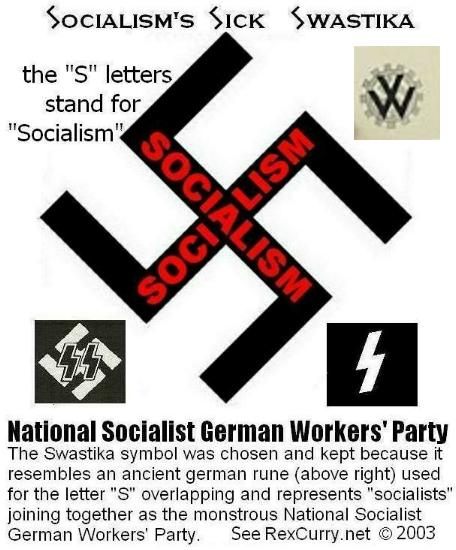
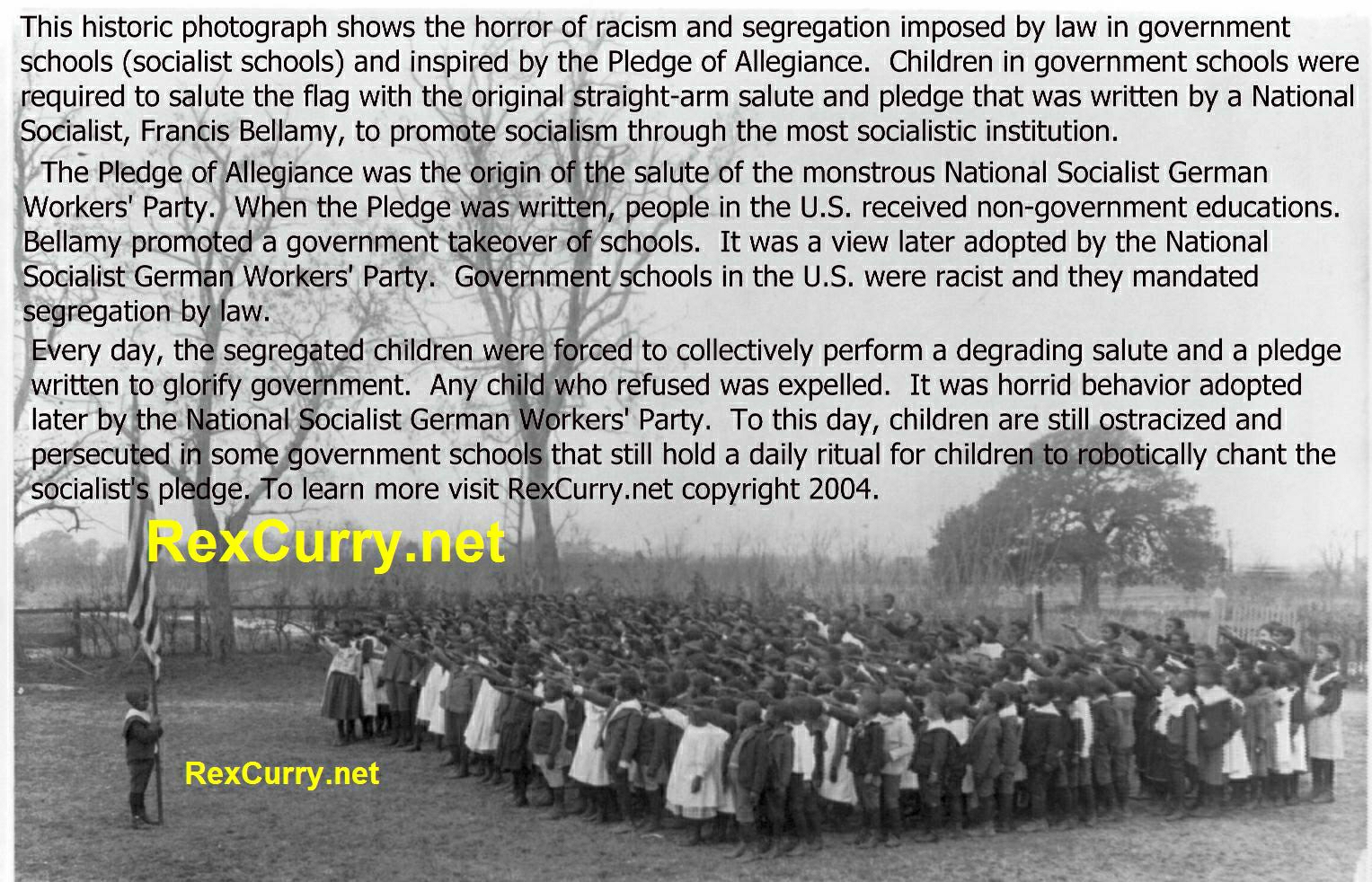
Hooked Cross image
ADDITIONAL INFORMATION:
Christian Socialism & Social Gospel of Bellamys
http://rexcurry.net/christian-socialism-social-gospel.html
Christian Socialism & Jesus the Socialist ?!?!
http://rexcurry.net/pledge-jesus-the-socialist.html
Christian Socialism & the KKK, Ku Klux Klan
http://rexcurry.net/kkk-ku-klux-klan-christian-socialism.html
Christus Rex, Rexist, Rexism, Leon Degrelle
http://rexcurry.net/rexists-rexism-christus-rex-rexiste-leon-degrelle.html
Christian Socialism & the Swastika in Germany
http://rexcurry.net/swastikacross.html
Christian Socialism & the Socialist Cross
http://rexcurry.net/bookchapter3a1d.html
Pledge of Allegiance to the Christian Flag
http://rexcurry.net/christian-socialism-Jesus-Camp-the-movie.html
Swastika symbolism
http://rexcurry.net/swastika3clear.jpg
and old photographs of the Pledge of Allegiance
http://rexcurry.net/pledge-allegiance-pledge-allegiance.jpg
expose frightening features of American history, American socialists, and
Christian Socialism.
In 1892 Francis Bellamy and James Bailey Upham collaborated to write
the Pledge of Allegiance to the flag. Francis Bellamy was the cousin and
cohort of the also-famous Edward Bellamy. The Bellamys were self-proclaimed
"Christian Socialists" and National Socialists who espoused military socialism.
http://rexcurry.net/pledge-jesus-the-socialist.html
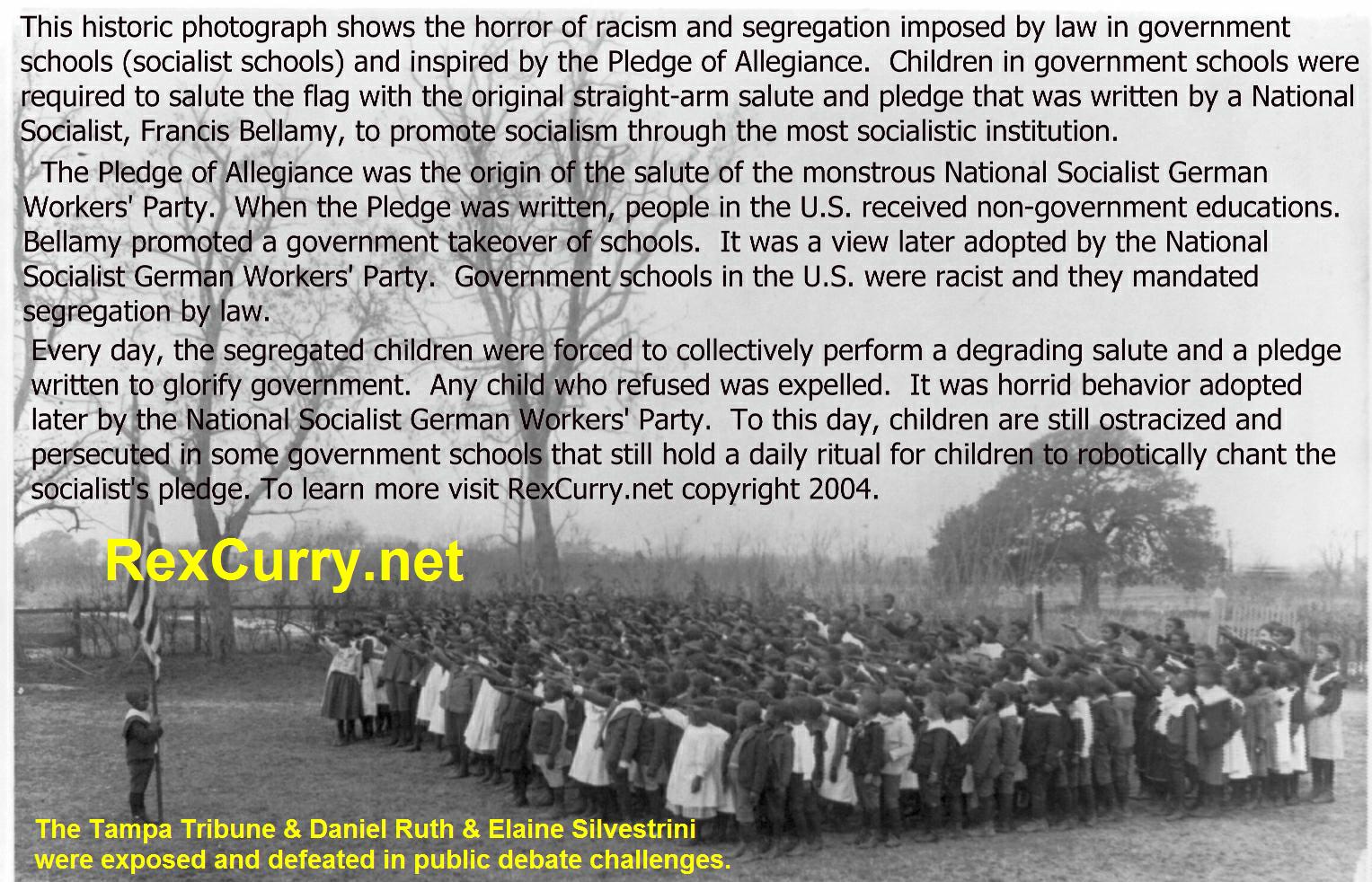
The pledge originally used a straight-arm salute, and was designed to
be chanted in unison by children in government schools. The pledge was the
origin of the salute of the National Socialist German Workers’ Party (Nazis)
and the Bellamy dogma also influenced the Nazis.
http://rexcurry.net/bellamy-francis-christopher-columbus-day.html
The following page shows more examples of the stiff-arm salute of the
early Pledge of Allegiance
http://rexcurry.net/pledge2.html
Before the Pledge of Allegiance was written, James Upham and Daniel
S. Ford (owner of the Youth’s Companion) were well aware of Bellamy’s socialist
dogma before Bellamy was hired because Francis was a minister who was
forced out of his Boston church for his socialist sermons, including topics
like “Jesus the Socialist" and a series of sermons on "The Socialism of
the Primitive Church." Because of such socialist sermons, in 1892 he was
forced to resign from his Boston church, the Bethany Baptist church. "
http://rexcurry.net/book1a1contents-pledge.html
Edward Bellamy did something similar with churches and religion in
“Looking Backward.” A cynical passage near the end of Chapter 26
gives the only mention of the minor status of churches and religion, used
as a story device for spouting Edward Bellamy’s socialist philosophy.
This is a quote from a sermon by a preacher named Mr. Barton: “...it must
not be forgotten that the nineteenth century was in name Christian, and
the fact that the entire commercial and industrial frame of society was
the embodiment of the anti-Christian spirit must have had some weight, though
I admit it was strangely little, with the nominal followers of Jesus Christ.”
http://rexcurry.net/pledgebackward.html
After Edward Bellamy’s book of 1888, and shortly before Francis Bellamy
wrote the Pledge for the Youth’s Companion written in 1892, Francis
was pushed out of the ministry for his real-life socialist propagandizing,
including sermons like “Jesus the Socialist.” An actual copy of a
speech entitled “Jesus the Socialist” by Francis Bellamy is not known to
exist today.
http://rexcurry.net/pledgetragedy.html
What is known is that Francis espoused Edward’s dogma. Edward’s
character “Mr. Barton” inspired Francis Bellamy’s ministry and its end.
Francis’ sermon “Jesus the socialist” was probably similar to Mr. Barton’s
sermon in the book “Looking Backward.”
http://rexcurry.net/bookchapter1a1h.html
Edward Bellamy withdrew from the religiosity of his mother, in favor
of socialism. The biography “Edward Bellamy” by Arthur E. Morgan
states “...there is repeated evidence that in his effort to become free
from the loving pressure upon him, he came to the point of spiritual rebellion.”
In one of Edward Bellamy’s early journals is this short note “It
has come to that now that I don’t know how a man can better serve his
country than by becoming an infidel.”
http://rexcurry.net/edward%20bellamy.jpg
His infidel status reached the ultimate socialist point with his
last book “The Religion of Solidarity” (Antioch Bookplate Company, 1940)(see
more below), published posthumously the year after the National Socialist
German Workers' Party invaded Poland as allies in a pact with the Union
of Soviet Socialist Republics to divide up Europe.
The Bellamy “Nationalism” movement was so large that in the 1930's
Edward Weeks, Charles Beard, and John Dewey all listed Bellamy’s book
as being nearly as influential as Karl Marx’s “Das Kapital” (1867). Back
then, they intended that as a compliment. http://rexcurry.net/nazi%20salute%201.jpg
A popular explanation for the "Garden of Eden" story in the old testament
is that it was intended to explain mankind's transition from hunter-gatherers
to farmers. Eating of the tree of knowledge is part of that explanation:
in the process of gaining "knowledge" men learned how to farm.
http://rexcurry.net/pledge-jesus-the-socialist.html
In farming people control animals, plants and the environment and thus
they strive to become like gods. People gain control of food, clothing,
shelter and other goods and services through the creation of private property
and then they engage in trade with their property (capitalism). Through
capitalism, people improve upon the God-created state of nature in the so-called
"Garden of Eden" where subsistence living occurs because everything is communal,
un-owned and socialistic. Instead of the Garden of Eden, people create the
Garden of Eating (and the abundance of clothing, shelter and all goods and
services).
http://rexcurry.net/socialists.jpg
Even in modern times, egomaniacal socialists have tried to maintain god-like
powers to impose communal living, and destroy capitalism and private property.
It created shortages, poverty, misery, and mass slaughter. It led
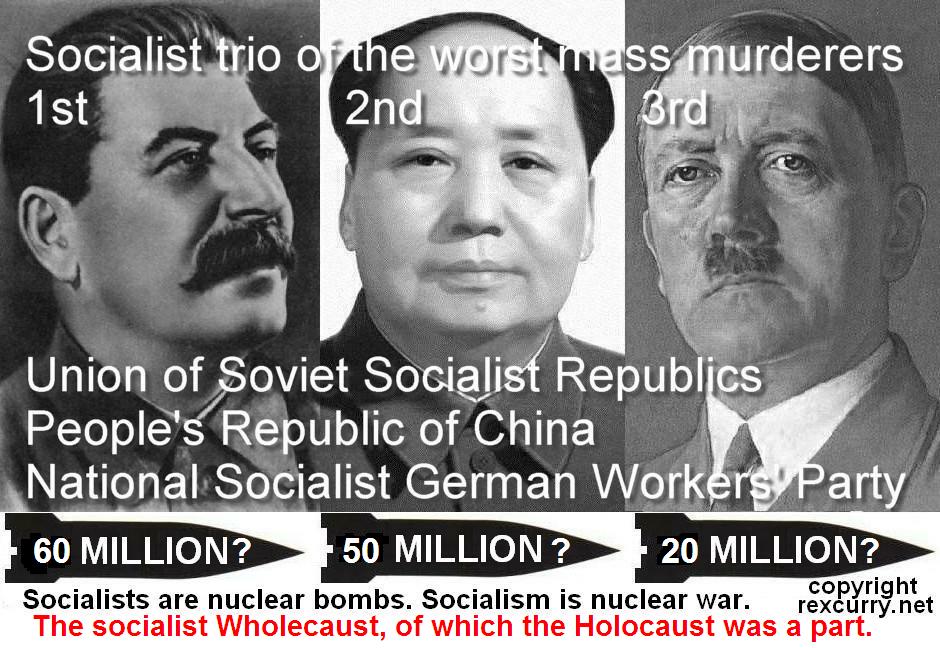
to the socialist Wholecaust (of which the Holocaust was a part): ~60 million
killed under the former Union of Soviet Socialist Republics; ~50 million
under the Peoples' Republic of China; ~20 million under the National
Socialist German Workers' Party. See the work of Dr. Rex Curry (author of
"Pledge of Allegiance Secrets"). http://rexcurry.net/socialists.html
|
CHRISTMAS IN THE YEAR 2000
More evidence of the "Jesus the Socialist" demagoguery of the Bellamys
is below in excerpts from an article by Edward Bellamy. "Christmas in
the Year 2000" was published during the Holiday season in 1894 in the
popular magazine Ladies Home Journal (Jan. 1895, Vol. 12, No. 2):
During the present bi-millennial year 2000, now so near its end,
let us imagine, if we can, an American of today caught up by some miracle
of translation and set down on Christmas Day among our forefathers a
hundred years ago, say in the last quarter of the 19th century. Our contemporary
would be astonished to discover that in America a hundred years ago Christmas
was remembered.
And this astonishment would certainly be a most rational feeling.
To anyone previously ignorant of the real facts, no suggestion would seem
more absurd on the face of it than that a society illustrating in all
its forms and methods a systematic disregard of the Golden Rule, would
permit any notice, much less any open celebration of Christ's birthday.
One would have taken for granted that as December 25th drew near
the police would be doubled and detectives in citizens' clothes stationed
on every corner to arrest any who should so much as whisper that tremendous
name of Jesus. For what treason so black could there be to the social
state of that day as any act in honor of the mighty leveler who laid the
axe at the root of all forms of inequality by declaring that no one should
think anything good enough for another which he did not think good enough
for himself, and who struck at the heart of the lust of mastery when He
said that our strength measured our duties to others, not our claims on
them, and that there was no field for greatness but in serving? It would
plainly be the only reasonable supposition that if there were any who loved
this revolutionary doctrine, so irreconcilable with the existing order,
they must live in hiding.
How, then, shall we imagine the stupefaction of our contemporary,
who, thus expectant, should awaken on Christmas morning to hear the day
ushered in by a chorus of jubilant bells and popular rejoicing? How shall
we measure his mounting amazement on going forth to find the disciples of
the Golden Rule celebrating the praises of its author, not in caves or
forest depths, but in lordly temples in the high places of the city, and
what, above all, shall he say when he observes that the rich and the rulers
not only permit, but encourage, the toiling masses who serve them to render
homage to the memory of Him who came expressly to preach deliverance to
the captive, to set at liberty them that are bruised, and to break every
yoke save that of love?
But no. In that day of which I write, one had but to pause a moment
and listen to catch the deep voice of perpetual lamentation, the cry of
the blood of Abel against his brother, which ceasing not from the beginning,
has only in these last days been hushed in blessed silence. And if our contemporary,
for this reason, did not recognize the dolorous sound, yet he would need
but to look about him to see that this generation which so loudly cried,
'Lord, Lord!' had yet no more mind to do the things Christ said than the
generation He addressed. On every hand the contrast of pomp and poverty,
the full and the hungry, the clothed and the naked -the picture that broke
Christ's heart- remained.
Our whole order is but an application of that rule so simple that
a child could not fail to deduce the result from the terms. What is the
rule? Simply that if people would live well together every one should see
that every other fares as well as he. Individual efforts are inadequate
to secure this end. If the Golden Rule is to be realized in society the
only method is a collective guarantee from all to each of what each owed
individually to every other, namely, as good treatment as he himself had,
which means as applied practically, the guarantee by all to all of equality
in everything that touches material and moral conditions. So our state is
founded, and ingrates, indeed, should we be found if we did not celebrate
Christmas as founder's day in honor of Him who gave us in a phrase the master-key
of the political, the humane and the economic problems.
In a society such as that of the 19th century, based upon inequalities
and existing for the benefit of the few at the cost of the many, it was,
of course, out of the question to celebrate Christmas in the way we do,
as the world's great emancipation day and feast of all the liberties.
The Religion of Solidarity
By Edward Bellamy
The Religion of Solidarity was Edward Bellamy's last book (Antioch Bookplate Company, 1940).
It contains fourteen essays by Edward Bellamy, the nineteenth century
National Socialist writer of Looking Backward. The title essay,
The Religion of Solidarity, written when Bellamy was twenty-four,
is a statement of what Bellamy calls "the human need for self-transcendence."
The Blind Man's World is a ditzy flight of imagination
in which an astronomer learns from Martians the consequences of
lack of foresight, a severe handicap which intensifies the fear
of death and change. To Whom This May Come examines friendship and
intimacy amongst mind-readers. A Republic of the Golden Rule,
from Looking Backward, extolls the assumption of control
of economic development through totalitarian socialism (a "Great
Trust"). Lifelong Education from Equality, considers
the use of leisure in under Bellamy's totalitarian plans. Bellamy
calls for a socialist system that he calls "fraternal cooperation" in Why
a New Nation? He sets forth the "basis for brotherhood" in
Declaration of Principles. which is the complete opposite
of the Declaration of Independence and the Bill of Rights.
In Nationalism - Principles and
Purposes he please for the socialist cliche
of "social and economic reform" based upon a programme of
nationalization, and he refines his recommendation in Some Misconceptions
of Nationalism. Why Every Working Man Should Be a Nationalist
touts government ownership of everything (Bellamy, of course, calls
it "public ownership"). The Programme of the Nationalists
shows other terrifying points to his radical economic revolution. Bellamy
looks forward to a Second American Revolution in Fourth of
July, 1992 which will reverse the First American Revolution. He indicates
the line of thinking that led him to write his infamous novel in
How I wrote 'Looking Backward'. The book concludes with
his Introduction to 'The Fabian Essays', in which he
considers Fabian socialism from his standpoint (he calls his standpoint
an "American standpoint").
The principle of
the Brotherhood of Humanity is one of the eternal truths that govern
the world's progress on lines which distinguish human nature from
brute nature. The principle of competition is simply the application
of the brutal law of the survival of the strongest and most cunning.
—Edward
Bellamy
"[The average American] conceived of a socialist, when he considerd
him at all, as a mysterious type of desperado, reputed to infest the dark
places of continental Europe and engaged with his fellows in a conspiracy
as monstrous as it was futile, against civilization and all that it implied."
- Edward Bellamy, Introduction the American edition of
Socialism: The Fabian Essays (1894).