The Bellamy German connections are scary reminders of people
persecuted under German National Socialism and of the "Socialist
Slavery" symbolized by the overlapping S-letters of the
swastika under the National Socialist German Workers Party.
http://rexcurry.net/book1a1contents-swastika.html And
American propaganda and flag fanaticism
at http://rexcurry.net/book1a1contents-pledge.html
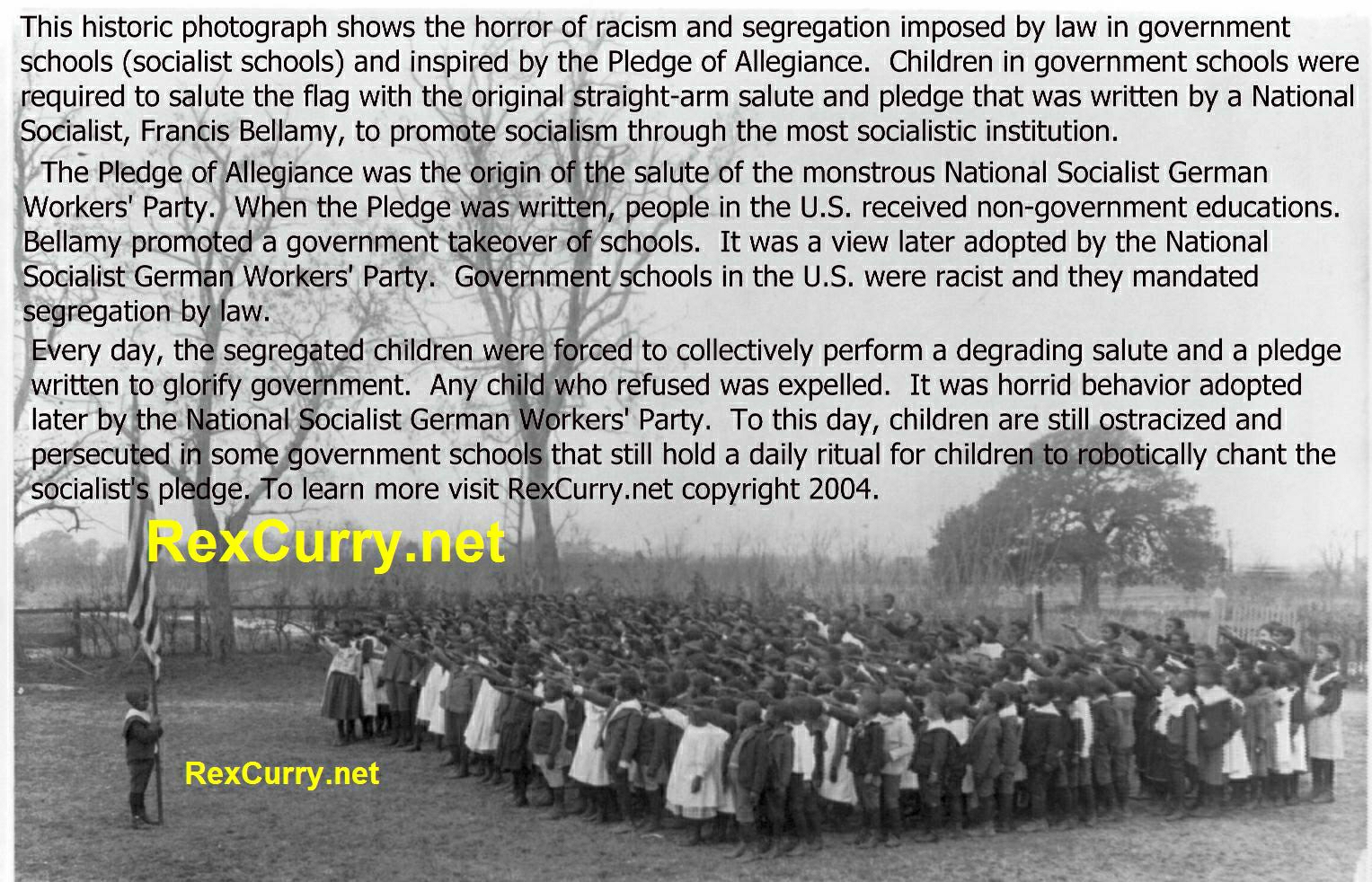
The stiff-armed salute of the National Socialist German
Workers' Party originated from a National Socialist in America
-Francis Bellamy- who wrote the Pledge of Allegiance in 1892, as
shown by the historian Dr. Rex Curry (author of "Pledge of
Allegiance Secrets"). http://rexcurry.net/pledgesalute.html
Francis
Bellamy was the cousin of Edward Bellamy. Edward was the head of the
Nationalism movement in America at that time, the inspiration for
Nationalist Clubs worldwide, and the founder of the Nationalist
Party. Edward was also the author of the national socialist fantasy
Looking Backward (1888), an international bestseller, and in
November, 1888, Edward personally made a contract with an interpreter
to translate his book into German (see the biography by Arthur
Morgan, p. 65).
In 1891, American advertisements listed
German-language editions of Bellamy's book and stated that the
socialist's novel "Lays the foundation of the Nationalist
Movement." http://rexcurry.net/bellamy-charles-edward1891.pdf
The adverstisements coincide with Edward Bellamy's "Nationalist"
magazine, published by the "Nationalist Educational
Association." http://rexcurry.net/nationalistmagazine.jpg
The German translation not only promoted National Socialism in
Germany, it also promoted National Socialism in America and
cultivated those Americans who later supported the USA's
German-American Bund movement that supported the National Socialist
German Workers' Party. It has been said that the Bellamys were
"more Nazi than the Nazis."
Bellamy's comments in
the Sprinfield Union newspaper show his glorification of
German folk life. According to the biographer Sylvia E. Bowman, "To
Bellamy, Americans had much to learn from the Germans who enjoyed
nature, had outdoor summer houses and beer gardens, and from all of
these, had found a placid contentment which contrasted to the hustle
and bustle of American life."
In 1935,
Columbia University requested three people (John Dewey, a
philosopher; Charles Beard, a historian; and Edward Weeks, the editor
of Atlantic Monthly) to list the ten most influential books of
the preceding 50 years (from 1885 to 1935). On all three lists,
prepared independently, Edward Bellamy's Looking Backward
appeared second on the list, the first being Karl Marx’s Das
Kapital. It is important to remember that during this time of
Bellamy's great influence, the National Socialist German Workers’
Party had been in existence since 1920, with electoral breakthroughs
in 1930, and dictatorship in 1933. Many writers have suggested
that Bellamy was viewed as an alternative to Marx, and that view
raised his influence among German National Socialists.
According
to Gail Collins, at that time "...far more American workers read
Looking Backward than ever made it through Marx..." Tomorrow
Never Knows, The Nation, Vol. 252, Issue # 2, January 21, 1991.
The book was "debated by all down to the bootblack on the
corner," reported Henry Demarest Lloyd in 1894.
The book,
Edward Bellamy Abroad, by Sylvia E. Bowman, is an amazing 543
pages of evidence that Edward Bellamy's scheme for an "industrial
army" (openly modeled after the military) was a bad influence
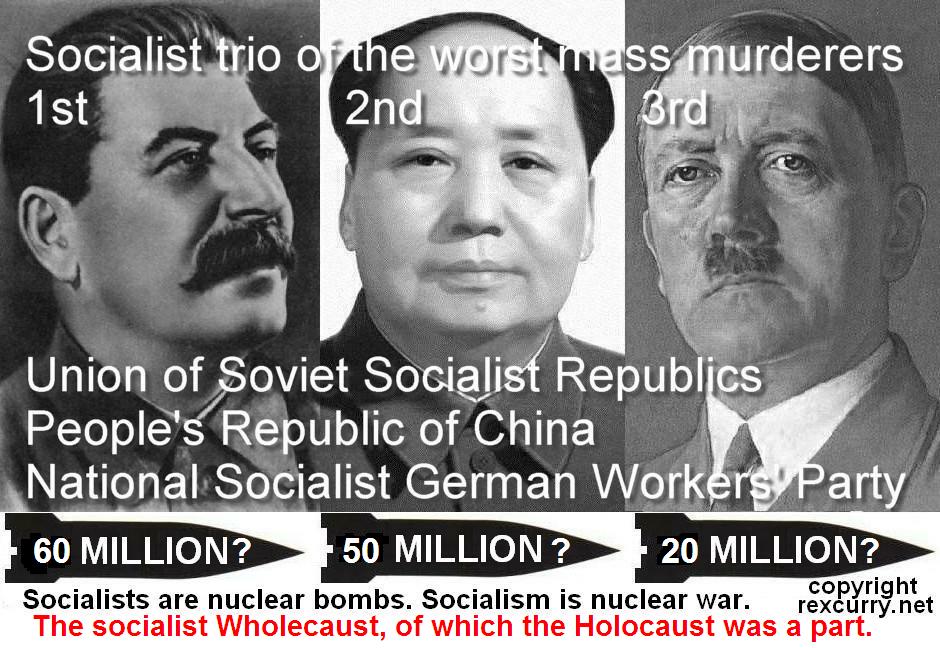
upon WWII and the socialist Wholecaust (of which the Holocaust was a
part): the National Socialist German Workers' Party (21 million
people slaughtered); the Union of Soviet Socialist Republics (62
million slaughtered); the People's Republic of China (35 million).
(Also see http://rexcurry.net/socialists.html
and http://rexcurry.net/socialists.jpg
) In Bowman's chapter on Germany alone, there are 54 pages,
with comments about the monstrous National Socialist German Workers'
Party, mentioning the similarities in Bellamy's philosophy.
Looking
Backward became an international bestseller, translated into every
major language, including German, and it inspired military socialism
worldwide. The book, described by socialists as the "Bible of
Nationalism," inspired the creation of 167 “Nationalist
Clubs” worldwide, including Germany. In the USA and in
Germany it inspired the "Nationalism" movement, the
"Nationalist" magazine, the "Nationalist Educational
Association," and the "Nationalist Party." Bellamy
nationalists focused on nationalism (“my country over others”),
a government takeover of schools, rabid patriotism (e.g. Pledges of
Allegiance in government schools with the original straight-arm
salute), and their interest in nationalization, or public ownership
and management of everything. The government takeover of
schools also led to segregation imposed by law and taught as official
policy, and it outlasted the National Socialist German Workers' Party
by decades.
Bellamy's influence was still going strong in
1938 with the publication of Bellamy's “Talks on Nationalism.”
President Franklin Delano Roosevelt imposed national socialism
and socialist slave numbers (social security) in 1935 as a "worker's"
program for Roosevelt’s vision of the industrial army that
coincided with similar numbering programs of the National Socialist
German Workers’ Party. During that time, children in the
government's segregated schools were required by law to salute the
flag with the straight-armed salute in military formation daily on
the ring of a government bell, like Pavlov’s lapdogs of the
state. Bellamy's "Talks on Nationalism" is a
terrifying look at the parallels between American National Socialists
and German National Socialists.
German National Socialism was
supported by American National Socialism via German-Americans who
joined the German American Bund movement (Deutsch-Amerikanischer
Volksbund) to support national socialists in Germany before WWII.
http://rexcurry.net/pledgebund.html
The Bund began as the Friends of New Germany in Chicago
in 1933. This group traced its roots to the Teutonia Society
and National Socialist Party, both active in the USA during
the 1920s. The phrase "National Socialist" was
added to the original name of the party (the German Workers' Party),
and the National Socialist German Workers' Party also partnered with
the "Nationalist Party" of Franz von Papen to take power.
In March of 1933 (03-05-1933), the National Socialist German
Workers Party received 44% of the total vote. Its 288 seats combined
with 52 Nationalist Party to give German National Socialists a bare
16-seat majority (Shirer, Rise and Fall, pp. 195-196). [The plurality
of the NSDAP in the 07/31/32 election had been 37%, making it the
largest party for the first time. However, the NSDAP lost two million
voters in the 11/05/32 election and had to partner with the
Nationalist Party to create a bare 16-seat majority]. It gave
the National Socialists and Nationalists a clear majority in the
Reichstag. The leader of the National Socialist German Workers'
Party became chancellor of Germanay via deal-making with the
Nationalist Party of Franz von Papen. One breakthrough
for the NSDAP came in 1929, when the Nationalist Party solicited
Hitler's help in its campaign against the a plan for German
reparations. Hitler had campaigned in the presidential
elections of 1932, losing to Paul von Hindenburg, but strengthening
his position by promising to support Chancellor Franz von Papen of
the Nationalist Party, who lifted the ban on the storm troops (June,
1932). Hindenburg, on the urging of von Papen, called Hitler to be
chancellor of a coalition cabinet and Hitler took office on January
30, 1933. In growing difficulties, Hindenburg eventually dismissed
the government and appointed a new one under the ex-military man
Franz von Papen of the Nationalist Party, which immediately called
for new Reichstag elections. In those elections of July 1932, the
National Socialist German Workers Party had their best showing
yet. From 1868 to 1869, Edward Bellamy spent a year in Germany,
learning to speak and write German and attending lectures and
studying German socialism. Edward Bellamy even wrote A Süd
Deutsch Volklied (South German Peoples' Song) in German on the
inside cover of his notebook (dated Jan. 4, 1878, see Arthur Morgan's
Edward Bellamy from Columbia University Press 1944).
Edward's
brother Frederick stated that Edward had talked and read about
socialism before Edward went to Germany. Frederick wrote that
Edward's letters to him from Germany were full of German socialism
which "he had read and studied much at home." (see Sylvia
E. Bowman's 1958 book The Year 2000).
While Bellamy
was in Germany, the first German unions were founded and the German
Workers' Party (Die Deutsche Arbeiterpartei) issued its program of
socialist cliches that Bellamy repeated in his bestseller (Looking
Backward) and his other writings for the rest of his life. (Die
Deutsche Arbeiterpartei : Ihre Prinzipien und ihr Programm. - Berlin
: Jonas, 1868. - 32 p. ; 23 cm; also see Karl Marx: Randglossen zum
Programm d. deutschen Arbeiterpartei (1875) (Criticism of the Gothaer
of program. Marginal notes for the program of the German Labour
Party) and "On the Jewish Question" written in 1843
(published Feb.1844) by the anti-semitic Karl Marx. See Friedrich
Engels: The Prussian military question and the German Labour Party
(Written at the end of January until 11 February 1865). And Friedrich
Engels: Bismarck and the German Labour Party (Written in the middle
of July 1881).
Hitler's party (the National Socialist German
Workers' Party or Nationalsozialistische Deutsche Arbeiterpartei or
NSDAP ) had originally been named the German Workers' Party and later
added the phrase "National Socialism" to the front of its
name. Hitler had suggested that his Party be named the "Social
Revolutionary Party." The ominous parallel of Bellamy ideas and
U.S. socialists can be seen in the 25 point program of the
NSDAP.
Edward later wrote in support of socialism, "It
was in the great cities of Europe and among the hovels of the
peasantry that my eyes were first fully opened to the extent and
consequences of 'man's inhumanity to man.'" But Edward
died in 1898, and did not witness the worst of man's inhumanity to
man in the socialist Wholecaust (of which the Holocaust was a part):
the National Socialist German Workers' Party (21 million); the Union
of Soviet Socialist Republics (62 million people slaughtered); the
People's Republic of China (35 million). The invasion of Poland
in WWII occurred in 1939, with the National Socialist German Workers’
Party and the Union of Soviet Socialist Republics as allies in their
scheme to divide up Europe. It was preceded by Hitler's 1936
invasion of the Rhineland and the Sudetenland.
By 1936,
National Socialism had grown so much in the USA that Fritz Kuhn, the
head of the German-American Bund, and a few of his followers, visited
Germany that same year in Berlin for the Summer
Olympics. There was much travel between Germany and
America. There was even travel by lighter-than-air crafts, and on May
6, 1937, while the Hindenburg was attempting to land at the Lakehurst
Naval Air Station in New Jersey, the entire airship was consumed by
fire.
In 1888, Bellamy Clubs (Nationalist Clubs) gained the
backing of the Theosophical Society and its leader, Madam Blavatsky.
Theosophists saw in the Nationalist Movement a practical means to
further their "ideal of universal brotherhood." (see
Arthur E. Morgan in his biography, Edward Bellamy, 1948,
pp. 260-75; see also The Key to Theosophy by H. P.
Blavatsky, pp. 44-5. -- K.V.M.]
http://rexcurry.net/theosophy-madame-blavatsky-theosophical-society.html
A
symbol for Madame Blavatsky and the Theosophical Society includes a
swastika or hakenkreuz
http://rexcurry.net/bellamy-blavatsky-brooch.gif
Blavatsky travelled extensively to Germany, India and
worldwide (The Esoteric World of Madame Blavatsky: Reminiscences
and Impressions by Those Who Knew Her by Daniel H. Caldwell:
Chapter 14, Germany and Return to India 1884-1885; Chapter 15, From
India to Italy and Germany, 1885; Chapter 16, Germany 1886).
After Bellamy's book Looking Backward, Blavatsky
continued to promote Theosophy and National Socialism in Germany and
worldwide.
Another mystical India-Germany promoter of National
Socialism was Savitri Devi. Known as the "Aryan Hindu
prophetess," she believed that Hitler was an avatar or god come
to earth. Born Maximiani Portas, she became a strong admirer of
Hitler in the 1920s, moved to India in 1932 because of its caste
segregation system, and took a Hindu name. Later, her writings were
republished, and she gained new fans in the 1970s as new interest in
National Socialism spread. Devi died in 1982, but the author boasted
that her combination of Hindu religion and Nordic racial ideology
became a bridge between National Socialism and the New Age movements.
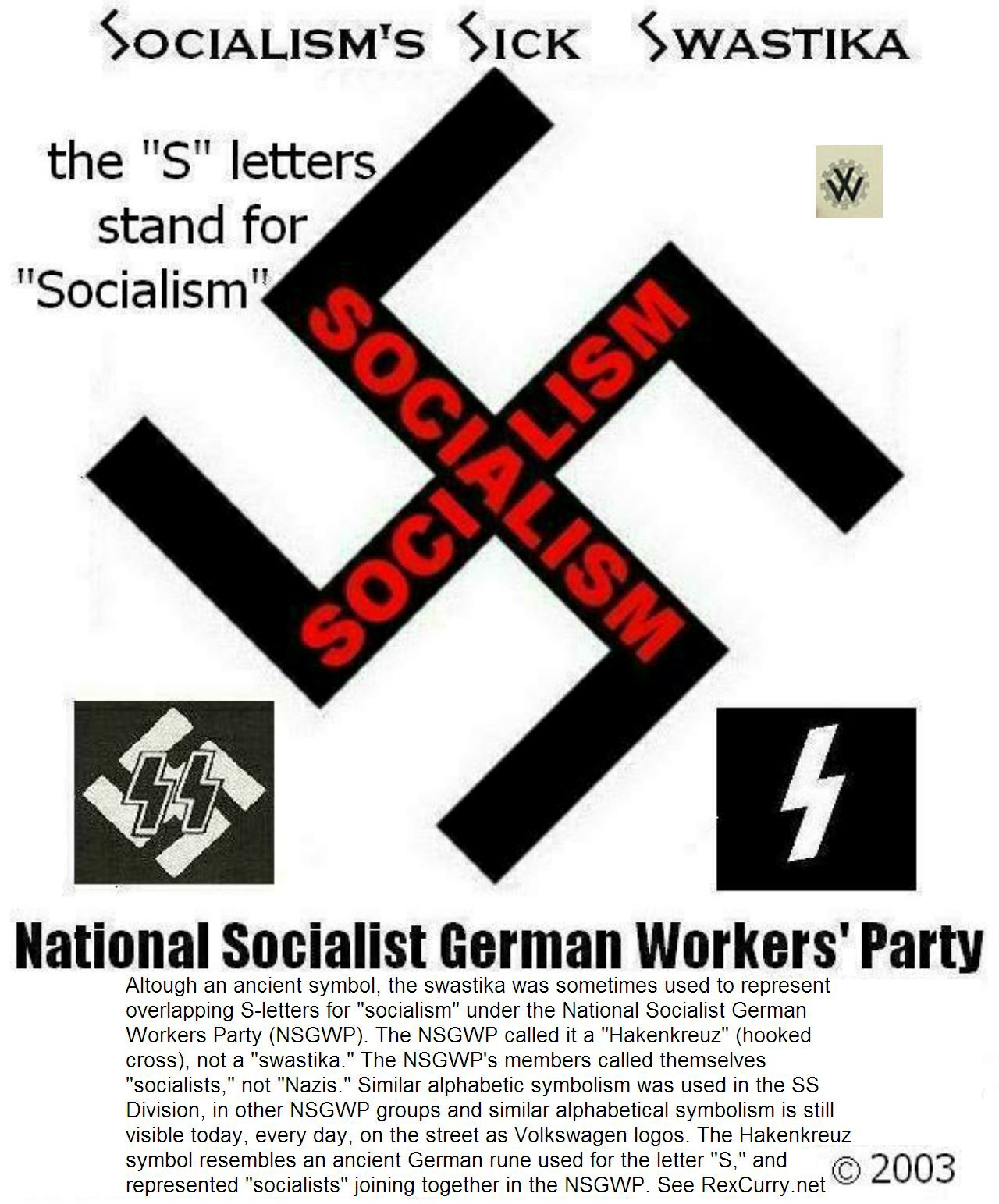
Although the swastika was an ancient symbol, Professor Curry
showed that it was also used sometimes by German National Socialists
to represent "S" letters for their "socialism."
Curry changed the way that people view the symbol of the horrid
National Socialist German Workers' Party. Hitler altered his own
signature to use the same stylized "S" letter for
"socialist" and similar alphabetic symbolism still shows on
Volkswagens. http://rexcurry.net/book1a1contents-swastika.html
John
Toland’s biography of Hitler (p 183) discusses the swastika and
makes reference to Hans Knirsch, founder of the National Socialist
Workers' Party in Czeckoslovakia also known as the Sudetendeutsche
National Sozialistische Partei or Sudeten-German National Socialist
Party. If the swastika was a symbol of the Sudetendeutsche
National Sozialistische Partei, then it provides an additional early
use of the swastika's two overlapping "S" letters: "Südeten
Socialism" or even "Süd Socialism" or
"Southern Socialism." The word "Sudeten"
came to mean "Southern" for many Germans, even though the
original etymology is unclear.
In 1897, the "American
swastika" appeared for the first time as the "equality
symbol" ( = ) repeated all over the cover of Edward Bellamy's
new book Equality, his sequel to Looking Backward.
http://rexcurry.net/bellamy-edward-equality-swastika.jpg
While the swastika/hakenkreuz was the symbol for German National
Socialists, the "equals sign" was the "swastika"
for American National Socialists. Bellamy wrote, "Nationalism is
not based on the maxim 'To each according to his needs, from each
according to his abilities.' Of course, as a matter of conscience,
every man is bound to do all he can, and the needs of others are
sacred claims upon his service; but both abilities and needs are
indeterminate, and therefore could not be made the basis of any
regulation to be enforced by society. The principle of Nationalism
is: From all equally; to all equally" (The Christian Union,
Nov. 13, 1890). The book Equality continues the story of
Julian West in Bellamy's totalitarian future of National Socialism.
In 1843, the anti-semitic Karl Marx wrote his notorious work
On the Jewish Question (published Feb.1844). In it, he
intended to libel Jewish folks when he said they were the
quintessential capitalists and worthy of total contempt.
Marxists and socialists had no interest in anyone they considered to
be “the weak,” only in the loyal, and their “language
of social justice” concerned a totalitarian plan for a new man,
or more accurately a soldier ant in an ant hill.
In Edward
Bellamy's own weekly publication, The New Nation, in which
Bellamy touted his National Socialism, Bellamy would sell his weekly
combined with Karl Marx's Capital as a package deal.
http://rexcurry.net/edward-bellamy-karl-marx.jpg
Note that the version of Capital offered in Bellamy's
New Nation is the translation by Dr. Edward Aveling (mentioned
below).
The Manifesto of the Communist Party had been
written (1848) in German by the Germans Karl Marx and Friedrich
Engels as the Communist League's programme on the instruction of its
Second Congress (London, November 29-December 8, 1847). The
first English translation, made by Helen Macfarlane, was published
between June and November 1850, in the Chartist journal The Red
Republican. Its editor, Julian Harney, named the authors for the
first time in the introduction to this publication. All earlier and
many subsequent editions of the Manifesto were anonymous. Its
advocates sought the overthrow of the existing economic and social
institutions and control by "the people" of all production,
distribution and industry. They sought also to abolish all
idleness and all private property except incomes and minor personal
possessions.
Socialism grew in America and, according
to Sylvia E. Bowan, "Aside from the New York German Communist
Club (1857), the first large, organized society to propagate the idea
of socialism was the German Gymnastic Union, or Turnverein, which by
1850 was organized on a national basis. The platform adopted in
Philadelphia in 1850 'proclaimed the promotion of socialism and the
support of the socialistic democratic party to be its chief purpose.'
" (see Sylvia E. Bowman's 1958 book The Year 2000).
(Also see the German American Bund movement referenced above
and at http://rexcurry.net/pledgeapology.html
).
The film "Triumph of the Will" (1934),
directed by Leni Riefenstahl, shows the National Socialist German
Workers' Party parading its industrial army. In keeping with their
socialist dogma, Hitler is praised as an "epitome of altruism"
and the speakers refer to each other as "comrades" who will
cause a "revolution of the people and workers" to end
"class struggle" and create "egalitarianism."
http://rexcurry.net/filmrev-triumph-of-the-will.html
Karl
Marx's book Das Kapital had been published in 1867, the year
before Bellamy's trip to Germany. Although it was not
translated into English until after 1886, his ideas had been promoted
in newspapers and pamphlets. Edward Bellamy learned how to
speak and write in German during his stay in Germany. While
Bellamy was in Germany, Marx fought with Bakunin and Proudhon in the
First International about their fundamentals of "social
revolution." Bebel and Liebknecht took part in the
debates, also.
In 1886, Dr. Edward Aveling and his wife
Eleanor -the daughter of Karl Marx- wrote that when they toured the
U.S. and preached the gospel of socialism as far westward as Kansas,
they were surprised by the prevalence of what they termed
"unconscious socialism" and that the "American people
... were waiting to hear in their own language what socialism is."
Later, Looking Backward was popular among the elite in
pre-revolutionary Russia, and Lenin’s wife was known to have
read the book, because she wrote a review of it.
In
1891, advertisements listed German-language editions of Edward
Bellamy's Looking Backward and stated "Lays the
foundation of the Nationalist Movement."
http://rexcurry.net/bellamy-charles-edward1891.pdf
Bellamy
exemplified the amateurism and irrationalism of National Socialism.
It is similar to the experience of Peter Drucker in a meeting of
farmers. A member of the National Socialist German Workers’
Party had shouted to the cheering crowd: "We don't want lower
bread prices, we don't want higher bread prices, we don't want
unchanged bread prices - we want National-Socialist bread
prices."
In 1867, Bellamy became a bitter military
failure due to his inability to pass the physical exam at West
Point. Still, he loved Prussian militarism and the educational
system.
Bellamy's 1868-1869 stay in Germany (including
Dresden) occurred shortly after the war between Prussia and Austria.
Saxony, of which Dresden was the capital, had sided with Austria, had
been conquered by Prussia, and then had joined the North German
Federation. That would interest all who loathe the monstrous
National Socialist German Workers’ Party, because Prussia led
to the formation of the German empire, and after World War I, Prussia
continued to exist as the largest Land (state) within the Weimar
Republic and under the National Socialist German Workers’
Party. After World War II it was dissolved by decree of the
Allied Control Council in 1947.
At the time this was written,
the Theosophical Society of America (TSA) continued to maintain its
Springfield Branch office at the Edward Bellamy House, 93 Church
Street, Chicopee, MA and also its library. Recent lectures included
"Discovering the Secrets in the Akashic Records" and
"Alchemical Art Therapy" and "Gnosis: An Ancient Path
of Illumination."
**************************** About
Edward Bellamy's time in Germany, the author Sylvia E. Bowman states
"Though his story 'Lost' and some unfinished stories are based
upon this European sojourn, very little was recorded by Bellamy or
others about this period of his life."
As a libertarian
lawyer, Dr. Curry provides pro bono services nationwide to educate
the public about the news-making historical discoveries.
1.
Dr. Curry showed that the USA's first Pledge of Allegiance used a
straight-arm salute and it was the origin of the salute of the
monstrous National Socialist German Workers' Party (Nazis). Professor
Curry helped to establish that it was not an ancient Roman salute,
and that the "ancient Roman salute" is a myth.
http://rexcurry.net/pledgesalute.html
3.
Francis Bellamy (author of the "Pledge of Allegiance") and
Edward Bellamy (author of the novel "Looking Backward") and
Charles Bellamy (author of "A Moment of Madness") were
socialists. Edward and Charles were brothers, and Francis was
their cousin. Francis and Edward were both self-proclaimed National
Socialists and they supported the "Nationalism" movement in
the USA, the "Nationalist" magazine, the "Nationalist
Educational Association," and their dogma of "military
socialism," and Edward inspired the "Nationalist Party"
(in the USA) and their dogma influenced socialists in Germany, and
the Pledge was the origin of the Nazi salute. "Nazi" means
"National Socialist German Workers' Party." A mnemonic
device is the swastika. Although the swastika was an ancient symbol,
Professor Curry discovered that it was also used sometimes by German
National Socialists to represent "S" letters for their
"socialism." Curry changed the way that people view
the symbol of the horrid National Socialist German Workers' Party.
Hitler altered his own signature to use the same stylized "S"
letter for "socialist" and similar alphabetic symbolism
still shows on Volkswagens.
http://rexcurry.net/book1a1contents-swastika.html
Dr.
Curry showed that many modern myths about swastikas are based on the
false belief that Nazis called their symbol a "swastika."
German National Socialists did not use the word "swastika,"
but called their symbol a "Hakenkreuz."
Professor Curry showed that many modern myths rely on a false belief
that Nazis called themselves "Nazis" or used some other
term (Party members referred to themselves as "National
Socialists" and did not use the term "Nazis").
In summation, there are many ways in which Hitler and his national
socialists were familiar with American national socialists and
American practices (including America's nazi salute from the Pledge
of Allegiance and its persecution of people who refused the
mechanical brainwashing), here are a few ways:
American socialist eugenicists, as explained by various
authors including Edwin Black. Hitler personally communicated with
and lauded American socialist eugenicists.
The automaker Henry Ford and his book “The
International Jew” and his Dearborn, Michigan newspaper. James
D. Mooney, vice-president of overseas operations for General Motors,
also received a medal from Hitler, the Merit Cross of the German
Eagle, First Class.
Edward Bellamy and Francis Bellamy via the international
bestseller “Looking Backward” (translated into German)
and the book “Equality” and via other print and film
sources, and via “Nationalist Clubs” or “Nationalism
Clubs” and various Nationalist publications that promoted the
Bellamy dogma in and around Germany. They were both Freemasons and
they spread their dogma and the salute/pledge of allegiance
internationally via that organization and others (e.g. Boy Scouts),
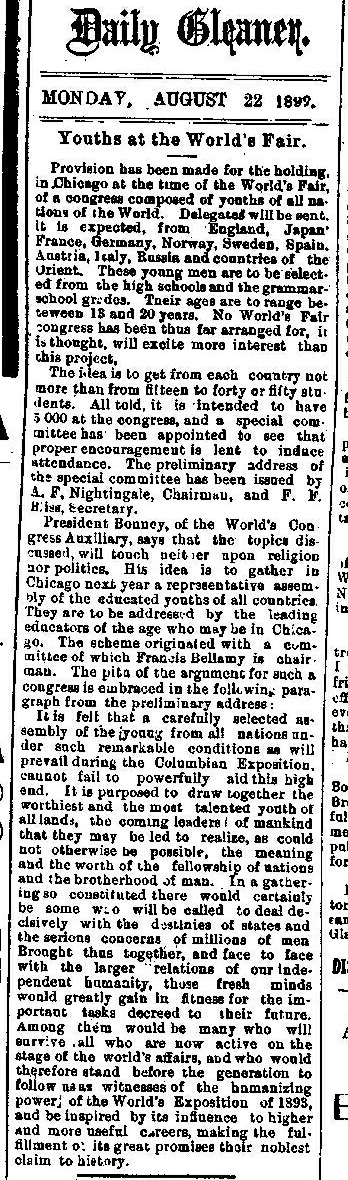
and a Youth's Congress. Francis wrote the pledge with the intent
that it be used by other nations. See the book Edward Bellamy
Abroad, by Sylvia E. Bowman, with an amazing 543 pages, and an
entire chapter about Bellamy's influence in Germany.
http://rexcurry.net/francis-bellamy-daily-gleaner-kingston-jamaica.jpg
The early silent movie "The Vanishing American" (by
George B. Seitz) based on the Zane Grey novel that shows the
American stiff-armed salute taught to native Americans in a
government school. And other American movies.
American books and writers. See “Hitler’s Private
Library: The Books That Shaped His Life” by Timothy W. Ryback,
including the book by American eugenicist Madison Grant titled “The
Passing of the Great Race.” Karl May, the German author who
was one of Hitler's favorite authors and whose books were set in the
USA as cowboy and Indian westerns.
Ernst Hanfstaengl, an American and a Harvard grad and an
intimate friend of Hitler known as “Putzi” and “Hitler's
piano player” and who advised Hitler on how to lead a crowd
into adulation and loyalty (e.g. as was -and is- done with the
Pledge of Allegiance and its early Nazi salute).
Via the Olympics, including the 1924 Olympics which displays
the stiff-armed salute that the Olympics adopted from the USA's
Pledge of Allegiance.
News reports and court cases concerning pledge persecution
that reached its nadir at the U.S. Supreme Court in 1940 in
Minersville School District v. Gobitis when the Court upheld
government persecution of children in government schools (socialist
schools) if they refused the daily robotic brainwashing.