The USA's Civilian Conservation Corps (CCC) was military socialism inspired
by Francis Bellamy (the author of the "Pledge of Allegiance") and his cohort
Edward Bellamy (author of the book "Looking Backward"). The Bellamys
idolized the military and wanted all of society to ape the military.
It was an American dogma that led to conscription, drafts, inquisitions,
involuntary servitude, slavery, and Holocausts.
The same socialist schemes spread under the Union of Soviet Socialist
Republics, the People's Republic of China, and the National Socialist German
Workers' Party. There, the schemes contributed to massive poverty and millions
of deaths. In the USA, the schemes extended the Great Depression, enlarged
domestic poverty, and led the country into WWII and large loss of life.
The CCC in the USA used scenes of the homeland, and men with shovels and
other hand tools. The CCCP (Union of Soviet Socialist Republics) used
the hammer and sickle to glorify harsh manual labor dictated by its socialist
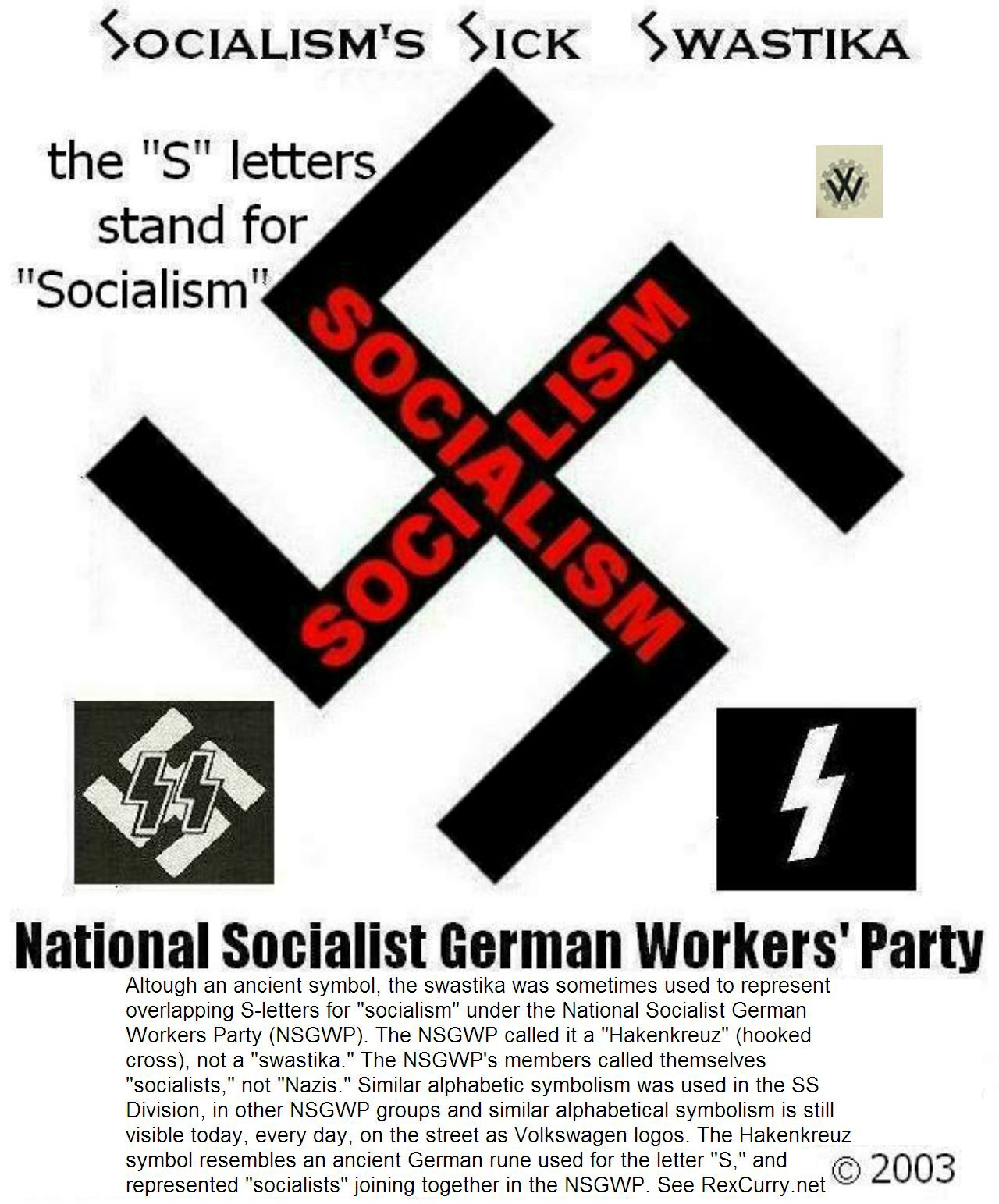
government. The Reich Labor Service (Reicharbeitdienst or "RAD" or
State Labor Service) under the National Socialist German Workers' Party used
a shovel with two shafts of wheat.
In 1933, Franklin Delano Roosevelt said "I propose to create a Civilian
Conservation Corps to be used in simple work… more important, however, than
the material gains will be the moral and spiritual value of such work."
The same sentiment is expressed by the Adolf Hitler in the 1934 film “Triumph
of the Will.”
But which socialists inspired the other? It was probably mutual.
The RAD under Germany's Socialist Party was formed in July of 1934, though
similar organizations had existed in Germany for many years prior to 1934.
Long before the NSDAP gained power, the Union of Soviet Socialist
Republics ran "work camps" and "concentration camps" and Hitler and Roosevelt
were starkly aware of the USSR's monstrous behavior.
A 1973 article in the American Historical Review by Professor John A. Garraty states “during the first years of the New Deal
the German press praised him [Roosevelt] and the New Deal to the skies....
Early New Deal policies seemed to the Nazis essentially like their own and
the role of Roosevelt not very different from the Führer’s.”
In June 1933, Reichsbank President Hjalmar
Schacht was quoted in the Völkischer Beobachter, the official
paper of the National Socialists, that the American leader had adopted the
economic philosophy of Hitler and Mussolini. Hitler also at first remarked
admiringly about Roosevelt’s “dynamic” leadership, stating that “I have
sympathy with President Roosevelt because he marches straight to his objective
over Congress, over lobbies, over stubborn bureaucracies.”
FDR's shovel brigade was known as the "Roosevelt Tree Army" or the "Roosevelt
Shovel Army." In the Nazi film "Triumph" it is impossible to forget
(once it is heard) the phrase "Present Shovels!" barked to the industrial
army of the shovel brigade, each carrying his G.I. spade as though it were
a gun. The only thing missing at that point of hilarity is a choreographed
dance routine with the ditch-diggers. It is reminiscent of the skit "Leaning
on a shovel" in the production of "Sing for Your Supper" (under the New
York City Federal Theatre Project, photograph in the records of the Work
Projects Administration (WPA) May 1939 in the National Archives 69-TS-737-923-106).
The glorious comrades in the USA, the USSR and in Germany, needed their
"weapons" to shovel all the socialist manure that was piling up under their
governments. It is unfortunate that the shovel army was later used to bury
the victims of the incredibly deadly dogma.
It is ironic that the first "C" in the CCC refers to the "Civilian" Conservation
Corps because the program was actually run by the Army. CCC enrollees
were organized and transported by the War Department. Usually, they were
shipped far from home to the socialist labor camps. Delbert Apetz
joined the CCC in York and was sent to Pawnee City, Nebraska, for his induction
and training. Most enlistees began with a five-day boot camp at a military
base where they got physical training and orientation. Discipline at most
camps was military too, with marching, formations, KP duty and "lights out"
orders at night. Photographs show that officers at the camps wore military
uniforms and used military titles.
CCC enrollees were housed in military style barracks in the USA. The
film "Triumph of the Will" also shows thousands of tents lined up in hundreds
of rows, as seen from the air over Germany.
Roosevelt and Hilter used the same excuses: The work camps were used
to "supply labor for various civic and agricultural construction duties
and to generally help relieve the strain of high unemployment." Such
scams are socialist plans to keep young men out of the labor market, and
that is one reason they gain support from unions. They also provided
preparation for military service that followed. It is the welfare-warfare
of the military-socialist complex.
As with any military camp, the CCC camps had flags on central flag poles
and flag ritualism. Photographs suggest that CCC soldiers used the
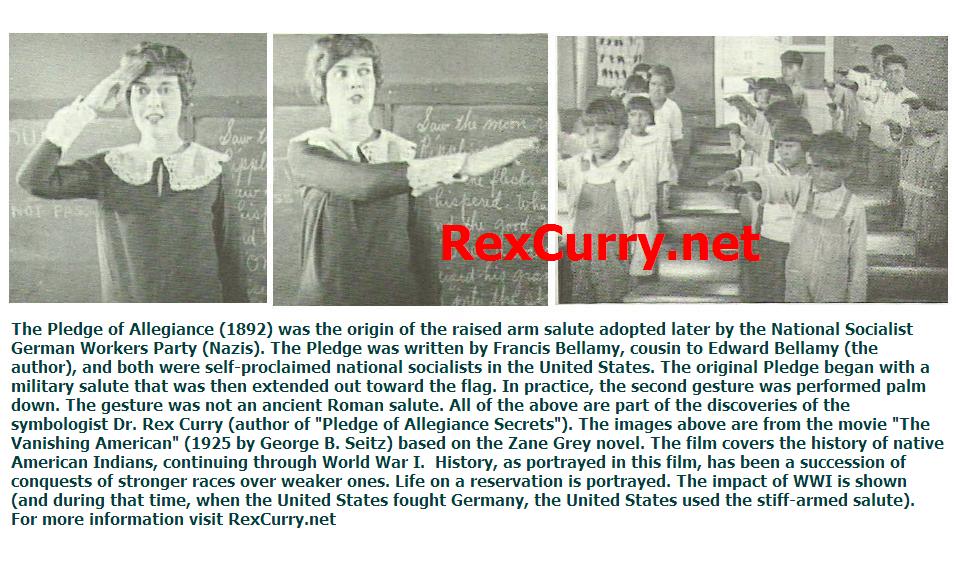
military salute. However, the original pledge of allegiance began with a
military salute that was then extended outward toward the flag into the Nazi
salute. Francis Bellamy wrote the pledge to inspire an "industrial army"
that would impose "military socialism" on all of society via a government
takeover of schools. The USA's original pledge of allegiance was the
source of the Nazi salute, as exposed by the historian Rex Curry in the book
"The Pledge of Allegiance and the Bellamys" at http://rexcurry.net/book1a1contents-pledge.html
The military salute became the Nazi salute. FDR pledged allegiance
with the Nazi salute and he was sometimes saluted in that way by civilians.
see the photograph at http://rexcurry.net/bookpic-nazi-salute-fdr.JPG
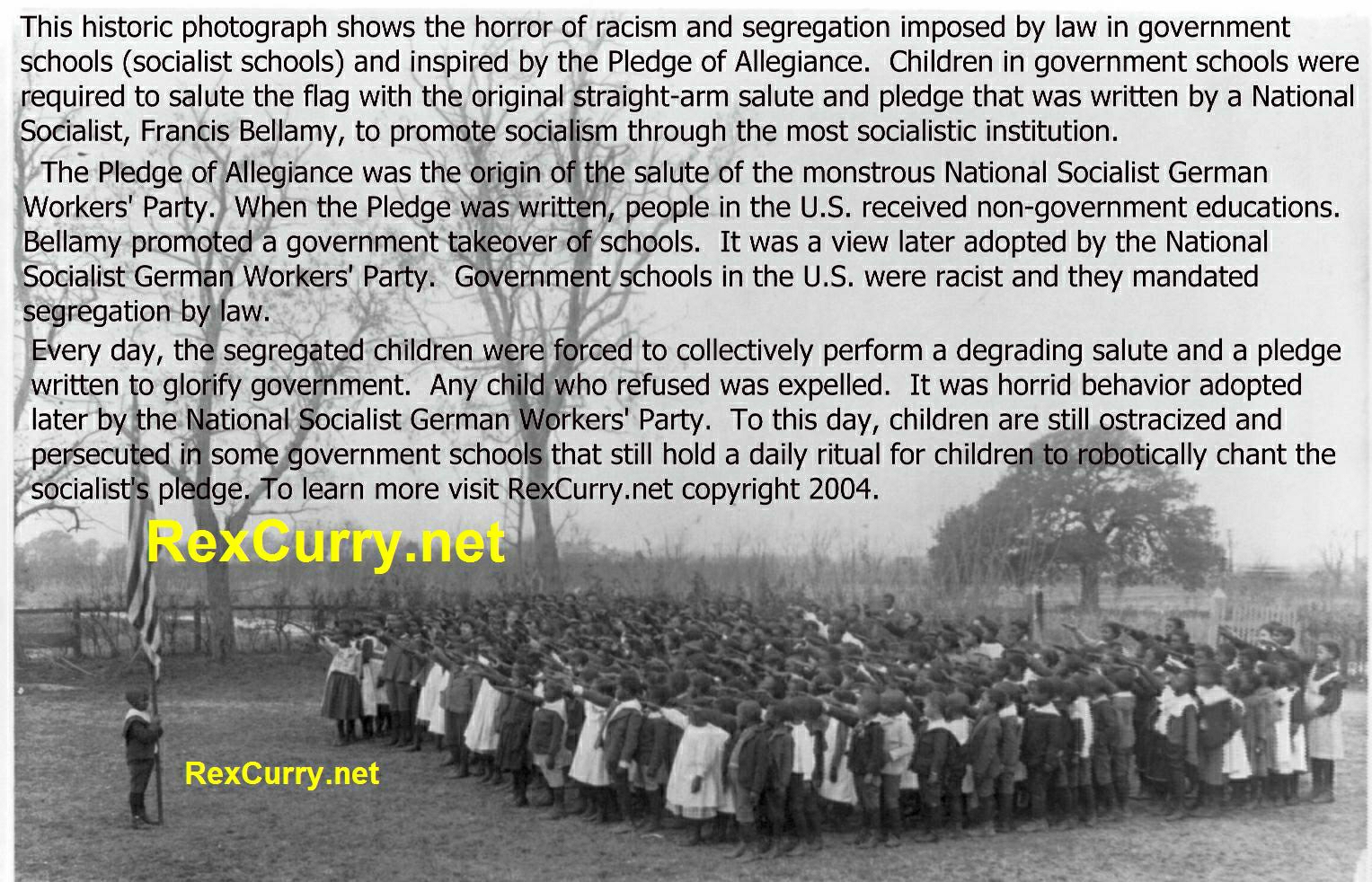
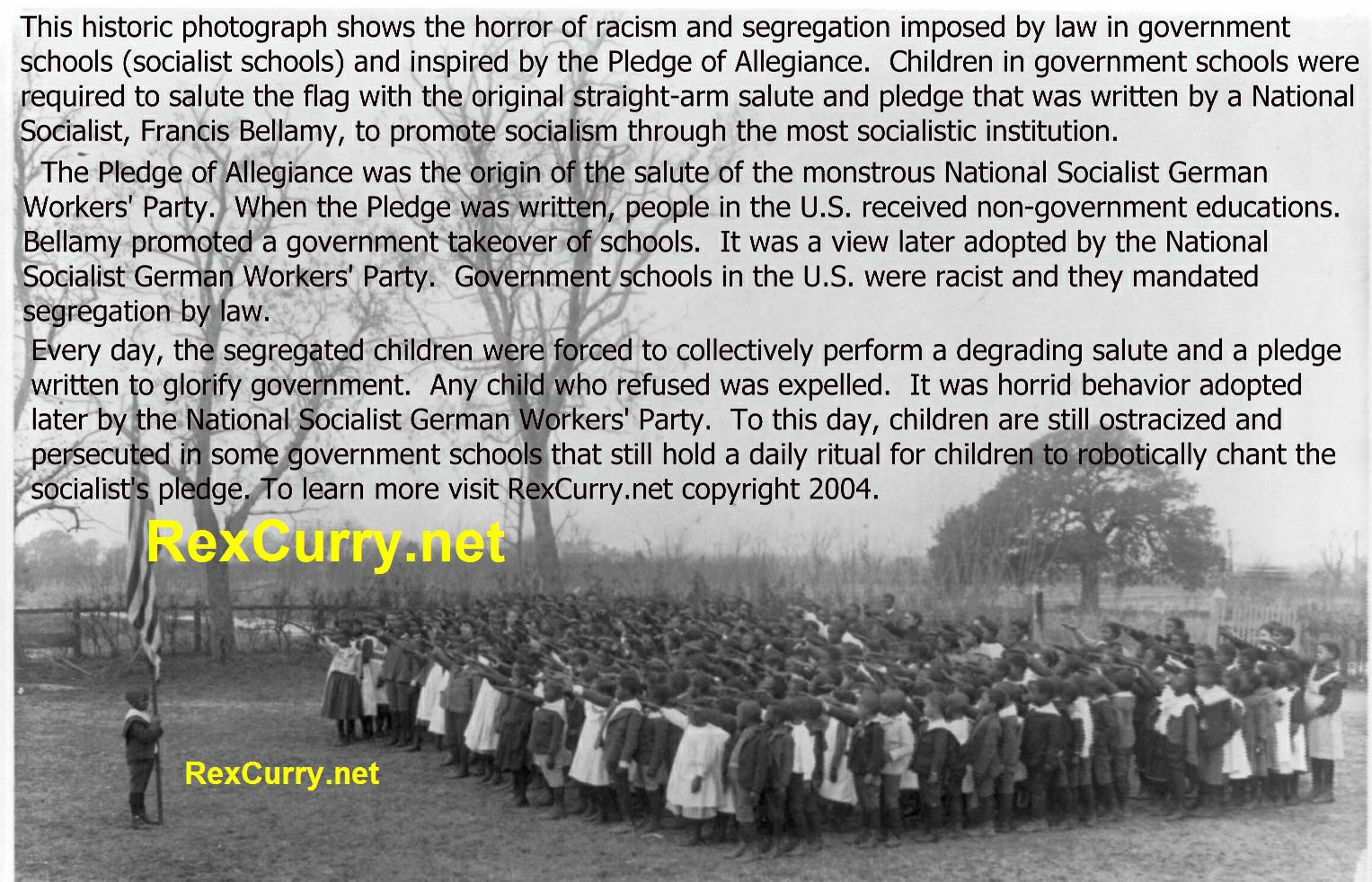
The government's takeover of schools imposed segregation by law and taught
racism as official policy, and compelled by law a daily pledge with the Nazi
salute. The CCC enabled the government to expand socialism's segregation
and racism at the very same time that similar policies were being followed
by the National Socialist German Workers' Party.
Segregated CCC camps occurred despite the fact that the CCC law contained
a clause outlawing discrimination based on race. The CCC bureaucrat, Robert
Fechner, justified the practice by stating, "segregation is not discrimination."
On top of that, Black membership in the CCC was limited to 10 percent
of the overall membership. There were 250,000 African Americans who enrolled
in the CCC.
Native Americans were also included in the CCC. There were 80,000 Native
Americans in the CCC and they followed orders on labor camps on some of
the socialized land that the government had taken from them through treaty
or war.
Much CCC work was labor performed for the government's socialized land.
FDR had campaigned on a platform of cutting taxes, cutting spending,
and cutting government. In other words, he would stop the massive socialism
started by the republican-socialist Hoover and the make-work projects (i.e.
Hoover Dam). FDR was a liar and did the complete opposite right after
election.
FDR gave feverish thought to socialist projects during the months prior
to his inauguration, and he presented the concept of a "Civilian Conservation
Corps" to his staff only hours after his oath of office. As proposed by
FDR, the "CCC" would be an "army" of young men directed by the government.
The CCC was one of the first socialist programs created by FDR during
the first hundred days of his old socialist deal (the New Deal). It
is frightening how fast FDR imposed the program and brought in the military.
FDR took office on March 4, 1933 and immediately called Congress into
special session. The CCC bill was introduced in both houses on March 27 and
the bill passed both houses on March 31, four days later. FDR signed it,
appointed an administrator and brought in the military. The first enrollee
was inducted April 7, 1933, just 37 days after FDR's inauguration.
Days after FDR's first announcement of the CCC, a selection of officials
from various bureaucracies heard Rex Tugwell explain the newest layer of
bureaucracy. To the several bureaucracies who would administer field work,
the CCC represented an opportunity for massive growth.
The National Park Service (NPS), in particular, was quick to seize that
opportunity. During the Hoover Administration the National Park Service (NPS)
had succeeded not only in preserving itself in the face of considerable
pressure to reduce the size of government, but it had actually grown in number
of areas, staffing, and funding. The NPS and the CCC share blame as
two of many reasons why so much land in the USA is socialized, with the government
as the owner.
One of Roosevelt's excuses for the socialist program was to help safeguard
the environment. Often, the dictated labor was called "soil conservation
projects" which sounds better than saying that the government ordered Americans
to shovel dirt and dig ditches. The reality was that FDR directed more
than three million young adults to build roads and trails and structures
in wilderness, to dam rivers, fell trees, string telephone lines, and drain
swamps.
Those drained swamps are the same ones that the government now steals
billions in taxes to “restore” due to the damage that the government's socialism
taxed everyone for in the past. One estimate is that 248,000 acres of swamp
was drained.
Those roads are the same roads that the government used to destroy private
mass transit (railroads) and now steals billions in taxes to promote new
mass transit that is owned by the government, while blaming you for using
the roads that it taxed you to build. One estimate is that 125,000
miles of roads were built.
Although the CCC was created quickly, many people were still opposed
to the scheme. On Dec. 26, 1941, Senator Robert Taft, a Republican, warned
the nation that the Roosevelt Administration would try to control the American
economy and society. Taft believed that within six months Congress could
abolish the CCC.
On the other hand, some politicians wanted to export FDR's socialism
overseas. But despite suggestions by Secretary of State Henry L. Stimson,
Roosevelt's long-time political rival, Roosevelt refused to expand parts
of the New Deal to Germany after World War II. There was much anti-German
sentiment within America because of Germany's role in WWII.
"I see no reason for starting a WPA, PWA, or a CCC for Germany when we
go in with our Army of Occupation," Roosevelt said. It had already
been tried there with even more disastrous results. The only reason that
the effects were not even worse in the USA is because it was already so wealthy,
capitalistic, individualisitc and because of the Second Amendment's right
to keep and bear arms and the widespread possession of firearms by individuals
in the USA.
During the lifetime of the CCC from 1933-1942, FDR imposed even more
national socialism on the workers in the U.S., including socialist slave
numbers (social security) in 1935 at the height of Nazi power. It
was touted as another worker's program for Roosevelt’s vision of the industrial
army that coincided with similar numbering programs of the National Socialist
German Workers’ Party.
By 1942 when it was disbanded, the CCC had diverted almost 3.5 million
men from productive work in a free market economy. In the process they
developed a vivid sense of depedency, and that they were being controlled
by the government.
FDR also caused unemployment with labor laws, social security laws, and
minimum wage laws (25 cents in October 1938) which all exacerbated the depression.
His extension of the depression was another reason for FDR to go into
war.
The CCC existed for over nine years until June 30, 1942, at which time
it was absorbed into America's Armed Forces. Roosevelt moved industry toward
war production and began enormous deficit spending.
The Reichsarbeitdienst was disbanded with the collapse of the Third Reich
on May 8th, 1945.
After World War II, Lewis Mumford (1951) argued for a “public work corps”
that would involve all American youth. It is fortunate that the corps did
not take shape, and that only a marginal number of such cockamamie schemes
exist today.
*************************
Constructed by the Civilian Conservation Corps in 1936, Hillsborough
River State Park is one of the oldest state parks in Florida.
Highlands Hammock State Park, Sebring FL., was a CCC project and now
has a statue that was dedicated August 2, 1997. It was the fourth CCC worker
statue and was donated by Henry Billitz in honor of his brother, Emil Billitz
who suffered complete paralysis as the result of a truck accident while serving
in the CCC. Through hard work and therapy he regained the use of his upper
body. The statue is also dedicated to the 2,876 men who lost their lives
while working for the CCC between 1933 and 1942.
The Bellamy dogma of military socialism and the Bellamy salute spread all
over the world.
Croatia (Nesavizna Drzava Hrvatska): The 1943 semipostal set aiding the Croatian State
Labor Service. Founded in 1941, the "Drzavna Radna Sluzba" (DRS) was modelled
on the German RAD. All physically fit males between 19 and 25 were obliged
to serve in the DRS for 12 months, prior to a call-up for service in the
armed forces.
The stamps depict: Labor Corps men marching;
digging; receiving instruction; being reviewed by Ante Pavelic