|
|
CHARLIE CRIST WANTS TO CRUCIFY US !
Socialists in Florida's government ask
snitches to tattle on "price gougers" over a toll-free hotline. True
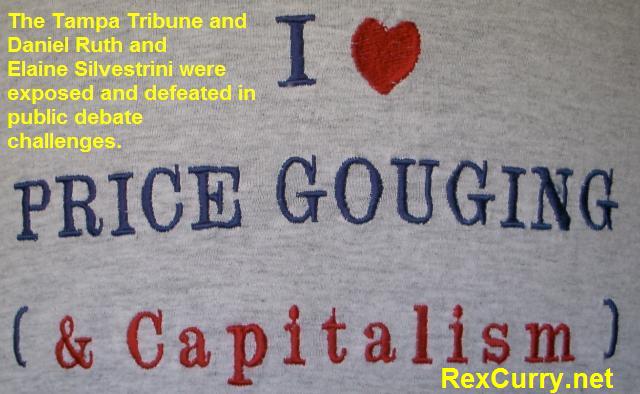
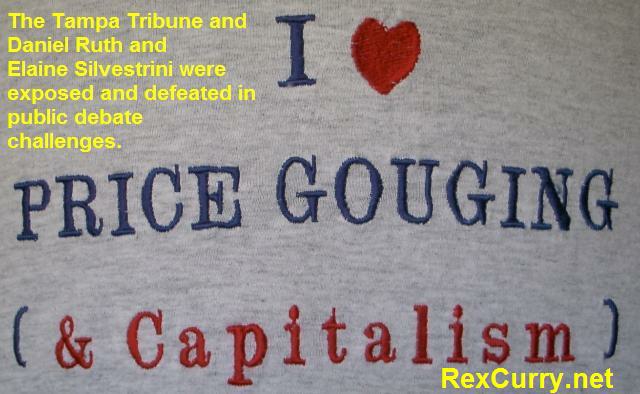
price gouging is what the socialists in Florida's government do 24/7
with their taxes, spending, debt and police-state behavior. Because
of "price gouging" laws, Florida's socialists kill people and cause
widespread shortages and suffering. It is the same deadly dogma as under
the "Office of Price Administration" under the tyrant Roosevelt. When Charlie Crist was Florida's Attorney General,
he and Consumer Services Commissioner Charles
Bronson dueled for their media cheerleaders to see who was
the biggest ignoramus and scam-artist on the topic. They were both hardcore
republican-socialists and
proved that the party is a lost cause for liberty, and that government
schools must end, pronto. Did someone just say that they are "a lost
cause for liberty"? They are aggressive
EVIL against liberty. The Republican Administration outsocialized
the Clinton Administration by double (in social spending alone) and that
is not a defense of the Clinton Administration. At that time Crist wanted
to be the next of Florida's republican-socialist governors (and he then
succeeded in attaining that goal). Thank goodness that captalism provides
so many ways to defeat them and their incredibly deadly dogma. Due to
government schools (socialist schools), the media are too ignorant to criticize
laws against price gouging and merely spew government propaganda from the
scripts. Violations can net $10,000 fines each, and that is socialism's
true price gouging and the real scam. Thus, beneficent price-increases
(slandered as "price gouging") are banned so that socialists can commit
true price-gouging and harm everyone by giving government more money for
more violence. Rumor has it that the telephone hotline receives complaints
against "price gouging" laws and complaints against the true price gouging
scam: Taxes, fines, and the police state imposed by local socialists. The
turds answering the phone hotline are as confused as scammers Crist and Bronson because they attended
the same government schools. 1-866-9-NO-SCAM (1-866-966-7226) . P.S.
Government schools (with their outrageous cost paid for by extorted taxation)
are another example of a price gouging scam by socialists.
Government Schools keep Americans ignorant about economics
and price gouging.
The need to hoard rises when government bans price
gouging.
Laws that ban price gouging are laws that
kill people.
**************
I had planned on making a killing this week. Lease an
18-wheeler. Load up on gallons of gasoline, a gross of generators and enough
bottled water to satisfy a dipsomaniac crawling in the
But before I could clean out Sam's Club,
Charlie Crist, the
http://www.pittsburghlive.com/x/tribune-review/opinion/columnists/vassilaros/s_249644.html
The only thing worse than Katrina's devastating destruction
is government's horrific "help." http://www.lewrockwell.com/akers/akers16.html
So-called "price gouging" in emergencies is also defended
by Walter Williams HERE: http://www.capmag.com/article.asp?ID=3578
http://www.townhall.com/columnists/walterwilliams/ww20040324.shtml
Frank Bubb HERE: http://www.objectivistcenter.org/text/fbubb_hurricane-gouging.asp?mc
and by Sheldon Richman HERE: http://www.fee.org/vnews.php?nid=6181
Economics textbook chapters on price controls are excerpted
here: http://FreedomKeys.com/pricecontrols.htm