China's government announced that it will stop pegging its currency
to the dollar. The announcement accompanied a new proposal to update
the appearance of the paper currency. In the past, China's money boasted
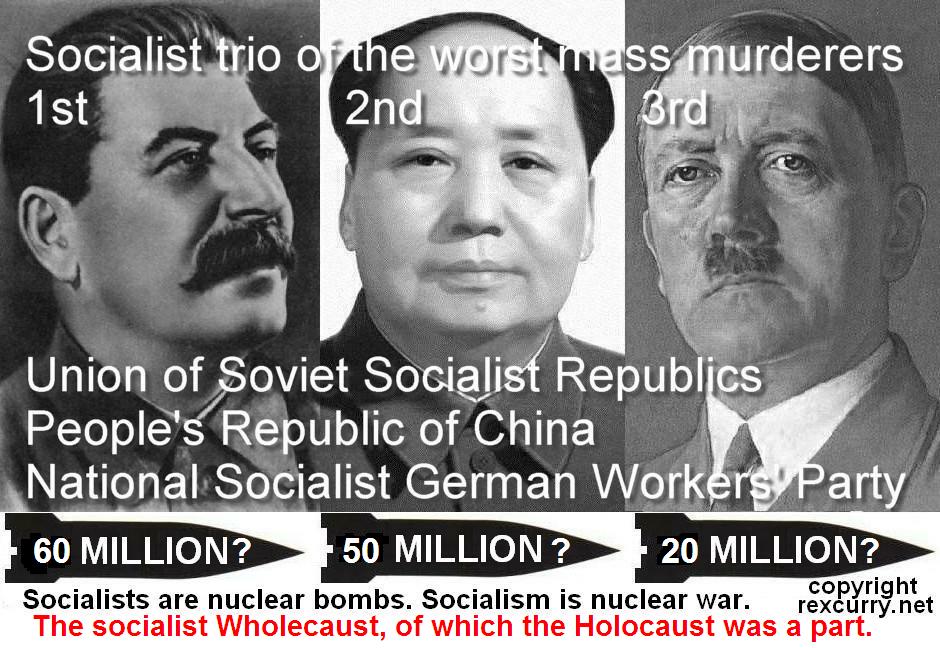
a portrait of only one of the world's worst mass murderers in all of history.
And the people he murdered were mainly his own Chinese people. The
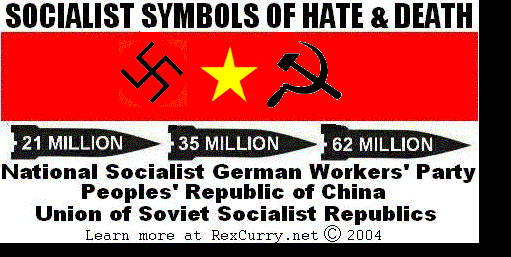
new proposal includes the trio of socialist atrocities responsible for the
Wholecaust (of which the Holocaust was a part): 62 million dead under the
former Union of Soviet Socialist Republics; 35 million dead under the Peoples'
Republic of China; 21 million dead under the National Socilaist German Workers'
Party. The slaughter was so bad that Holocaust Museums could quadruple
in number, size and scope with Wholecaust Museums. It is embarassing to note
that China has bought a lot of the debt of the government in the United Socialist
States of America, thereby subsidizing the massive socialism in the USSA
and its growing police state. The USSA's debt is enormous in part
because Republican-socialists are outsocializing Clinton by more than double
(in social spending alone).
************************
CHRISTIAN SOCIALISM IN CHINA KILLED MILLIONS AND INFLUENCED THE KILLER
MAO ?
The Taiping Rebellion was a large-scale revolt conducted from 1850 to 1864
by an army led by heterodox Christian convert Hong Xiuquan. He established
the Taiping Heavenly Kingdom (traditional Chinese: 太平天國; simplified Chinese:
太平天国; pinyin: Tàipíng Tiān Guó), namely Heavenly Kingdom
of Great Peace with capital Nanjing and gained control of significant parts
of southern China, at its height ruling over about 30 million people. They
tried to institute several social reforms, such as strict separation of
the sexes, land socialization, suppression of private trade, and the replacement
of Confucianism, Buddhism and Chinese folk religion by a form of Christianity,
holding that Hong Xiuquan was the younger brother of Jesus. Troops were
nicknamed the Long hair (長毛) pinyin: cháng máo, as they sported
a different queue to the Qing. Qing government papers refer to them as "hair
rebels".
cháng máo jī 'long-haired fowl' 翟 dí 'di'
(ancient name for long-tailed pheasant) that version of "mao" means
"hair". (Where did Mao Zedong acquire his name?)
Hong declared the foundation of the "Heavenly Kingdom of Transcendent Peace"
on January 11, 1851.
Hong Xiuquan ruled by making frequent proclamations from his Heavenly Palace,
demanding strict compliance with various moral and religious rules. Most
trade was suppressed and property socialized. Polygamy was forbidden and
men and women were separated, although Hong and other leaders maintained
groups of concubines.
The Taiping areas were constantly besieged and harassed by Qing Dynasty
forces; the rebellion was eventually put down by the Qing army aided by French
and British forces. Guinness Book of World Records calls this the bloodiest
civil war in history, with an estimated death toll of between 20 and 30 million
dead. Mao Zedong viewed the Taiping as early heroic revolutionaries against
a corrupt feudal system. Today, artifacts from the Taiping period can be
seen at the Taiping Kingdom History Museum in Nanjing.
In God's Chinese Son, The Taiping Heavenly Kingdom Of Hong Xiuquan, renowned
Chinese historian and Yale University professor Jonathan Spence offers a
fresh look at the extraordinary Hong, his millenarian-style Christianity
and his army of God-worshippers.
For more than a decade, from 1850 - 64, the greater part of China was torn
apart in a titanic war between the Manchu troops (aided by British and French
gunboats, cannons and men) and Hong's Taiping followers. It ended only with
his death and the near-total massacre of his followers, as well as the inhabitants
of Nanjing, Hangzhou and other great Taiping cities.
Today, the memory of the Taiping is honoured by the communist government
in Beijing, which views it as a prototype revolution of peasants in the
modern world.
It is also probable that Mao Zedong and his Red Army commanders absorbed,
understood and applied the Taipings' military tactics and doctrines in the
1930 - 49 civil war. Many of the Taipings' campaign marches and strategic
advance corresponded closely with those of the Red Army
........................................
During the 1911 Revolution, Mao enlisted as a soldier in a local regiment
in Hunan, which fought on the side of the revolutionaries. Once the Qing
Dynasty had been effectively toppled, Mao left the army and returned to school.
.......................................
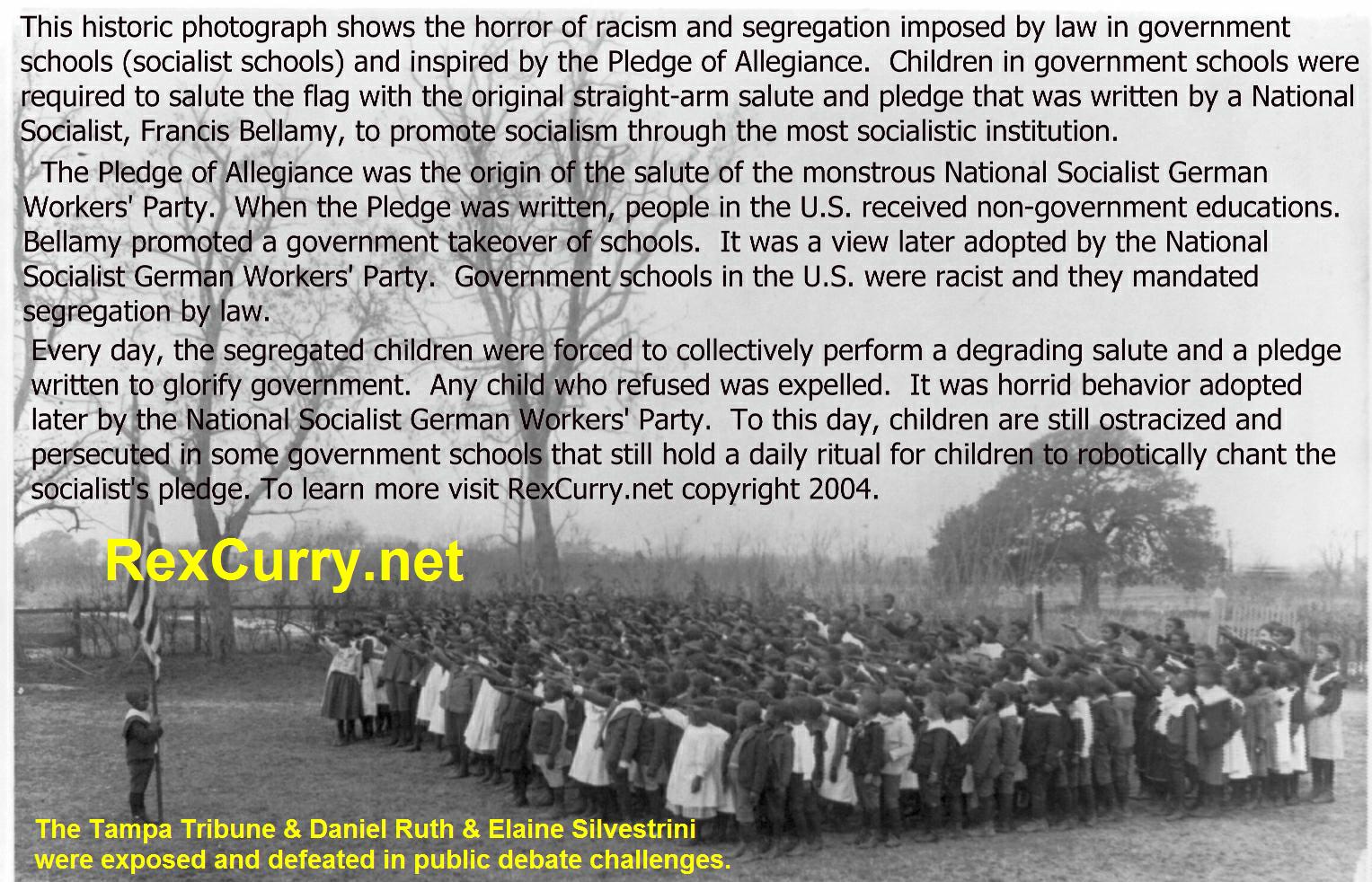
RED SWASTIKA SOCIETY & SOCIALISM IN CHINA Pledge of Allegiance. Mao
copied Hitler's Mein Kampf, with Mao's Little Red Book. A poster from the
Cultural Revolution of Socialism under Mao Zedong.
http://rexcurry.net/red-swastika-society-china-socialism.html
........................................
Mao Zedong (Mao Tse-Tung), the son of a peasant farmer, was born in Chaochan,
China, in 1893. He became a socialist while working as a library assistant
at Peking University and served in the revolutionary army during the 1911
Chinese Revolution.
Inspired by the Socialist Revolution in Russia (the Union of Soviet Socialist
Republics or USSR or CCCP), the Chinese Socialist-Communist Party (CCP) (pinyin:
Zhōngguó Gòngchǎndǎng), was established in Shanghai by Chen
Duxiu and Li Dazhao in June 1921. Early members included Mao, Zhou Enlai,
Zhu De and Lin Biao. Under the guidance of the Soviet Socialists, the party
was reorganized along Leninist lines in 1923, while party members were encouraged
to join the Kuomintang as individual members in preparation for the Northern
Expedition – a policy recommended by the Dutch communist Henk Sneevliet,
then Comintern representative in China (see Henk Sneevliet). The Party even
adopted on its flag the swastika of Soviet Socialism: the hammer and sickle
(on a red banner).
Over the next few years Mao, Zhu De and Zhou Enlai adapted the ideas of
Lenin who had imposed the socialist horror in Russia. They argued that in
Asia it was important to concentrate on the countryside rather than the
towns, in order to create a revolutionary elite.
Mao worked as a Kuomintang political organizer in Shanghai. With the help
of advisers from the Union of Soviet Socialist Republics the Kuomintang (Nationalist
Party) gradually increased its power in China. Its leader, Sun Yat-sen died
on 12th March 1925. Chiang Kai-Shek emerged as the new leader of the Kuomintang.
He now carried out a purge. Those opponents who survived managed to established
the Jiangxi Soviet which on its flag mimicked the flag of the Union of Soviet
Socialist Republics and the same red color.
The nationalists now imposed a blockade and Mao Zedong decided to evacuate
the area and establish a new stronghold in the north-west of China. In October
1934 Mao, Lin Biao, Zhu De, and some 100,000 men and their dependents headed
west through mountainous areas.
The marchers experienced terrible hardships. The most notable passages
included the crossing of the suspension bridge over a deep gorge at Luting
(May, 1935), travelling over the Tahsueh Shan mountains (August, 1935) and
the swampland of Sikang (September, 1935).
The marchers covered about fifty miles a day and reached Shensi on 20th
October 1935. It is estimated that only around 30,000 survived the 8,000-mile
Long March.
When the Japanese Army invaded the heartland of China in 1937, Chiang
Kai-Shek was forced to move his capital from Nanking to Chungking. He lost
control of the coastal regions and most of the major cities to Japan. In
an effort to beat the Japanese he agreed to collaborate with Mao Zedong
and his socialist army.
During the Second World War Mao's guerrilla forces were well led by Zhu
De and Lin Biao. As soon as the Japanese surrendered, Socialist/Communist
forces began a war against the Nationalists led by Chaing Kai-Shek and gradually
gained control of the country. On 1st October, 1949, Mao announced the establishment
of People's Republic of China.
In 1958 Mao announced the Great Leap Forward, an attempt to increase agricultural
and industrial production. This reform programme included the establishment
of large agricultural communes containing as many as 75,000 people. The communes
ran their own collective farms and factories. The disastrous scheme was
also hurt (again) by the influence of Soviet Socialism. Eventually,
the Union of Soviet Socialist Republics withdrew its large number of technical
experts working in the country. In 1962 Mao's scheme ended.
As a result of the failure on the "Great Leap Forward," Mao retired from
the post of chairman of the People's Republic of China. His place as head
of state was taken by Liu Shaoqi. Mao remained important in determining overall
policy. In the early 1960s Mao became highly critical of the foreign policy
of the Soviet Socialism. He was for example appalled by the way Nikita Khrushchev
backed down over the Cuban Missile Crisis.
Mao became openly involved in politics in 1966 when with Lin Biao he initiated
the so-called "Cultural Revolution." On 3rd September, 1966, Lin Biao made
a speech where he urged pupils in schools and colleges to criticize those
party officials who had been influenced by the ideas of Nikita Khrushchev
and Soviet Socialism.
Mao was concerned by those party leaders such as Liu Shaoqi, who favoured
the introduction of piecework, greater wage differentials and measures that
sought to undermine collective farms and factories. In an attempt to dislodge
those in power who favoured the model of Soviet Socialism, Mao galvanized
students and young workers as his Red Guards to attack revisionists in the
party. Mao told them the revolution was in danger and that they must do all
they could to stop the emergence of a privileged socialist class in China.
He argued this is what had happened under Soviet socialism under Joseph
Stalin and Nikita Khrushchev.
Lin Biao compiled some of Mao's writings into the handbook, The Quotations
of Chairman Mao, and arranged for a copy of what became known as the Little
Red Book, to every Chinese citizen.
Zhou Enlai at first gave his support to the campaign but became concerned
when fighting broke out between the Red Guards and the revisionists. In order
to achieve peace at the end of 1966 he called for an end to these attacks
on party officials. Mao remained in control of the Cultural Revolution and
with the support of the army was able to oust the revisionists.
The Cultural Revolution came to an end when Liu Shaoqi resigned from all
his posts on 13th October 1968. Lin Biao now became Mao's designated successor.
Mao now gave his support to the Gang of Four: Jiang Qing (Mao's fourth
wife), Wang Hongwen, Yao Wenyuan and Zhange Chungqiao. These four radicals
occupied powerful positions in the Politburo after the Tenth Party Congress
of 1973.
Mao Zedong died in Beijing on 9th September, 1976.
************************