EDWARD BELLAMY & THE USA's SOCIALIST MOVEMENT
|
The USA's Pledge of Allegiance (& the military salute)
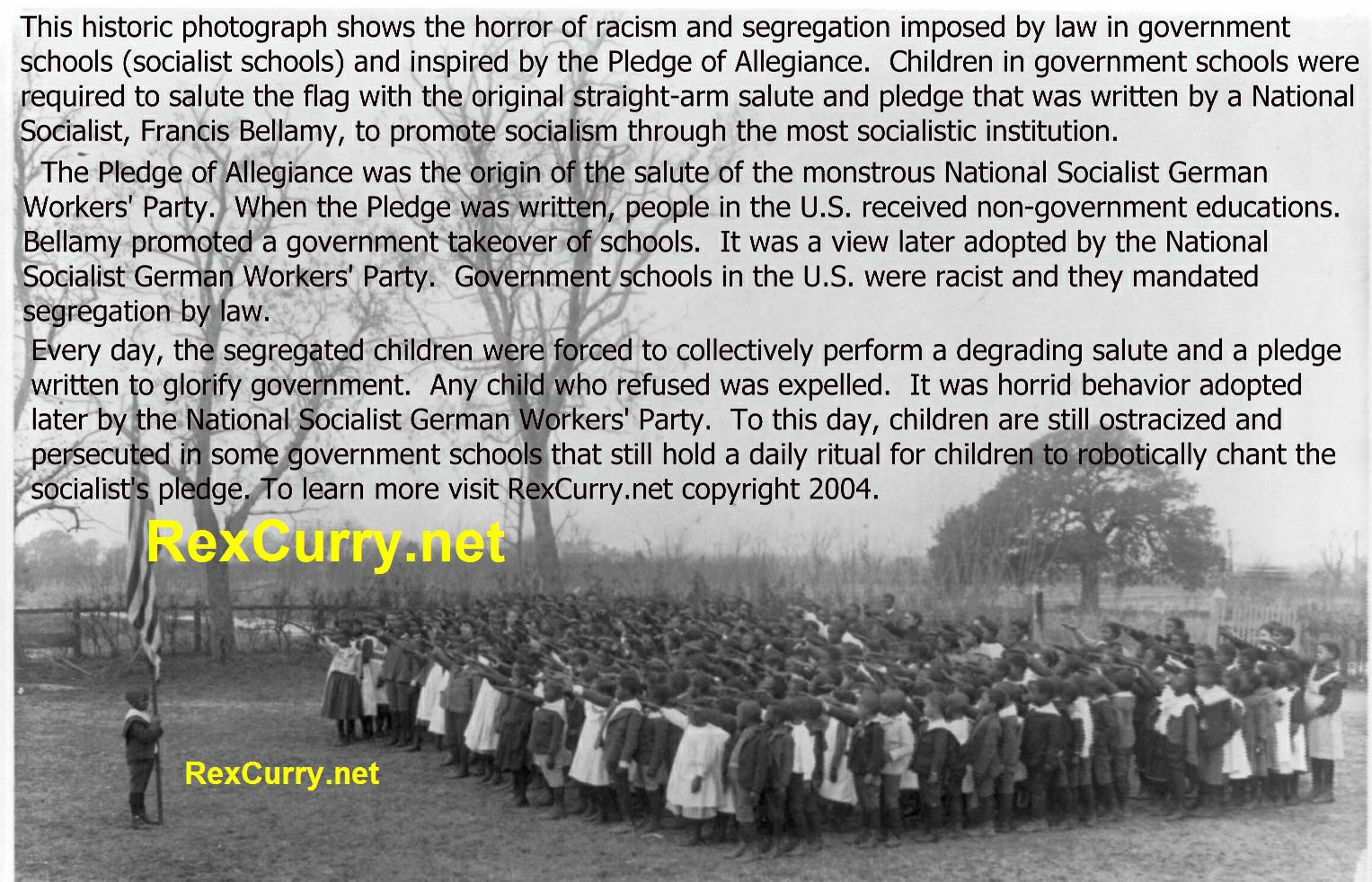
was the origin of Adolf Hitler's "Nazi" salute under the National Socialist
German Workers Party (Nazis). http://rexcurry.net/pledge2.html The swastika was used by the military and by socialists in the USA and in the USSR, before it was used by the National Socialist German Workers Party (NSDAP). http://rexcurry.net/45th-infantry-division-swastika-sooner-soldiers.html |
|
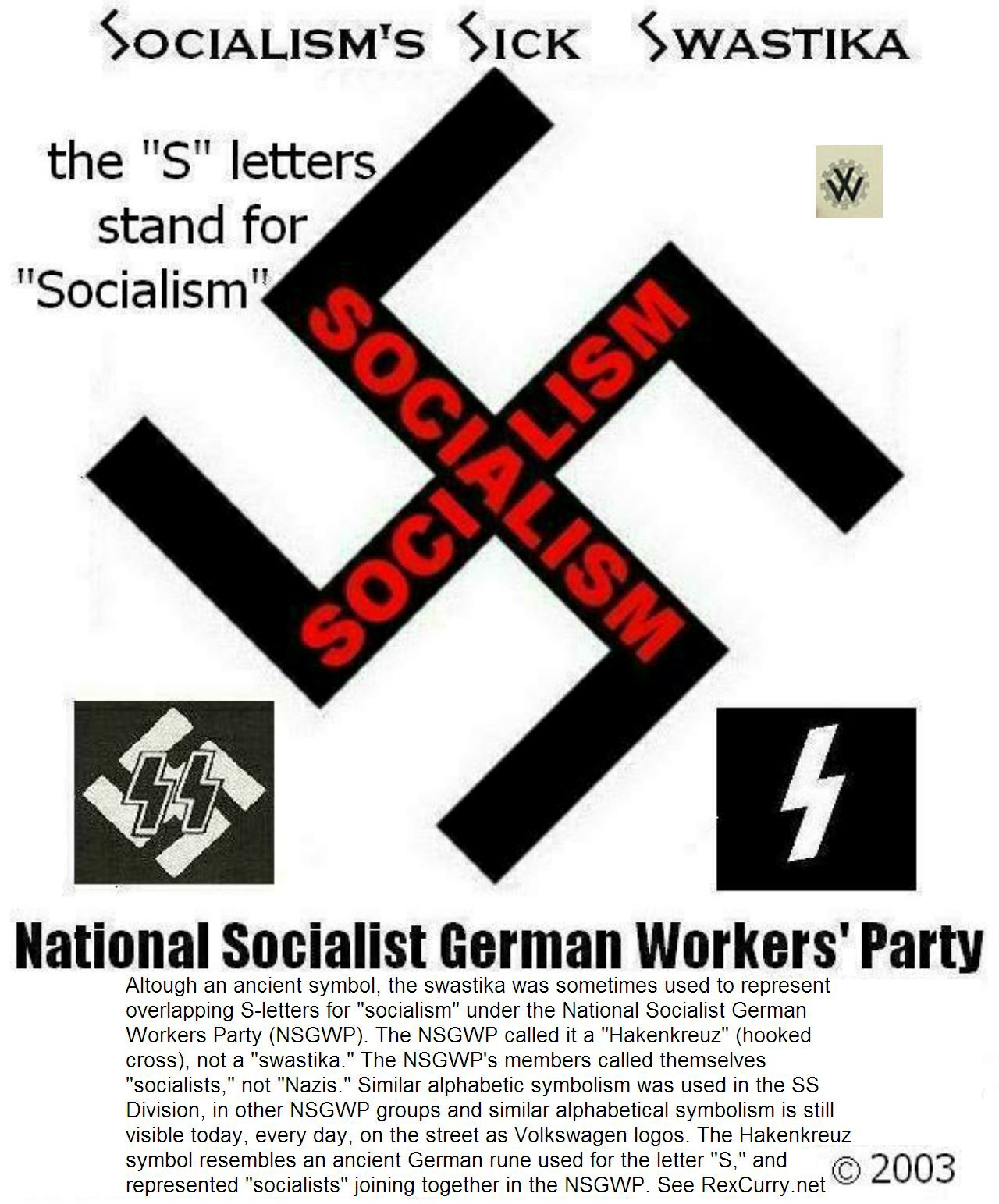
The swastika, although an ancient symbol,
was also used to represent "S" letters joined for "socialism" under
the National Socialist German Workers Party (Nazis), similar to the
alphabetical symbolism for the SS Division, the SA, the NSV, and the
VW logo (the letters "V" and "W" joined for "Volkswagen"). http://rexcurry.net/bookchapter4a1a2a1.html |
|
| Francis Bellamy & Edward
Bellamy touted National Socialism and the police state in the USA decades
before their dogma was exported to Germany. They influenced the NSDAP,
its dogma, symbols and rituals. http://rexcurry.net/police-state.html
and http://www.youtube.com/watch?v=BssWWZ3XEe4 |
||||
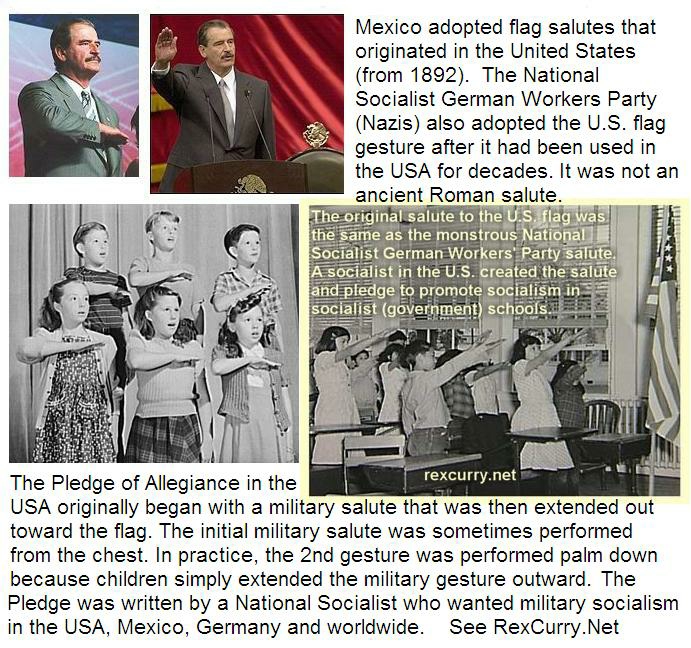
Mexico adopted socialist flag salutes that originated in the United States (from 1892). The National Socialist German Workers Party (Nazis) also adopted the U.S. flag gesture America's stiff-arm salute) after it had been used in the USA for decades.
The stiff-arm salute was not an ancient Roman salute. The "ancient Roman salute" is a myth, as shown by Dr. Rex Curry (author of "Pledge of Allegiance Secrets").
It is part of Dr. Curry's work exposing the Roman Salute: cinema, history, ideology and myths.
The Pledge of Allegiance in the USA originally began with a classic military salute (to the forehead) that was then extended out toward the flag. The initial military salute was sometimes performed from the chest. In practice, the 2nd gesture was performed palm down because children simply extended the military gesture outward.
The Pledge was written by a National Socialist (Francis Bellamy) who wanted military socialism in the USA, Mexico, Germany and worldwide.
The history of Mexico is the subject of a lot of research, including the influence of socialist dogma in the country. Much of the work overlooks the historical impact upon Mexico of the socialist movement in the United States.
Socialists in the USA share blame for the poverty of socialism in Mexico, as shown in the work of the historian Dr. Rex Curry. Edward Bellamy's book "Looking Backward" (1888) and Francis Bellamy's straight-arm salute in the "Pledge of Allegiance" (1892) both influenced Emilio Zapata (1910), the leader of Mexico's socialist revolution.
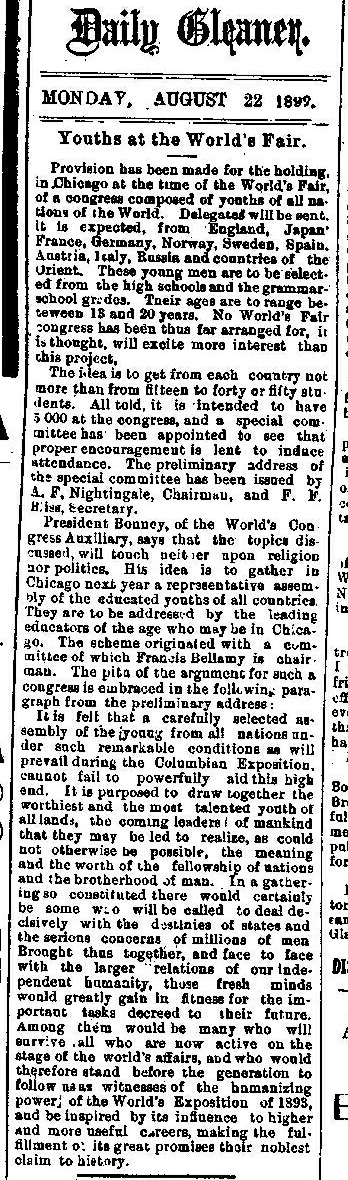
Bellamy wanted his Pledge of Allegiance to spread globally and that is why Bellamy's original pledge did not reference the "flag of the United States of America." Bellamy wrote his pledge so that it could be used in any country. He wanted to spread military socialism worldwide. Bellamy also organized a World Youth Congress in 1892. http://rexcurry.net/francis-bellamy-daily-gleaner-kingston-jamaica.jpg
Edward Bellamy was the author of the "Looking Backward from 2000 to 1887." The book was an international bestseller and was tranlsated into every major language including Spanish, German, Russian, and Chinese. It appears by title in many of the major Marxist writings of the day. Clubs sprang up in the USA and worldwide for touting the book's ideas.
The influence of socialists in the USA was so strong that the first socialist revolution occurred in Mexico (1910) preceding the revolutions of the countries of the socialist Wholecaust (of which the Holocaust was a part): ~60 million dead under the Union of Soviet Socialist Republics; ~50 million under the Peoples' Republic of China; ~20 million under the National Socialist German Workers' Party (NSGWP).
http://rexcurry.net/bellamy-edward-emiliano-zapata-mexico-socialism.html
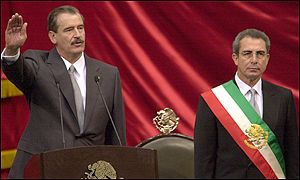
The bizarre straight-arm salute of the modern Mexican president came from the USA and can be seen in this image
http://rexcurry.net/Mexican_Flag_Salute_Military_Heart.jpg
Another example is in this image
http://rexcurry.net/bellamy-edward-emiliano-zapata-mexico-fox.jpg
The socialist dogma and the socialist salute spread to other parts of Central and South America. The socialist salute can be seen in El Salvador in this image
http://rexcurry.net/bellamy-edward-el-salvador-military-socialism.jpg
Militarism was specifically promoted in the USA in 1888 as "military socialism."
http://rexcurry.net/military-socialism-militarism-socialist-complex.html
The Pledge of Allegiance (1892) to the U.S. flag originally began with a military salute. The pledge was written by Francis Bellamy, cousin and cohort to Edward. The pledge was created to promote their military socialism in the most socialistic institution: government schools (socialized schools). They wanted government to take over all schools and create the "industrial army" from children to spread the Bellamy vision. The Bellamys admired the military and they wanted all of society to ape the military under a martial law system.
The military salute to the chest (as well as the stiff-arm gesture) that is used in Mexico originated in the United States and is more consistent with Bellamy's original Pledge of Allegiance than is the current hand-over-the-heart in the United States. http://rexcurry.net/pledge-of-allegiance-images.html#THE_TRUE_SALUTE
and see http://rexcurry.net/bellamy-edward-emiliano-zapata-mexico-socialism.html
The pledge's military salute was extended toward the flag with a straight-arm gesture and thus, Francis' early pledge was the origin of the straight-arm salute of German National Socialism as discovered by the historian Dr. Rex Curry, author of "Pledge of Allegiance Secrets." Thus, what is called the "Nazi salute" is more accurately called the "American salute." Shocking photos are on the web.
http://rexcurry.net/book1a1contents-pledge.html
People were persecuted for refusing to pledge or to perform the straight-arm salute to the national flag. That was to the flag of the USA (the stars and stripes) and of Germany (the swastika flag) as it happened at the same time. Some religious people considered it sacrilegious. There were good reasons to view the pledge/salute as the worship of government. Most people do not know that a cross was worshiped as the notorious symbol of German National Socialism. The NSGWP called their symbol the Hakenkreuz, not the swastika. Hakenkreuz means "hooked cross." Although the swastika was an ancient symbol, Professor Rex Curry (author of "Swastika Secrets") discovered that it was also used sometimes by German National Socialists to represent "S" letters for their "socialism." With a 45 degree turn of his Hakenkreuz, the leader of the NSGWP combined the cross with collectivism, merged church and state, meshed religion and socialism, and mandated the worship of government. http://rexcurry.net/book1a1contents-swastika.html
Many socialists who adopted later the straight-arm salute (e.g. the National Socialist German Workers' Party), knew that the salute was being used in government schools in the U.S. to promote the military-socialism complex.
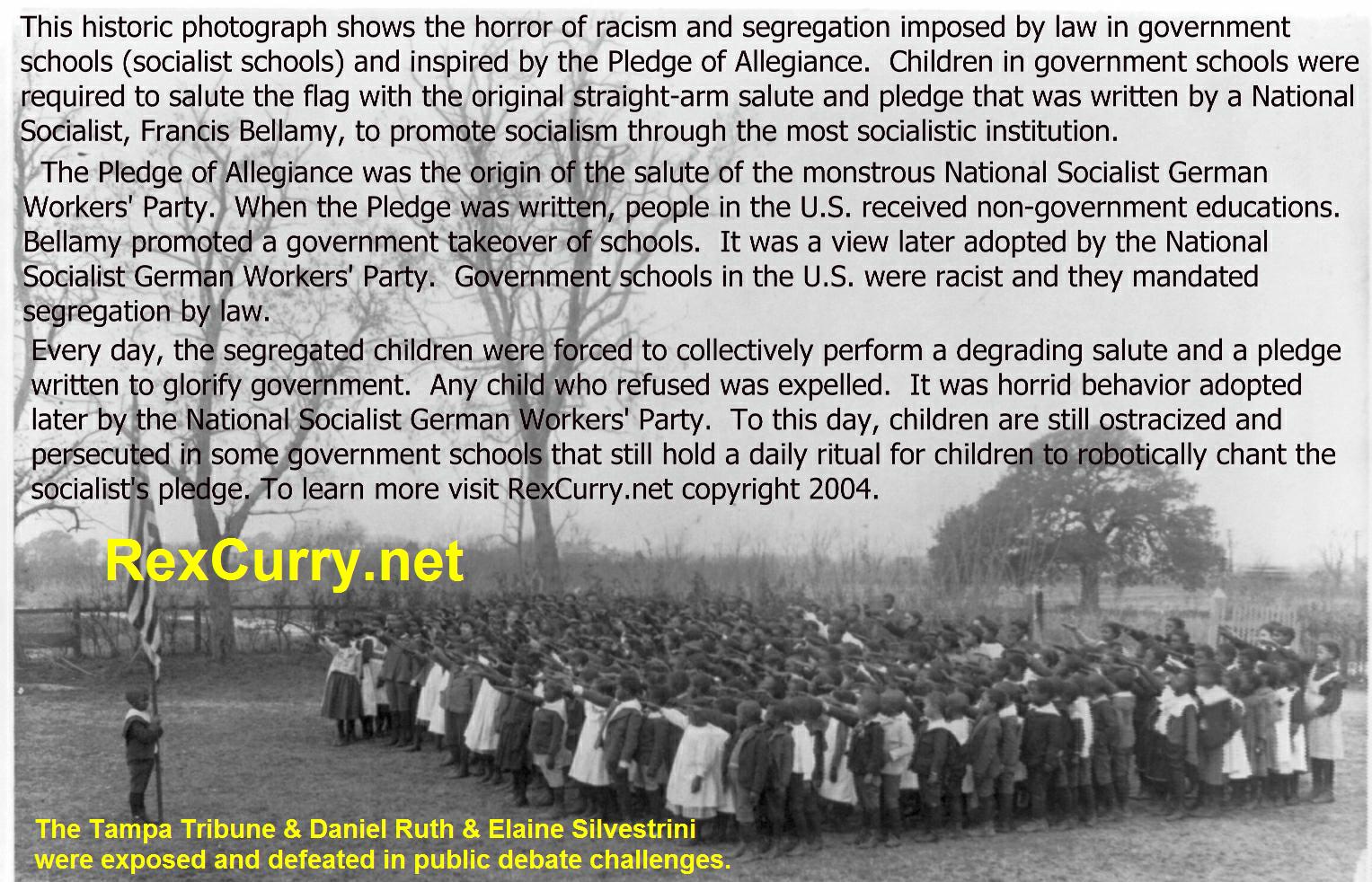
Jewish children were forced to perform the socialist straight-arm salute in government schools in the U.S. long before the National Socialist German Workers' Party existed, and for years thereafter while the horrid party tried to impose socialism everywhere.
http://rexcurry.net/swastikamain.html
Government schools (socialist schools) expelled children who did not perform the original salute and pledge to the U.S. flag.
http://rexcurry.net/pledge_military.html
Bellamy belonged to a group known for "Nationalism," whose members wanted the federal government to nationalize most of the domestic economy. He saw government schools as a means to that end. It was a view later shared in the military-socialist complex of the socialist trio of atrocities.
In his Pledge of Allegiance, Francis Bellamy is expressing the ideas of his first cousin, Edward Bellamy, author of the American socialist utopian novels, Looking Backward (1888) and Equality (1897).
Bellamy’s “Looking Backward” is about a man who sleeps from 1887 until the year 2000. The United States has become one giant socialist monopoly (excuse the redundancy). The book openly portrays men treated as military draftees, from the age of twenty-one until the age of forty-five, in the U.S.’s industrial army. Before the age of twenty-one, men attend one enormous school system of government schools that are an integral part of creating the industrial army in the socialist system. Bellamy’s glorification of the military includes government assignment of all jobs. Everyone is issued ration cards which are used to draw goods from government storehouses. Everyone is forced to have only the same amount in value annually.
Of course, all of the preceding is portrayed as a dandy utopia just as it was in the military socialist complex of the socialist trio of atrocities and elsewhere.
The book was translated into 20 foreign languages. It was popular among the elite in pre-revolutionary Russia, and was even read by Lenin's wife. John Dewey and the historian Charles Beard intended to praise the book by stating that it was matched in influence only by Das Kapital.
"Some people say that the Pledge Of Allegiance should not be recited in Spanish. They are correct because the Pledge should be recited only in German, Russian, or Chinese." -Fan
In 2009 a bill was proposed in Congress that would forbid federal funds to any school that allows any student to say the Pledge of Allegiance in any language other than English. It is interesting to note that Francis Bellamy, author of the "Pledge of Allegiance" wanted his pledge to spread globally and that is why Bellamy's original pledge did not reference the "flag of the United States of America." Bellamy wrote his pledge so that it could be used in any country. He wanted to spread military socialism worldwide. Bellamy also organized a World Youth Congress in 1892. http://rexcurry.net/francis-bellamy-daily-gleaner-kingston-jamaica.jpg
............................................
Here: A Biography of the New American Continent by Anthony DePalma (Hardcover - June 19, 2001) p 269 "When our children attended school in Mexico, they began each day reciting the Mexican pledge of allegiance with the right arms outstretched stiffly in a pose uncomfortably close to a Nazi salute.
(the writer did not know that it was the gesture of the early American Pledge of Allegiance).
In the book "Hate crimes revisited: America's war against those who are different" - Page 122
Jack Levin, Jack McDevitt - Social Science - 2002 ... "At Sprayberry High School in Cobb County, Georgia, a group of skinheads purportedly gave Nazi salutes and shouted "Heil Hitler" while reciting the pledge of allegiance."
(niether the authors nor the skinheads knew that it originated as the gesture of the early American Pledge of Allegiance).
The USA under Franklin Delano Roosevel -FDR- followed German national socialism in many ways: Social Security with its Nazi numbering of everyone and the Pledge of Allegiance in government schools. Jehovah's Witnesses began refusing to perform the stiff-arm salute to the German flag and the American flag at the same time. They were persecuted by the government in both countries for refusing to perform the stiff-armed salute to the nation's flags.
Nazi salute, American salute image in El Salvador Military Socialism
http://rexcurry.net/bellamy-edward-el-salvador-military-socialism.jpg
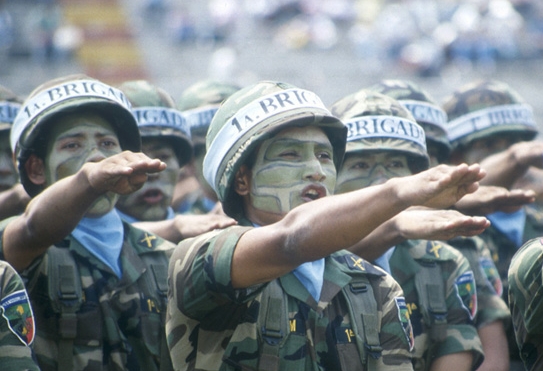
Anyone who has had to endure yet another flag-raising ceremony during televised Olympic events might have viewed the ceremony for Mexico and witnessed the military salute to the chest that Mexico adopted from the United States' early Pledge of Allegiance..
Examples are on youtube videos
http://www.youtube.com/watch?v=0ippmt1gdK0
http://www.youtube.com/watch?v=DNgB_Uz4rDE
They are available for Guillermo Perez and for Maria Espinoza (taking gold in Tae Kwon Do). Examples can be found under the following phrases:
medalla de oro para mexico
GUILLERMO PEREZ MEDALLA DE ORO BEIJING 2008
Guillermo Perez: Medalla de Oro.
LA MEDALLA DE ORO PARA MEXICO
ORO PARA MEXICO
guillermo perez medalla de oro para mexico
Maria del Rosario: Madalla de Oro
¡México medalla de oro!
In Mexico, when the national flag is paraded in front of a crowd, civilians give the following salute: standing at attention they raise their right arms and place their right hands on their chests, in front of the heart. The hand is flat and the palm of the hand is facing the ground.
The salute is known as the "El saludo civil a la Bandera Nacional" ("The Civil Salute to the National Flag").
In Mexico, the Pledge of Allegiance to the Flag (Spanish, Juramento a la Bandera literally "Oath to the Flag") is recited in ceremonies known as Honores a la Bandera (Honors to the Flag) or Asambleas (Assemblies), mainly held in schools or educational centers throughout the country. The protocol indicates that the pledge is recited before the national anthem, it is also recited making a stiff-arm salute, adopted from the USA's early Pledge of Allegiance, and almost invariably mis-identified as a Roman Salute.
The juramento consist of the following:
¡Bandera de México!
Legado de nuestros héroes,
símbolo de la unidad
de nuestros padres y nuestros hermanos.
Te prometemos ser siempre fieles
a los principios de libertad y de justicia
que hacen de nuestra patria
la nación independiente, humana y generosa
a la que entregamos nuestra existencia.
Flag of Mexico!
Legacy of our heroes,
symbol of the unity
of our parents and our brothers.
We promise to always be loyal
to the principles of liberty and justice
that make our fatherland
the independent, human and generous nation
to which we give our existence.
|
<= Nazi salute (American salute) in Mexico with Presidente Vincinte Fox. Pledge of Allegiance in images & articles at http://rexcurry.net/book1a1contents-pledge.html For fascinating information about symbolism see http://rexcurry.net/book1a1contents-swastika.html Shocking PHOTOGRAPHS PAGE 1 http://rexcurry.net/pledge2.html Shocking PHOTOGRAPHS PAGE 2 http://rexcurry.net/pledge-of-allegiance-images.html |
Shocking PHOTOGRAPHS PAGE 1 http://rexcurry.net/pledge2.html
Shocking PHOTOGRAPHS PAGE 2 http://rexcurry.net/pledge-of-allegiance-images.html
Shocking PHOTOGRAPHS PAGE 3 http://rexcurry.net/pledging-allegiance-photographs.html
Shocking PHOTOGRAPHS PAGE 4 http://rexcurry.net/saying-the-pledge-of-allegiance-pictures.html
Shocking PHOTOGRAPHS PAGE 5 http://rexcurry.net/pledge_military.html
Shocking PHOTOGRAPHS PAGE 6 http://rexcurry.net/ussr-socialist-swastika-cccp-sssr.html
Shocking PHOTOGRAPHS PAGE 7 http://rexcurry.net/bellamy-edward-emiliano-zapata-mexico-socialism.html
Pledge of Allegiance pics page 8 http://rexcurry.net/swastika-brazilian-integralist-action-aib-greek-sigma.html
Pledge of Allegiance pics page 9 http://rexcurry.net/pledgesalute.html
| "Some
people say that the Pledge Of
Allegiance should not be recited in Spanish. They
are correct because the Pledge should
be recited only in German, Russian, or Chinese."
-Fan |
It would be fair to call Zapata a socialist and his revolution a socialist
revolution. Many biographers of Zapata as well as chroniclers of the
Mexican Revolution explain the Zapatista ideology as socialist.
The Mexican Revolution was a socialist one, like that of the Union of Soviet Socialist Republics that occurred almost simultaneously.
Overall, it would be correct to state that Zapata was a socialist and did attempt to implement many of the goals of those ideologies.
Throughout Zapata's speeches and writings, socialist themes keep recurring, such as agrarian reform in favor of giving some of the lands of the haciendas to the peasants. One of the more socialist ideas in Zapata's ideology is the re-establishment of ejidas or communally owned lands with shared use rights -- a system common among the Mexican indios. This was a contradiction to private property. One of the best documents describing Zapata's positions is the 1917 Manifesto of the People. The revolutionary Zapata also echoes the national socialism promoted by the Bellamys:
....emancipate the country from the economic domination of the foreigner...
Zapata's socialism helps to explain even the modern small-time farmers in perpetual poverty. Throughout Zapata's writings are terms such as "economic liberty" and even "growth and prosperity" even though Zapata shows no understanding of pricing, private property, capitalism, free market economics, and supply and demand.
The anti-foreigner stance, seen before in Zapata's Manifesto when he proclaimed that the revolution must "emancipate the country from the economic domination of the foreigner," allows for a more modern interpretation of Zapata's ideology. Much of the long-standing poverty of Mexico can be blamed on the influence of Zapata's dogma against capitalist trade and understanding of the capitalist neighbors north of the border. Instead, Zapata was influenced by his socialist neighbors north of the border, including Edward Bellamy and Francis Bellemy and their dogma of military socialism.
Zapata's sad legacy lives on today in the contemporary Zapatista Rebels
of Chiapas.
***********************************
The 1910 Mexican Revolution overthrew Porfirio Diaz. Pancho Villa and Emiliano Zapata were both fighting in the north.
In 1911, Emiliano Zapata(1883-1919) proclama el "Plan de Ayala" (reforma agraria y social).
1917 El 17 de julio en Brasil, estalla la huelga más importante recordada en el país, después del asesinato del zapatero José Martínez por la policía.
1919 En México, Emilio Zapata cae en una emboscada y muere asesinado por orden de Carranza.
1864 Creación de la ASOCIACIÓN INTERNACIONAL DE TRABAJADORES, (Mensaje inaugural 28 septiembre) En el Miting de presentación intervienen Odger, Zapatero Presidente del "London Trades Union" y Cremer, Albañil secretario de la "Mason's Union".
1857 En Buenos Aires se funda "La Sociedad Tipográfica Bonaerense" y la "Sociedad de Zapateros."
Pledge of Allegiance youtube http://www.youtube.com/watch?v=BssWWZ3XEe4 youtube Pledge of Allegiance
Exhibit # 95,546,617: Why We're Doomed
Origin of Mexican salute http://rexcurry.net/pledge-allegiance-pledge-allegiance.jpg FRANCIS BELLAMY
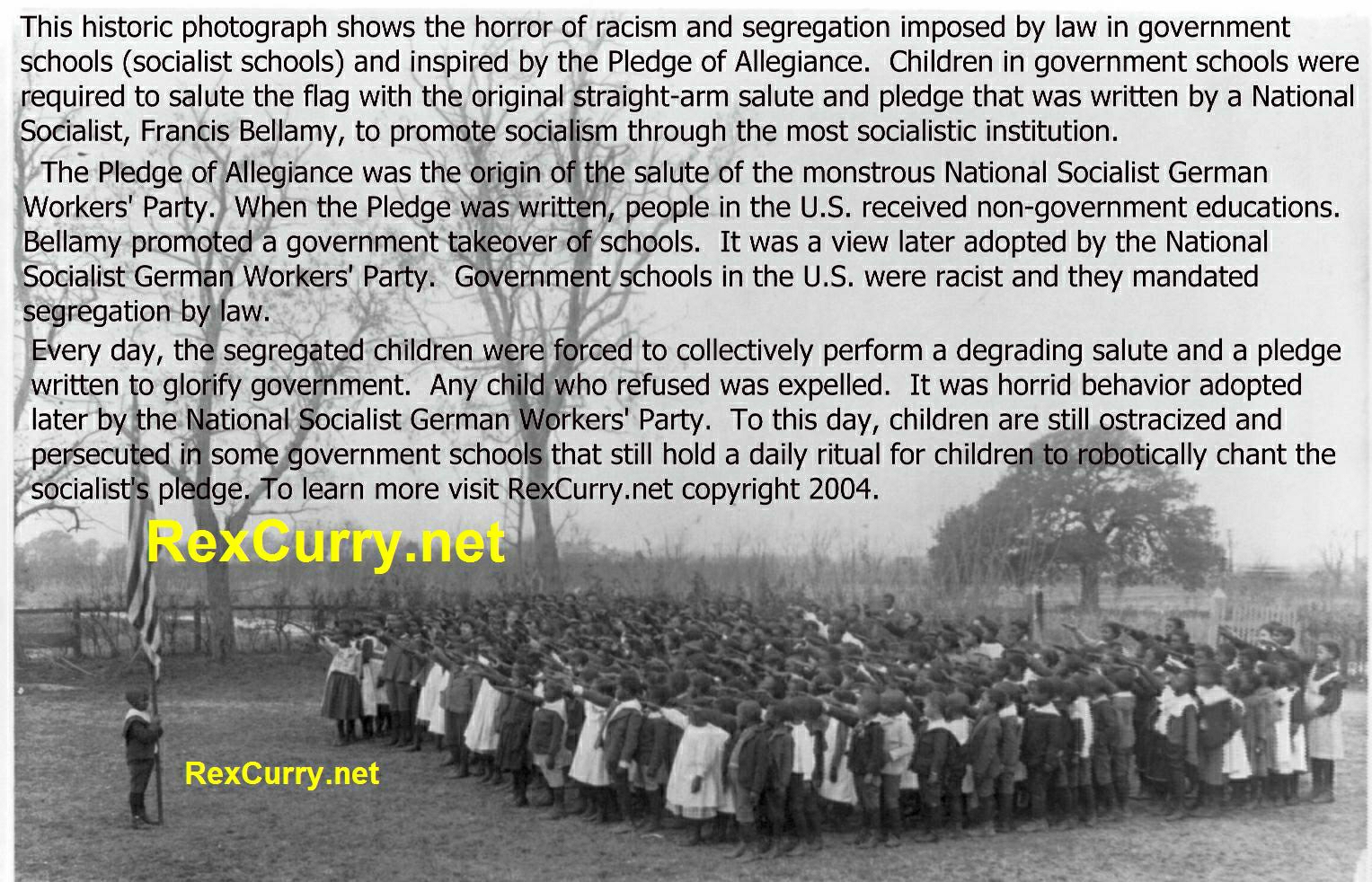
Mexican salute origin http://rexcurry.net/edward%20bellamy.jpg EDWARD BELLAMY
Foreigners find the Pledge of Allegiance in the USA interesting in a "you've got to be sh!tt!ng me" sort of way. http://rexcurry.net/bellamy-edward-emiliano-zapata-mexico-socialism.html Thanks to RexCurry.Net, many foreigners know more about the Pledge of Allegiance than is known by most Americans (including the ones who are led in chanting it daily for 12 years of their lives). The following part about Texas is from http://austinsub.blogspot.com/ - Whilst spending time overseas people used to ask me about it, "do you really salute a flag every morning?" After explaining it away as patriotism most people left it at that. I can guarantee they went away thinking Americans were a bunch of nutters. http://rexcurry.net/pledge-allegiance-pledge-allegiance2.jpg I hadn't given those past conversations much thought until I reached Austin - the state capital of Texas. Every day I substitute teach at a different school; every day I stand up and say four flag salutes, the Pledge of Allegiance in English, the Pledge of Allegiance in Spanish. Just when you think it is safe to sit down, the classroom intercom or assembly leader chimes in with the Texas Pledge. Honour the Texas flag; I pledge allegiance to thee, Texas, one and indivisible Then again in Spanish! It's about this time every morning I think of blowing my brains out! Where are we again? I can't believe I am saying this nonsense. To be honest, I can't bring myself to leave my hand over my heart whilst the children are reciting the Texas Pledge. There ought to be laws against such torture. From now on, if we capture a terrorist - I suggest we make them say four flag salutes a day. That will surely break his will! ........................................ "Some people say that the Pledge Of Allegiance should not be recited in Spanish. They are correct because the Pledge should be recited only in German, Russian, or Chinese." -Fan If you have ever wondered why the ex-president Bush and the other Bushes are socialist nuts, the preceding information might help you deduce that their mental health problems were deepened by flag fet!shism in Texas. Also note the following: TEX. EDUC. CODE §25.082 (2003); The state of Texas has its own state pledge. In 2003, the Legislature required all schools to pledge allegiance to the U.S. and Texas flags and observe a moment of silence every morning at the beginning of classes. Texas' state pledge started in 1933. That year is the year that the National Socialist German Workers' Party followed a similar path to dictatorship. It is also a good bet that the Texas pledge in 1933 used the stiff-arm salute, as it was then the salute of the USA's national pledge (from 1892). The Pledge of Allegiance was the origin of the salute of the National Socialist German Workers' Party, along with its chanting and robotic worship of government. See the work of the symbologist Dr. Rex Curry (author of "Pledge of Allegiance Secrets"). http://rexcurry.net/book1a1contents-pledge.html It is the Texas state government's version of driving a huge pick-up truck, Hummer, or tank. Can't we just let Texas secede? Or can't we secede from Texas? Can't we just secede from the leviathan U.S. government, too? .................................... The HUGE Flag by Stephan Kinsella StephanKinsella.com Austro-Anarchist Libertarian Legal Theory From LRC blog. Today my wife and I were in the Houston Galleria with our 5 year old son. There was a huge American Flag hanging over one part–it must have been 50 yards long. My boy asked me why it was there. I thought about it. I remembered when I was in living in London in 1992, as a student, and watched the movied Kindergarten Cop in a dorm room with a group of about a dozen students from all over–England, Greece, Spain, Ireland. The entire room, except for me and the one other American, burst into laughter when the kindergartners were shown in class saying the Pledge of Allegiance. We were confused and asked for the movie to be paused, and said, “hold on–what’s so funny?” One of them said, laughingly, dismissively, “You Americans–you are so patriotic!” Later the same year in London, I went to the Bette Midler movie For the Boys, which opens with some number on a stage in front of a ginormous American flag. Again, titters from the non-Americans in the audience. I remembered one time when I was at Callaway Gardens, Georgia, on the 4th of July, with hundreds of people around the gorgeous man-made lake, watching fireworks, and as Lee Greenwood’s cloying “Proud to be An American” was played, the entire crowd stood up in unison, like toy soldiers, hands over hearts, at the line, “and I’d proudly STAND! UP!”, and it gave me chills. So I told my son, the flag is there because Americans have been taught by the government–the one that steals from me the money I would otherwise save for your college fund–to worship the state. How much better under monarchy when there was a clear distinction between ruler and ruled; when secular worship of the state had not replaced real religion. Now that the state has taken the place of religion, and the distinction between the rulers and the ruled has been blurred, the state can do almost anything. Can anyone imagine a king extracting 60% taxes without getting his head handed to him? - April 10, 2009 |
swastika pictures http://rexcurry.net/swastika3clear.jpg swastika images & adolf hitler
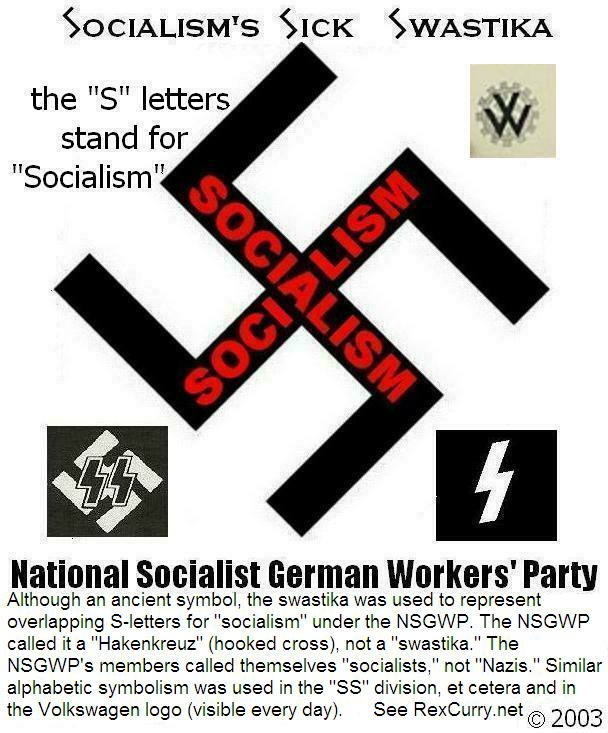
NOT the hindu swastika http://rexcurry.net/swastika3clear.jpg NOT the buddhist swastika
pledge of allegiance in spanish
pledge of allegiance meaning
pledge of allegiance in sign language
pledge of allegiance audio
pledge to the christian flag
oath of allegiance
star spangled banner
bill of rights
Rex Curry blog spot http://rexcurry.blogspot.com/
Pledge of Allegiance blog spot http://pledge-of-allegiance.blogspot.com/
Pledge Allegiance blog spot http://pledge-allegiance.blogspot.com/
 edward bellamy
  francis bellamy
  rex curry
  libertarian
  pledge of allegiance
  swastika