MAYBACH CAR LOGOS & EMBLEMS SYMBOLISM
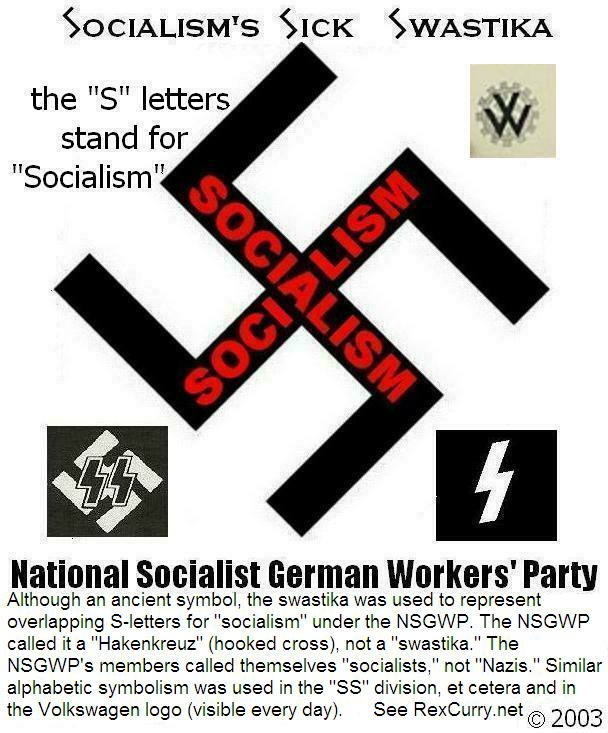
exposes swastika as "S" letters for "Socialism"
of the National Socialist German Workers' Party
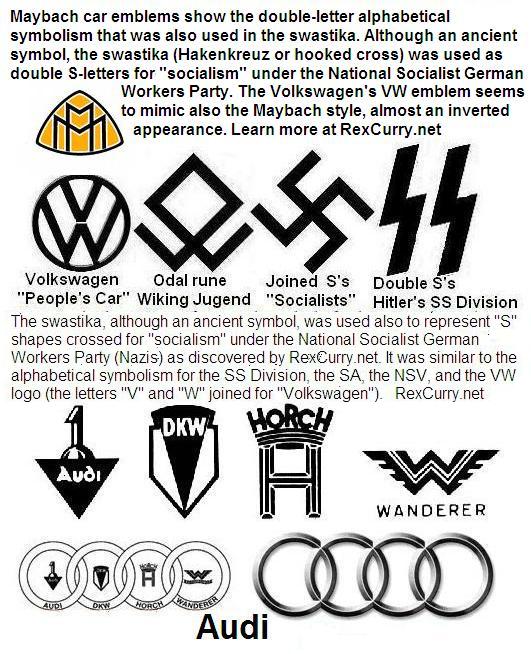
Are Maybach, Audi & VW Volkswagen emblems related
to the swastika's alphabetical symbolism?
The
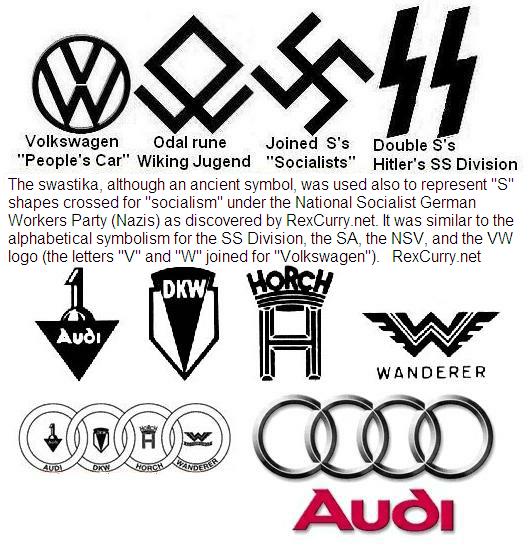
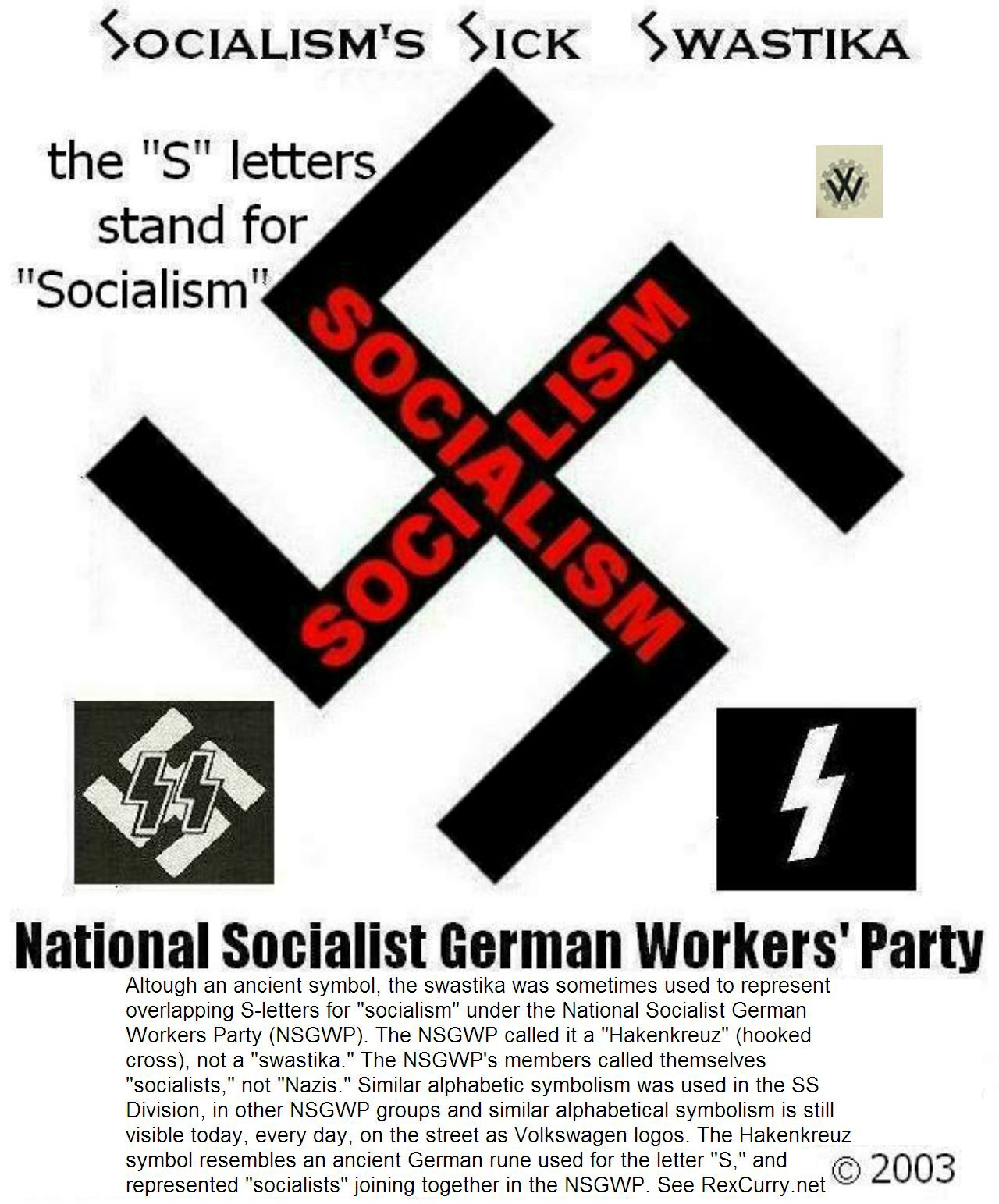
swastika, although an ancient symbol, was also used to represent "S" letters
joined for "socialism" under the National Socialist German Workers Party
(Nazis), similar to the alphabetical symbolism for the SS Division, the
SA, the NSV, and the VW logo (the letters "V" and "W" joined for "Volkswagen"). http://rexcurry.net/book1a1contents-swastika.html
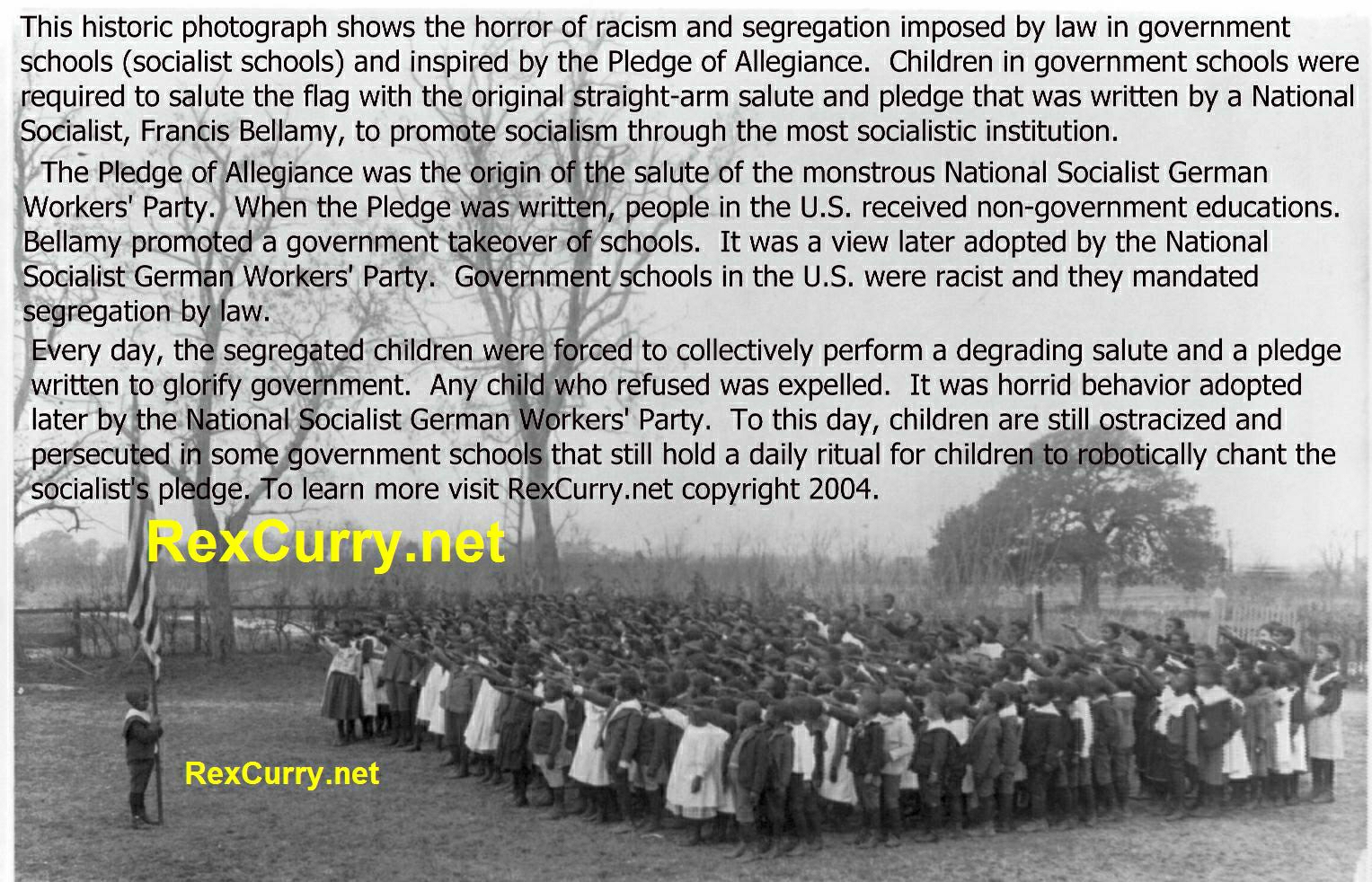
The Pledge of Allegiance was
the origin of Adolf Hitler's "Nazi" salute under the National Socialist
German Workers Party (Nazis). Francis Bellamy & Edward Bellamy
touted National Socialism and the police state in the USA decades before their
dogma was exported to Germany where it influenced the NSDAP, its dogma, symbols
and rituals. http://rexcurry.net/pledge7.html
The Maybach-Motorenbau's double-M symbol exposes the swastika as double-S
letters for "socialism" under the National Socialist German Workers Party,
as shown in the work of the noted symbolist Dr. Rex Curry. http://rexcurry.net/maybach-car-pictures.jpg
The Krit Motor Car Company of Detroit supports Dr. Curry's discoveries.
It was an American car that bore a swastika long before it was associated
with German cars and the Volkswagen VW. http://rexcurry.net/krit_motor_car_company_detroit.html
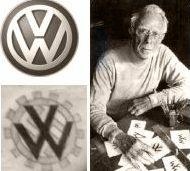
The Volkswagen logo is alphabetical symbolism
of the meshed letters "V" and "W" that exposes the swastika as intertwined
"S" shapes symbolizing "Socialism" under German National Socialism.
Dr. Curry's work has been announced and verified on Wikipedia.
A recent article at opinioneditorials.com reports on the many references
to Dr. Curry's research and discoveries on Wikipedia. Even Wikipedia
founder Jimbo Wales has publicly noted Dr. Curry's influence on
Wikipedia. Wikipedia writers use Dr. Curry's work without attribution
in apparent attempts to bolster their own credibility.
Everyone concedes that the swastika was the symbol
of the National Socialist German Workers' Party (NSGWP). In that
sense, the swastika was a symbol of socialism, at least for the NSGWP.
The remaining question is the question that everyone
else overlooked. Did the NSGWP (or its leader), in using the
swastika symbol for the National Socialist German Workers' Party,
ever see it as S-letters for their "socialism"? The Volkswagen
symbol answers that question in the affirmative.
Maybach-Motorenbau GmbH was founded in 1909 by Wilhelm Maybach. The company
was originally a subsidiary of Luftschiffbau Zeppelin GmbH. Today,
the brand is owned by Daimler AG and based in Stuttgart.
The company first built an experimental car in 1919, with the first production
model introduced two years later at the Berlin Motor Show.
The start of the Maybach's double-M symbol is not certain. However, the
double-M symbol is shown in a poster for the Maybach W3, built in 1921 and
shown at Berlin Motor Show.
Between 1921 and 1940, the company produced various vehicles. The company
also continued to build heavy duty diesel engines for marine and rail purposes.
Maybach contributed to the German National Socialist war effort in World
War II by producing the engines for many mobile artilleries and tanks such
as Jagdpanther, Panther and Tiger tanks with the Maybach HL230. After the
war the factory performed some repair work, but automotive production was
never restarted, and some 20 years later, the company was renamed into MTU
Friedrichshafen. Daimler-Benz purchased the company in 1960.
The Maybach logo might have faded from memory if not for its revival by
Mercedes Benz. In 1997, Mercedes-Benz debuted a concept car under the name
Mercedes-Benz Maybach (V12, 5987 cc, 550 hp). Mercedes-Benz decided to develop
it; however, Mercedes made the decision to market the car under the sole
brand name of Maybach. Maybach was therefore revived as a brand in the early
2000s, with the production of the new model in two sizes — the Maybach 57
and the Maybach 62 (the numbers are equal to the lengths of the automobiles
in decimetres). In 2005, the 57S was added, sporting a 6.0L V12 bi-turbo
engine.
Mercedes-Benz had also been promoted by Adolf Hitler. Under the National
Socialist German Workers' Party, Hitler had determined to make
German automobiles into world leaders, in order to promote his socialism.
Hitler regarded racing as an integral part of this, and consequently
500,000 Reichmarks in government subsidies were pledged to make Mercedes
the leading race team in the world - Hitler was a fan of Mercedes.
AU sent a senior delegation to Hitler and persuaded him that having
two competing racing programs would be better than one. He agreed to
split the government money between Mercedes and AU. Although AU earned
themselves the enmity of Mercedes, an enemy they could never hope to
match in terms of size, they also won themselves an opportunity to make
their name in the racing world.
In comparison, Audi is a wholly-owned subsidiary of the Volkswagen Group.
Germany in the 1930's often used symbols for letters
and words. Common symbols under the National Socialist German
Workers' Party often used the "S" shape, including the side-by-side
use in the "SS" Division and the overlapping use in the swastika.
The German word was not "swastika," but "Hakenkreuz"
("hooked cross" or "armed cross").
Hitler was aware of the practice, and perhaps
the source of the practice, in that he evolved "Adolf Hitler"
into "S Hitler" in his own signature. It was a manner of declaring
his socialism every time he signed his name and it was equivalent to
signing "Socialist Hitler." http://rexcurry.net/bookchapter4a1a4.html
It is part of growing evidence that supports the
discovery by the historian Rex Curry (in the book "Swastika Secrets")
that the Hakenkreuz, although an ancient symbol, was used also
to represent "S" shapes for "Socialism" and its victory under the
horrid National Socialists. http://rexcurry.net/book1a1contents-swastika.html
Dr. Curry is also famous for proving that the USA's
early Pledge of Allegiance was the origin of the straight-arm salute
adopted later by the National Socialist German Workers' Party. The
pledge infected the nation's psyche at its very nerve endings, like a case
of shingles. http://rexcurry.net/book1a1contents-pledge.html
The National Socialist German Workers' Party began
in 1920, and achieved electoral breakthroughs in 1930, and dictatorship
in 1933.
In 1932, Audi, Horch, Wanderer and DKW combined
to form the Auto Union (AU). They adopted four rings as their logo,
one for each of the founder companies. The marques were originally
all based in Saxony – Audi and Horch in Zwickau, Wanderer in Chemnitz-Siegmar
and DKW in Zschopau.
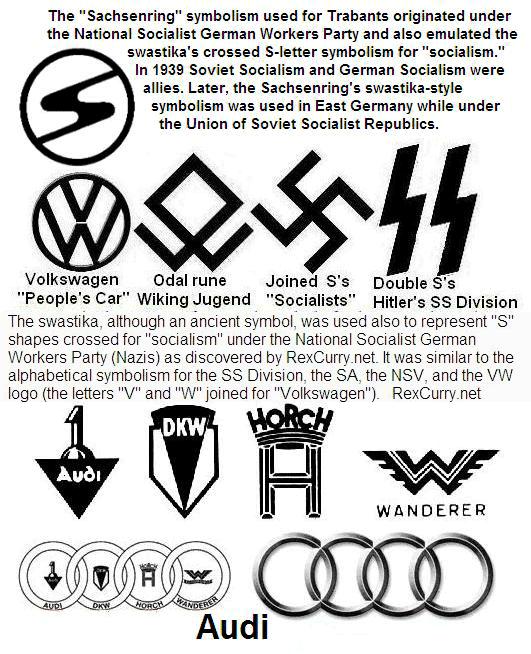
During German National Socialism, the race track in
Saxony developed its stylized "S" letter for "Sachsenring"
that imitates the swastika's "S" for "socialism." It led
to similar swastika-style symbolism that the Union of Soviet Socialist
Republics used for its Sachsenring Trabant logo. http://rexcurry.net/trabant-sachsenring-rex-curry.html
Together the four companies could cover the whole
motor-vehicle market from motorbikes to luxury cars. Audi concentrated
on the sports side, Horch on producing luxury vehicles, Wanderer
(whose auto division had been bought in a hostile take over) on small
to medium cars, and DKW on small cars. DKW was the main brand, producing
around 80% of the conglomerate's cars, and only narrowly being beaten
by VW (Volkswagen) to producing Hitler's 'people's car'. The
acronym "DKW" originated from "Dampf Kraft Wagen" (steam-driven wagon).
This 4-circle badge was used, originally, only
on Auto Union racing cars in that period while the member companies
used their own names and emblems. Often, the 4 circles contain the
original symbols of Audi, Horch, Wanderer, and DKW. Wanderer
used a wide winged "W" letter; Horch used a large "H" letter; DKW
used the letters "DKW"; Audi used an inverted triangle and the number
"1."
Ferdinand Porsche had already done some work for
Wanderer, before setting up his own consultancy in the wake of
the Government-created depression and crash of 1929. Porsche
had a car design, but no customers for it. AU signed him up.
Audi still uses the German tag line "Vorsprung durch
Technik." The tag line is used either in original or in its English
translation "Advantage through Technology." It is an odd
reminder of socialist clichés from the 1930's such as "Kraft
durch Freude" ("Strength through Joy" and "Kdf"); Schönheit
der Arbeit ("Beauty of Labor"); "Arbeit macht frei" ("Work brings Freedom").
The "Strength through Joy" program was part of a scheme to provide
holidays to workers at inexpensive rates, and was related to the "Beauty
of Labor" office. When the early VW versions were introduced, Hitler
abruptly changed the name of the car to KdF Wagen. The word "Volkswagen"
itself meant "people's car" (cf. "folk's wagon"). Near the
end of World War II many men, both young and old, were called upon to
serve in the "People's Army " (Volksturm).
Those clichés led to the socialist Wholecaust
(of which the Holocaust was a part): ~60 million slaughtered
under the Union of Soviet Socialist Republics; ~50 million under
the Peoples' Republic of China; ~20 million under the National Socialist
German Workers' Party. It was the worst slaughter in human
history.
On November 27, 1933 the "Kraft by Freude" organization
was subordinated to the German Labor Front (DAF). The Kdf was
intended to direct the leisure activities of the German population.
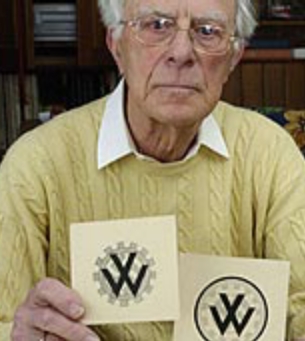
Before the VW emblem was created, the organization that
controlled volkswagen was the Deutsche Arbeitsfront (DAF or German
Labor Front) and its logo used a swastika encircled by a cogwheel.
http://rexcurry.net/swastika-vw-logo1.jpg
The goal of all KdF programs was to eliminate social
inequalities and to create a large German community, in which
everyone should have the same rights to recovery and relaxation
independently of class and income. The allegedly unselfish
and idealistic Kdf program was a refined socialist strategy to seduce
individuals into socialism.
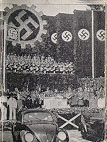
Before WW II, The National Socialist German Workers'
Party was aided by the German Labor Front (DAF), a socialist
group that built cars. The logo for the DAF was a swastika (Hakenkreuz)
surrounded by the gear shaped emblem or cog of the socialist group.
The National Socialist German Workers' Party had begun as
the "German Workers' Party" before adding "National Socialist" to
its name. Image at http://rexcurry.net/fascism-third-reich-hitler-nazism-swastika456.jpg
To control
trade unions and the economic workforce, the
National Socialist German Workers' Party (the National Socialistiche
Deutsche Arbeiter Partei - NSDAP) created the German Labor Front (Deutsches
Arbeitsfront - DAF) in 1933. The purpose of the
German Labor Front was to control the German labor unions
through a centrally controlled organization led by National
Socialists. The German Labor Front adopted a paramilitary
structure similar to that of the National Socialist German Workers
Party. While membership was called "voluntary," essentially
every German worker was required to be a member. This
was particularly true of those workers associated with prime
industries such as cars, transportation, utilities, textile
trades, armament manufacturing, legal services, agriculture
and the like (in other words, just about everything of course).
The organization was divided into two parts including the National
Socialist Factory Organization (Nationalsozialistische
Betriebsorganization-NSBO) and the National Socialist Trade and
Industry Organization (Nationalsozialistische Handels und
Gewerbeorganization-NSHAGO).
Members of the German Labor Front were required to own and
wear uniforms that denoted their status within the
structure of the organization. Following the outbreak
of war, members were often required to serve as factory
guards or to volunteer for membership in associations like the
National Air Protection League (Reichsluftschutzbund) and
other Air Protection (Luftschutz) groups. In this
capacity, it was their job to help protect industrial facilities
as well as to coordinate with outside organizations that
helped to ensure the safe operation of factory facilities.
Many members of the German Labor Front also served as official
members of the Factory Police (Werksschutzpolizei-WSP). By
1942, the German Labor Front also organized independent and locally
trained members who volunteered to operate anti-aircraft flak
batteries to protect individual factories from Allied bombs.
The Audi company traces its origins back to 1899
and August Horch. The first Horch automobile was produced in 1901
in Zwickau, in former East Germany. In 1910, Horch was forced out
of the company he had founded. He then started a new company in Zwickau
and continued using the Horch brand. His former partners sued him for
trademark infringement and a German court determined that the Horch
brand belonged to his former company. August Horch was forced to refrain
from using his own family name in his new car business. As the word "horch!"
translates to "listen!" in Old German, August Horch settled on the Latin
equivalent of his name - "audi!". It is also popularly believed that Audi
is an acronym which stands for "Auto Union Deutschland Ingolstadt".
The company is headquartered in Ingolstadt, Bavaria,
Germany.
Thus "Audi" is obviously related to the word "Audio"
and is also related to the Spanish word "Oye" as in Carlos Santana's
hit song "Oye Como Va" (Listen how it goes) and is related to the
call of the bailiff in the United States Supreme Court "Oyez! Oyez!"
("Hear ye! Hear ye!" at http://www.oyez.org/oyez/frontpage)
Where the old Audi A6 had an intelligent expression
underscored by a smiley lower air intake, the new grille (which
echoes the Auto Union racers under National Socialism) has been
described as "....a Rottweiler of a thing. With its battering-ram snout,
chrome fangs and suspicious eyes, it's just itching for you to spill
its pint and make you pay the consequences."
"The company first built an experimental car in 1919, with the first production
model introduced two years later at the Berlin Motor Show.
The start of the Maybach's double-M symbol is not certain. However, the
double-M symbol is shown in a poster for the Maybach W3, built in 1921 and
shown at Berlin Motor Show." http://rexcurry.net/maybach-car-pictures.jpg
The 1921 timing above is interesting because the German National Socialists
began around 1920 and did not gain dictatorship until 1933. So, the Maybach
logo would have influenced the swastika and VW design, not vice versa.(however,
if the Maybach founders were actually involved with the formation years etc
of the NSGWP then that would be very interesting). For example, it is unclear
if the original description of the swastika in Mein Kampf was flat on one
side or turned 45 degrees. There appears to have been some point when the
swastika started its use (with German National Socialists) while flat on
one side, and then at some point someone (probably whats-his-name) decided
to turn it 45 degrees from the horizontal. Whatever that point was, it definitely
indicates a comprehension (and use) of the symbol as having alphabetical
aspects as crossed S-letters. http://rexcurry.net/swastika3swastika.jpg
It would also be interesting to know more about Wilhelm and Karl Maybach
and the extent of any of their involvement in German National Socialism (and
how early).
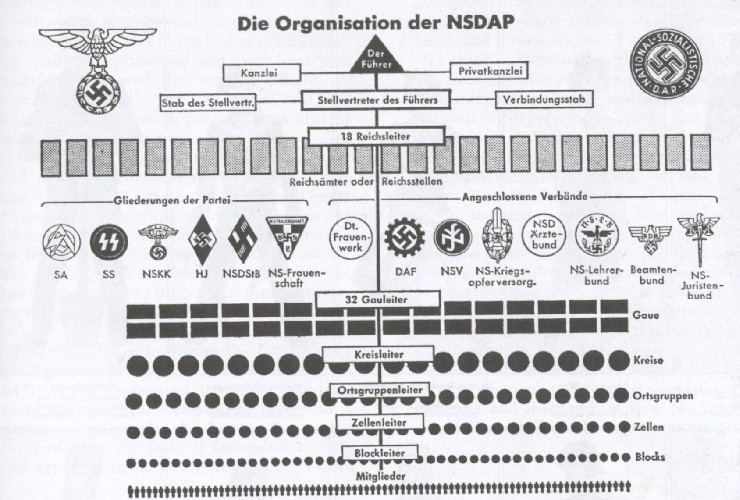
NSDAP ORGANIZATION CHART SHOWING
OTHER ALPHABETICAL SYMBOLISM
Pledge of Allegiance, Francis Bellamy, Edward Bellamy,
Looking Backward, Julian West, James Upham, Youths Companion, Nationalism,
Socialist Revolution, Theosophical, Theosophy, Blavatsky
**************
Opel acquired the familiar circle logo in 1935 as the
National Socialist German Workers' Party came to power and as its
alphabetical S-letter swastika for "socialism" pervaded society. The
circle contained a stylised dirigible airship displayed inside the
"O" representing the german socialist engineering "expertise."
An earlier Opel logo was known as the "eye" logo designed
by The Grand Duke of Hesse for Wilhelm Von Opel in 1910 after Wilhelm
had visited the US to study vehicle manufacture. "The Opel Eye"
was used until 1935 and during the takeover by General Motors in 1929.
The second world war brought problems for the company. Opel supplied
war equipment to Hitler's german army and with the profits, paid dividends
to it's American shareholders. The allies then promptly bombed the
Opel factory almost to destruction during the course of the war.
The more modern Opel "Z" logo within the circle did not
begin until 1964.
Deutsche Arbeitsfront (DAF or German Labor Front) logos used a swastika
encircled by a cogwheel. It was the origin of the Volkswagen logo, both
philosophically and stylistically. http://rexcurry.net/bookchapter4a1a2a1.html
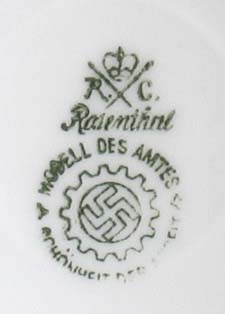
The emblem is encircled by the words MODELL DES AMTES SCHÖNHEIT
DER ARBEIT (Approved Model of the Office of Beauty of Labor) in the following
linked example image from porcelain that also shows the the Rosenthal crown
logo. http://rexcurry.net/deutsche-arbeitsfront-DAF-german-labor-front.jpg
The Office of Schönheit der Arbeit of the DAF decided what constituted
kitsch (trash) in Germany and what constituted good industrial design under
German socialism. Firms that produced what the socialists wanted were
allowed to use the MODELL DES AMTES SCHÖNHEIT DER ARBEIT cogged wheel
and swastika logo of the DAF as a seal of approval. http://www.youtube.com/watch?v=BssWWZ3XEe4
The swastika was used as S-letters for "Socialism" under the National
Socialist German Workers Party, as shown by the world-renowned symbolist
Dr. Rex Curry (author of "Swastika Secrets"). http://rexcurry.net/book1a1contents-swastika.html
Volkswagen's meshed VW logo letters are another example of alphabetical
symbolism that is similar to the meshed S-letters of the swastika for "socialism"
under the National Socialist German Workers Party. http://rexcurry.net/swastika-audi-logo.JPG
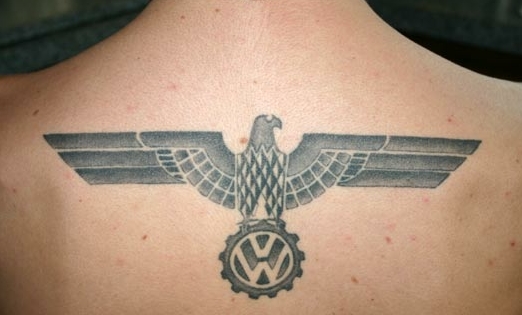
Are VW Volkswagen emblems used as swastika substitutes in
tattoos and symbolism today? Secrets exposed about the alphabetical
symbolism of the S-letters in the swastika under the National Socialist
German Workers' Party.
Tattoos and symbols in the Ku Klux Klan ( KKK ) often use
religious images, swastikas (the hooked cross) and symbols from the
National Socialist German Workers Party or from Christian Socialism.
Learn more at http://rexcurry.net/kkk-ku-klux-klan-christian-socialism.html
An amazing new historical discovery reveals how
the former Union of Soviet Socialist Republics adopted the swastika's
socialist symbolism from the National Socialist German Workers'
Party. http://rexcurry.net/trabant-sachsenring-rex-curry.html