Volkswagen logo, VW logo expose
the Hakenkreuz - swastika
as "S" letters symbolizing "Socialism" of the
National Socialist German Workers' Party - Nazism

|
|
Are Audi & VW Volkswagen emblems related to the
swastika's alphabetical symbolism?
The
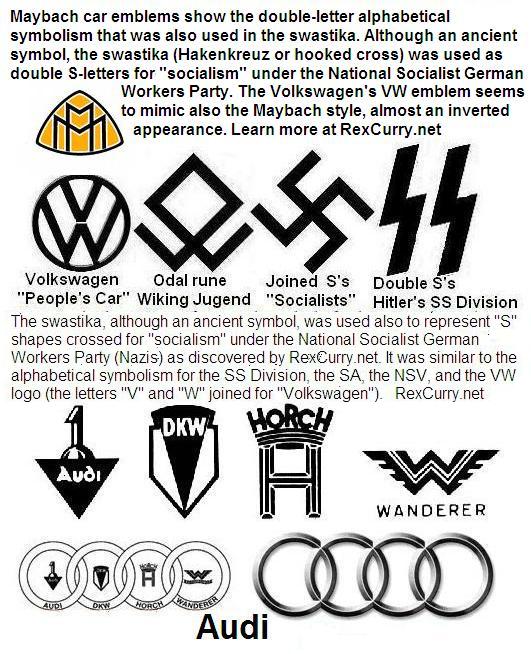
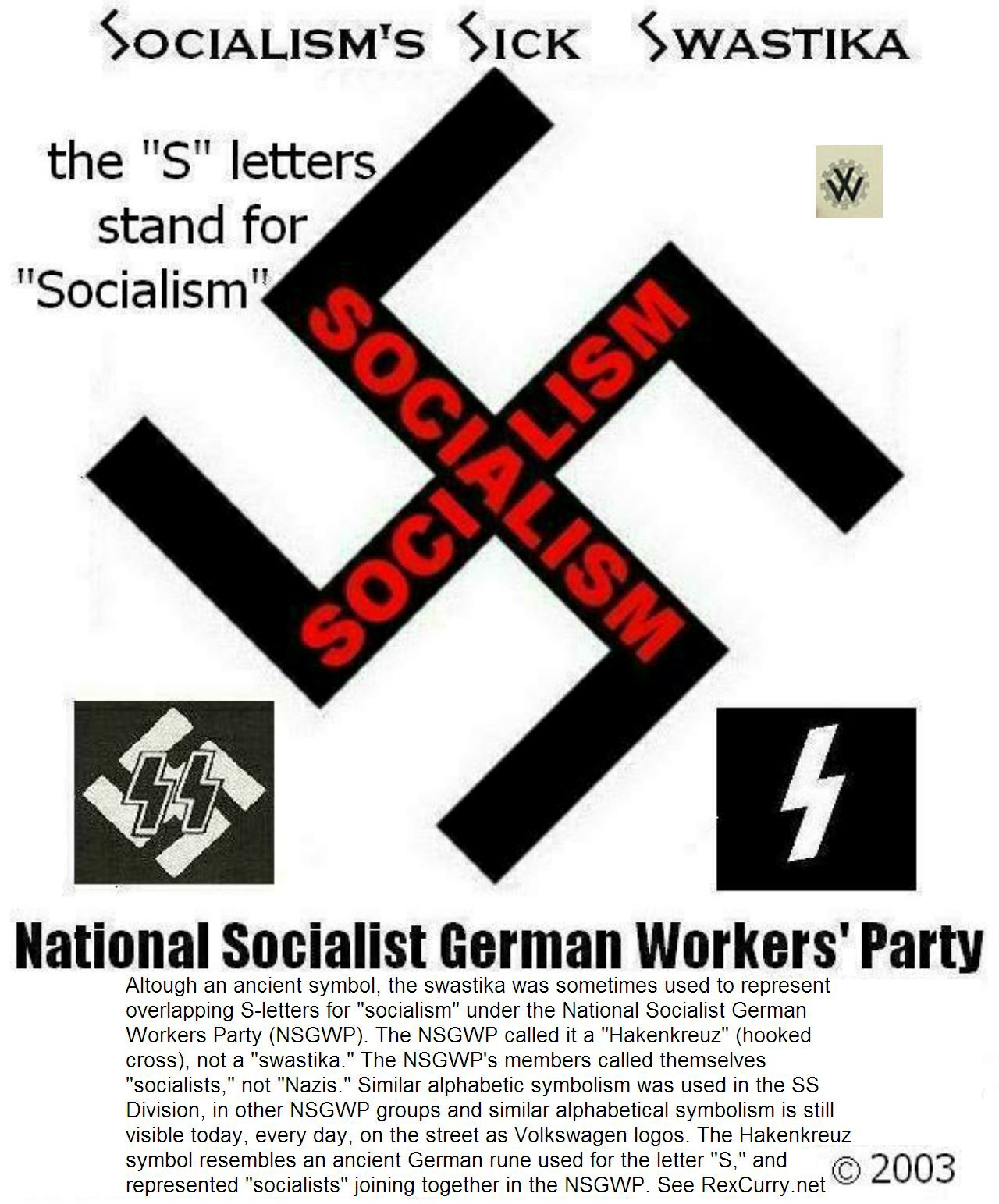
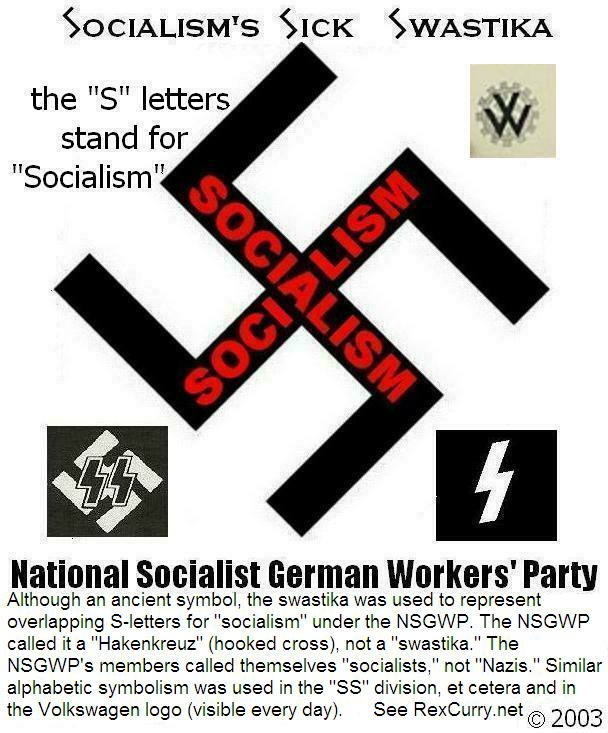
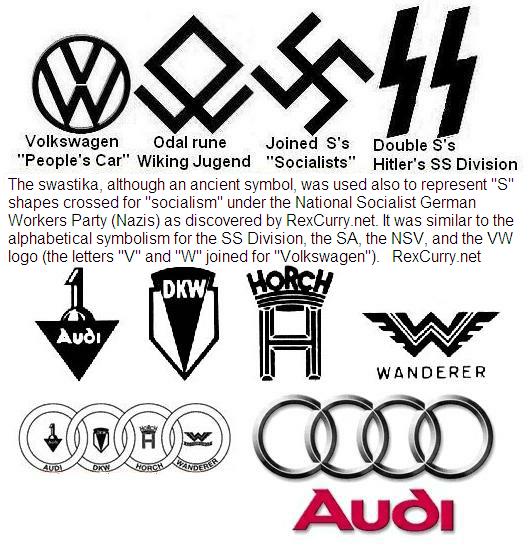
swastika, although an ancient symbol, was also used to represent "S" letters
joined for "socialism" under the National Socialist German Workers Party
(Nazis), similar to the alphabetical symbolism for the SS Division, the
SA, the NSV, and the VW logo (the letters "V" and "W" joined for "Volkswagen"). http://rexcurry.net/book1a1contents-swastika.html
|
^ Hammer
and Sickle Tattoos of the USSR and
Soviet Socialist Swastikas are related to tattoo topics
in the USSA (United Socialist States of America)
http://rexcurry.net/ussr-socialist-swastika-cccp-sssr.html
|
|
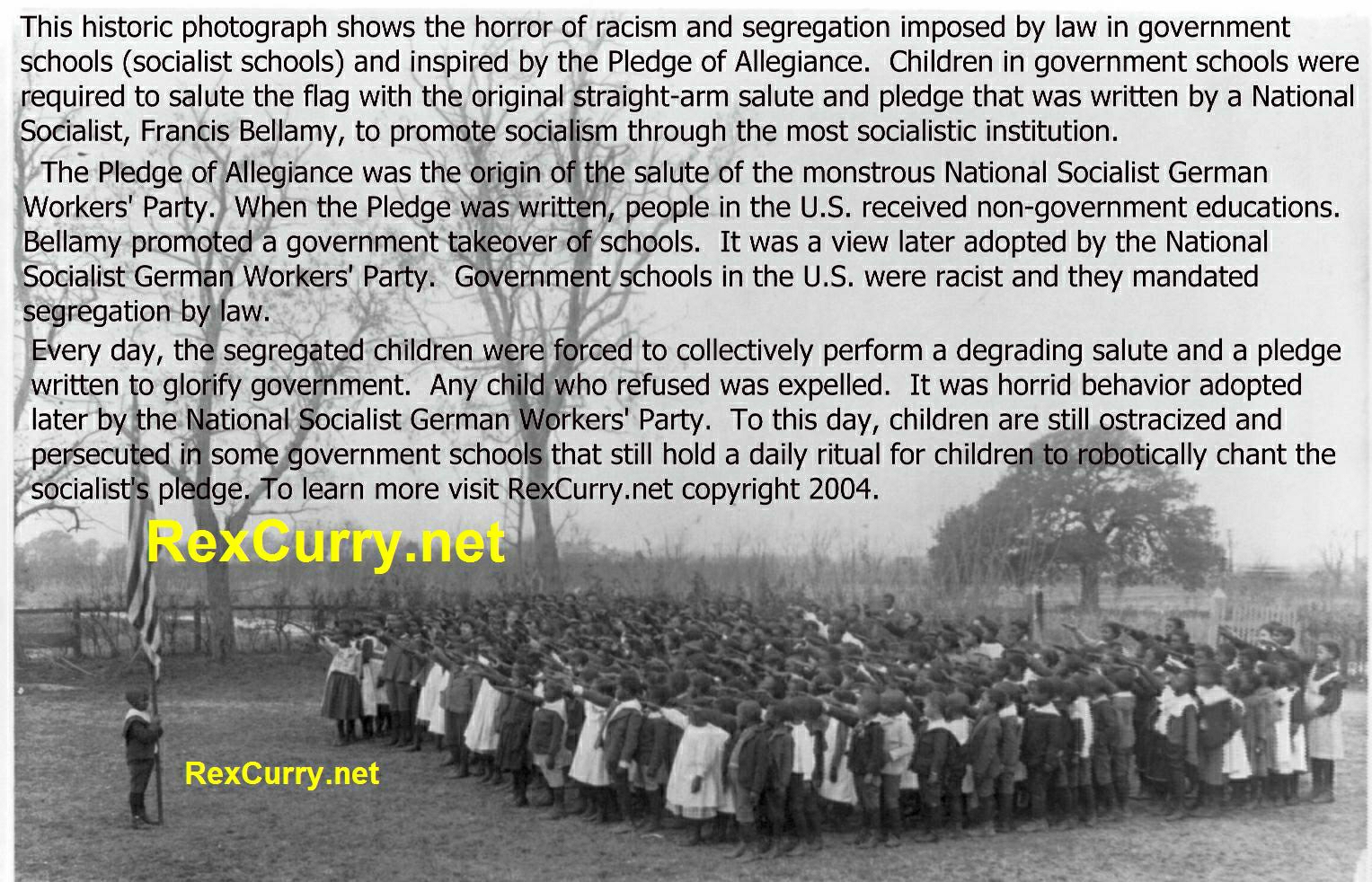
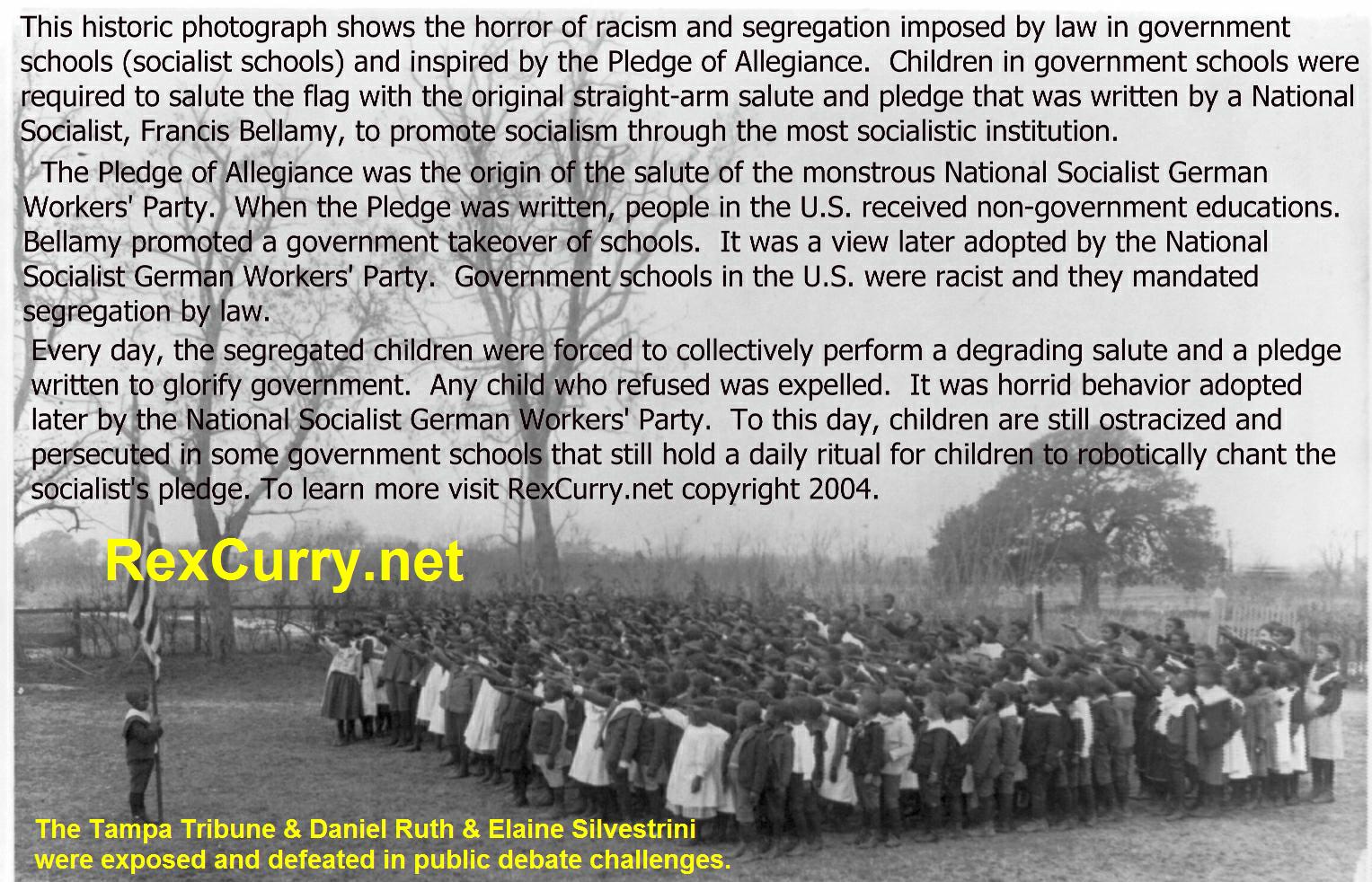
The Pledge of Allegiance was
the origin of Adolf Hitler's "Nazi" salute under the National Socialist German
Workers Party (Nazis). Francis Bellamy & Edward Bellamy touted
National Socialism and the police state in the USA decades before their dogma
was exported to Germany. http://rexcurry.net/pledge2.html
|
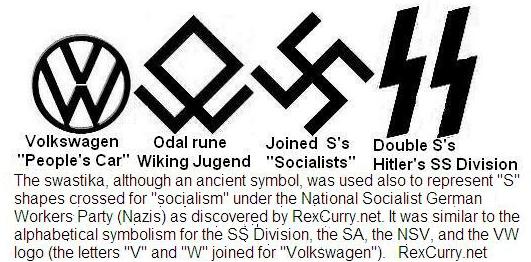
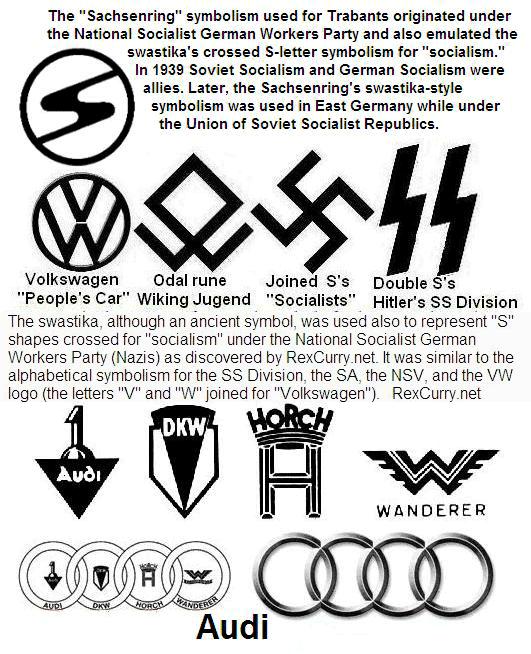
The Volkswagen logo is alphabetical symbolism of
the meshed letters "V" and "W" that exposes the swastika as intertwined
"S" shapes symbolizing "Socialism" for the monstrous National
Socialist German Workers' Party. It is more proof in support of discoveries
by the noted historian and symbologist Dr. Rex Curry. http://rexcurry.net/bookchapter4a1a2a.html
Audi also supports Dr. Curry's discoveries. http://rexcurry.net/bookchapter4a1a2a1.html
Trabant also provides support for the discoveries.
http://rexcurry.net/trabant-sachsenring-rex-curry.html
Maybach-Motorenbau GmbH provides additional evidence.
http://rexcurry.net/maybach-car-pictures.html
Organisation Todt under Dr. Ing. Fritz Todt also lends support. http://rexcurry.net/bookchapter4a1a2b.html
The Krit Motor Car Company of Detroit supports Dr. Curry's discoveries.
It was an American car that bore a swastika long before it was associated
with German cars and the Volkswagen VW. http://rexcurry.net/krit_motor_car_company_detroit.html
More graphic examples are at http://rexcurry.net/swastika-vw-logo.JPG
Many people forget that the word "Nazi" is a syncopation for "National
Socialist German Workers Party." The group's actual full name indicates
Nazism's clear affinities with collectivism.
Germany in the 1930's often used symbols for letters
and words. Common symbols under the National Socialist German
Workers' Party often used the "S" shape, including the side-by-side
use in the "SS" Division and the overlapping use in the Hakenkreuz
- swastika. The German word for "swastika" is "Hakenkreuz" ("hooked
cross" or "armed cross").
Swastika images 1 http://rexcurry.net/swastika3clear.jpg
Swastika pictures 2 http://rexcurry.net/swastika3swastika.jpg
Swastika images 3 http://rexcurry.net/fascism-third-reich-hitler-nazism-swastika456.jpg
Hitler was aware of the practice, and perhaps
the source of the practice, in that he evolved "Adolf Hitler" into
"S Hitler" in his own signature. http://rexcurry.net/bookchapter4a1a4.html
It was a manner of declaring his socialism every time
he signed his name and it was equivalent to signing "Socialist
Hitler."
It is part of growing evidence that supports the
discovery by Dr. Rex Curry (in the book "Swastika Secrets") that
the Hakenkreuz, although an ancient symbol, was used also to represent
"S" shapes for "Socialism" and its victory under the horrid National
Socialists.
http://rexcurry.net/book1a1contents-swastika.html
Dr. Curry is also famous for proving that the USA's
early Pledge of Allegiance was the origin of the straight-arm
salute adopted later by the National Socialist German Workers' Party.
http://rexcurry.net/book1a1contents-pledge.html
For additional proof of the use of the "S" shapes
of the "sieg" runes see a newly discovered youth's book at http://rexcurry.net/bookchapter4a1a3.html
and posters http://rexcurry.net/bookchapter4a1b.html
and more posters at http://rexcurry.net/socialist-propaganda/posters1.html
and German medals at http://rexcurry.net/socialism/germany.html
and flags and banners at http://rexcurry.net/swastikaflags.html
and for a fuller explanation see http://rexcurry.net/swastikanews.html
Another rune, the Odal rune, was used as a symbol
of the "Wiking Jugend" (Viking Youth, or Viking Young'uns).
The Volkswagen symbol then emulated the popular runes its
alphabetic symbolism, as discovered by Professor Curry.
The original VW logo was not "VW" but the swastika
/ Hakenkreuz. http://rexcurry.net/swastika-vw-logo1.jpg
Before the VW emblem was created, the organization that controlled
volkswagen was the Deutsche Arbeitsfront (DAF or German Labor Front)
and its logo used a swastika encircled by a cogwheel. http://rexcurry.net/swastika-vw-logo1.jpg
The Deutsche Arbeitsfront logos was the origin of the Volkswagen logo,
both philosophically and stylistically.
http://rexcurry.net/deutsche-arbeitsfront-DAF-german-labor-front.jpg
Similar alphabetical symbolism was used under the NSDAP for
the "SS" division, the "SA," the "NSV," et cetera. http://rexcurry.net/swastika-alphabetic-symbolism-nsdap2.jpg
The VW was known as the "swastika hubcap" car. The
early versions and drawings actually had swastika hubcaps, just
as the older versions had "VW" hubcaps. Some people believe that
the VW hubcaps resemble the swastika at certain speeds of rotation.
Hitler used the Volkswagen for his socialist propaganda.
The swastika was within the original cogged-wheel (gear)
symbol that later had the "VW" letters placed within it. The
"VW" letters replaced the original meshed "S" letters.
Dr. Curry's work has been announced and verified on
Wikipedia. A recent article at opinioneditorials.com reports on
the many references to Dr. Curry's research and discoveries on Wikipedia.
Even Jimbo Wales, Wikipedia founder, has publicly noted Dr. Curry's
influence on Wikipedia. Wikipedia writers use Dr. Curry's work without
attribution in apparent attempts to bolster their own credibility.
Volkswagen’s iconic buttressing of V and W was
the creation of an engineer named Franz Reimspiess. He was also
the same man who perfected the engine for the Beetle in the 1930s.
Nikolai Borg, 86, who now lives in Austria, says
he was involved in the development of the VW logo. The young commercial
artist impressed others when he won the competition for the creation
of a logo for the "Deutsche Jugendherbergswerk" (German youth mountain
hostel work?). Borg says that he was invited to draw the
car logo in a request from high-up: Dr. Ing. Fritz Todt,
with the "organization Todt" the general inspector for roads and
a militarily organized building troop used in the entire theater
of war. Borg made nine drafts with different connections of the
letters V and W before the final version was created.
Organisation Todt also supports Dr. Curry's discoveries regarding the alphabetical
symbology of the swastika. http://rexcurry.net/bookchapter4a1a2b.html
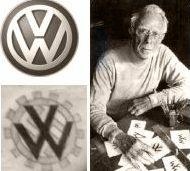
In photographs, Nikolai Borg shows that the VW logo
was created simply by replacing the two S letters of the swastika
with the two letters V and W.
http://rexcurry.net/volkswagen-vw-beetle-nikolai-borg-swastika.jpg
Also see Nikolai Borg in this photograph http://rexcurry.net/volkswagen-vw-beetle-nikolai-borg-swastika2.jpg
Literally, the word "volkswagen" means "people's
car" (cf. "folk's wagon"). When the early VW versions were
introduced, Hitler abruptly changed the name of the car to KdF
Wagen. KdF stood for "Kraft durch Freude" which meant "Strength
through Joy." The name-change upset Porsche, as he was not
a member of Hitler's Nazi-Sozi party, and he didn't support Hitler's
use of socialist propaganda to advertise the car.
Of the original KdF name, Hitler said: "It bears
the name of the organization that has done the most to fill the
broad masses with pleasure and therefore strength. It will be called
the 'KdF-Wagen.' "
There were many other socialist clichés.
The "Strength through Joy" program was part of a scheme to provide
holidays to workers at inexpensive rates. It was related
to the "Beauty of Labor" (Schönheit der Arbeit) office.
The phrase "Arbeit macht frei" ("Work brings Freedom") glared
at concentration camps.
Born out of sinister intentions, the VW Beetle
was propaganda for German socialists in helping create unity in
pre-war Germany. Hitler imposed socialism in the car market and
pushed the project.
The Beetle was the brainchild of Dr. Ferdinand Porsche,
a freelance automotive designer and constructor. In 1930, Porsche
set up an automotive design company, the Porsche Büro. In
1933, Adolf Hitler met with Porsche to discuss the socialist leader's
idea of a volkswagen.
Porsche drew inspiration from the success of Henry
Ford's creation of the mass-produced Model T. It is unfortunate
that the Volkswagen went down the road of socialism, instead of
the road of capitalism and the free market blazed by Henry Ford.
The leader of German socialism gave the project
his whole-hearted support, and became directly involved in plans
for the car's production. By 1938, several early production cars
had been constructed and production facilities had been built.
In 1939, the National Socialist German Workers'
Party joined with the Union of Soviet Socialist Republics as allies
to invade Poland in a pact of military socialism to divide up Europe.
The Second World War ended passenger-car production plans, and the
Stuttgart factory was converted to military use.
Only later, after the Volkswagen was towed from
socialism and driven by capitalism, would it meet its modern success.
Near the end of World War II many men in the "Volksgemeinschaft"
(national community), both young and old, were called upon to
serve in the "People's Army " (Volksturm).
Audi still uses the German tag line "Vorsprung
durch Technik." The tag line is used either in original or in
its English translation "Advantage through Technology." It
is an odd reminder of socialist clichés from the 1930's.
http://rexcurry.net/bookchapter4a1a2a1.html
Those clichés led to the socialist Wholecaust
(of which the Holocaust was a part): ~60 million slaughtered
under the Union of Soviet Socialist Republics; ~50 million under
the Peoples' Republic of China; ~20 million under the National Socialist
German Workers' Party. It was the worst slaughter in human history.
Sometime after 1945, the car company was re-named
Volkswagen by the British and the factory was placed under the
control of a man named Hirst. The British also renamed the
town at the factory "Wolfsburg", which was the name of a local castle.
In a bizarre way, some Nazism may still exist
at Volkswagen within Germany. In 1949 Hirst left the company,
now re-formed as a trust controlled by the West German government.
Volkswagen is said to still be owned by the government of Lower Saxony,
though it is not "run" by the state government. Ferdinand
Porsche's grandson, Ferdinand Piech, was chairman and CEO of the Volkswagen
Group from 1993 to 2002. With half of all voting shares, he also remains
the largest individual shareholder of Porsche AG. Stock can be
purchased in Volkswagen companies. Founded in 1955, Volkswagen of America,
Inc. is headquartered in Auburn Hills, Michigan, and is a wholly owned
subsidiary of Volkswagen AG, one of the world's largest automakers. Volkswagen AG (the Volkswagen Group) consists of
the Volkswagen plants in Wolfsburg, Brunswick, Hanover, Kassel, Emden
and Salzgitter. It is the parent company of all other companies in the
Volkswagen Group, which are either wholly owned subsidiaries or companies
in which Volkswagen AG has majority ownership. The Company operates
44 production plants in 11 European countries, as well as seven countries
in the Americas, Asia and Africa, etc.
Before WW II, when the car was still socialism's
“Strength through Joy” car the logo was surrounded by the gear
shaped emblem of the German Labor Front, a socialist group that
built it. The National Socialist German Workers' Party
had begun as the "German Workers' Party" before adding "National
Socialist" to its name.
The flag for Units of the German Labor Front had
as the center field the symbol of the Deutschen Arbeitsfront (DAF,
German Labor Front): a black cog wheel containing a black swastika.
The finial took the form of the DAF emblem, a voided white cogwheel
containing a swastika, all in polished white metal (from the Osprey
Men-At-Arms Series, #278 "Flags of the Third Reich 3: Party &
Police Units", p. 37).
An early design for the car featured the letter
V above a W and surrounded by a cog. After the war, Britain had
the cog changed to a circle and that design was filed for copyright
in 1948. The Volkswagen or "people's car" project was part of the
Nazi Kraft durch Freude propaganda scheme run by the Deutsche Arbeitsfront
(DAF). The logo of the DAF was a swastika surrounded by a cog – from
which the VW logo was derived.
Image at http://rexcurry.net/fascism-third-reich-hitler-nazism-swastika456.jpg
To control trade unions and the economic
workforce, the National Socialist German Workers' Party
(the National Socialistiche Deutsche Arbeiter Partei - NSDAP) created
the German Labor Front (Deutsches Arbeitsfront - DAF)
in 1933. The purpose of the German Labor Front was
to control the German labor unions through a centrally controlled
organization led by National Socialists. The German
Labor Front adopted a paramilitary structure similar to
that of the National Socialist German Workers Party.
While membership was called "voluntary," essentially every German
worker was required to be a member. This was particularly true
of those workers associated with prime industries such as
cars, transportation, utilities, textile trades, armament manufacturing,
legal services, agriculture and the like (in other words, just
about everything of course). The organization was divided into
two parts including the National Socialist Factory Organization
(Nationalsozialistische Betriebsorganization-NSBO) and
the National Socialist Trade and Industry Organization (Nationalsozialistische
Handels und Gewerbeorganization-NSHAGO).
Members of the German Labor Front were required to own and
wear uniforms that denoted their status within the
structure of the organization. Following the
outbreak of war, members were often required to serve as factory
guards or to volunteer for membership in associations
like the National Air Protection League (Reichsluftschutzbund)
and other Air Protection (Luftschutz) groups. In
this capacity, it was their job to help protect industrial
facilities as well as to coordinate with outside organizations
that helped to ensure the safe operation of factory facilities.
Many members of the German Labor Front also served as official
members of the Factory Police (Werksschutzpolizei-WSP).
By 1942, the German Labor Front also organized independent and locally
trained members who volunteered to operate anti-aircraft flak
batteries to protect individual factories from Allied bombs.
Copyright © by RexCurry.net All rights
reserved
Volkswagen logo image, VW logo image http://rexcurry.net/swastika3swastika.jpg
Evolution of the swastika into other symbols
http://rexcurry.net/bookchapter4a1a2.html
Volkswagen's VW logo exposes the swastika
http://rexcurry.net/bookchapter4a1a2a.html
The Soviet Socialist Trabant car symbol
http://rexcurry.net/trabant-sachsenring-rex-curry.html
Audi's logo provides more insights
http://rexcurry.net/bookchapter4a1a2a1.html
Todt Organization T-O logo exposes the
swatika http://rexcurry.net/bookchapter4a1a2b.html
States Steamship Company States Line logo
http://rexcurry.net/states-steamship-company-states-line.html
Allach Porcelain logo shows symbolism
http://rexcurry.net/allach-porcelain-munich-germany-swastika-mark.html
The field of runology supports Doctor Curry's
work http://rexcurry.net/guido-von-list-runes-swastika.html
Hitler Youth learned secrets of the swastika
http://rexcurry.net/bookchapter4a1a3.html
The symbol's N-S alphabetic symbolism
http://rexcurry.net/nazism-national-socialist-german-workers-party.html
Hitler's own words expose the swastika
myth http://rexcurry.net/bookchapter4a1a3b.html
Hitler's signature evolved into "S" for
"Socialism." http://rexcurry.net/bookchapter4a1a4.html
Hitler's other alphabetic symbolism &
Steven Heller http://rexcurry.net/swastikanews.html
Herman Goering shows his socialist signature
http://rexcurry.net/swastika-goering.JPG
The sign of socialism: the socialist
signature of Franz Hanfstaengl http://rexcurry.net/swastika-hanfstaengl.html
More on Leni Riefenstahl and her socialist
signature http://rexcurry.net/z6.jpg
Karl May favorite author of Adolf Hitler
http://rexcurry.net/karl-may-adolf-hitler-swastika-kkk-ku-klux-klan.html
Socialism in Signatures http://rexcurry.net/swastika-socialism-karl-may.jpg
The Swastika's "S" symbolism in posters
after 1933 http://rexcurry.net/national-socialists1.html
More Nazi posters 1933-1945 http://rexcurry.net/socialism-posters/posters2.html
Pre-1933 National Socialist posters at
http://rexcurry.net/socialist-propaganda/posters1.html
Pre-1933 more posters http://rexcurry.net/socialist-propaganda/national-socialism-posters.html
The swastika myth debunked in German medals
http://rexcurry.net/socialism/germany.html
Nazi-Sozi flags & banners
http://rexcurry.net/swastikaflags.html
Swastika stamps http://rexcurry.net/swastika-stamps.html
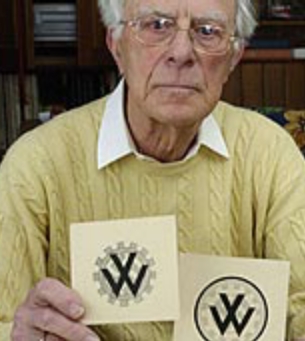
Nikolai Borg
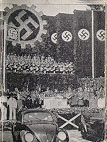
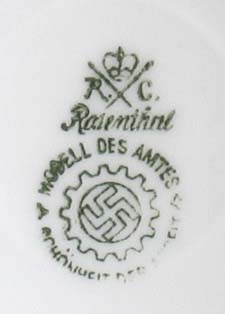
Deutsche Arbeitsfront (DAF or German Labor Front) logos used a swastika
encircled by a cogwheel. It was the origin of the Volkswagen logo, both
philosophically and stylistically. http://rexcurry.net/bookchapter4a1a2a1.html
The emblem is encircled by the words MODELL DES AMTES SCHÖNHEIT
DER ARBEIT (Approved Model of the Office of Beauty of Labor) in the following
linked example image from porcelain that also shows the the Rosenthal crown
logo.
http://rexcurry.net/deutsche-arbeitsfront-DAF-german-labor-front.jpg
The Office of Schönheit der Arbeit of the DAF decided what constituted
kitsch (trash) in Germany and what constituted good industrial design under
German socialism. Firms that produced what the socialists wanted were allowed
to use the MODELL DES AMTES SCHÖNHEIT DER ARBEIT cogged wheel and
swastika logo of the DAF as a seal of approval. http://www.youtube.com/watch?v=BssWWZ3XEe4
The swastika was used as S-letters for "Socialism" under the National
Socialist German Workers Party, as shown by the world-renowned symbolist
Dr. Rex Curry (author of "Swastika Secrets"). http://rexcurry.net/book1a1contents-swastika.html
Volkswagen's meshed VW logo letters are another example of alphabetical
symbolism that is similar to the meshed S-letters of the swastika for "socialism"
under the National Socialist German Workers Party. http://rexcurry.net/swastika-audi-logo.JPG
See related information regarding Allach porcelain. http://rexcurry.net/allach-porcelain-munich-germany-swastika-mark.html
Volkswagen logo image, VW logo image
VW Volkswagen, Swastika, Nazi Tattoos http://rexcurry.net/swastika-vw-volkswagen-tattoo-nazi-eagle.jpg
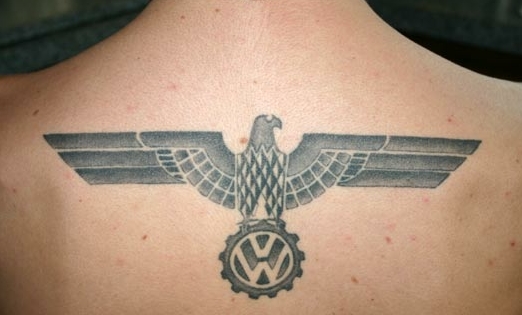
Are VW Volkswagen emblems used as swastika substitutes
in tattoos and symbolism today? Secrets exposed about the alphabetical
symbolism of the S-letters in the swastika under the National Socialist
German Workers' Party.
http://rexcurry.net/swastika-vw-volkswagen-tattoo-eagle.jpg
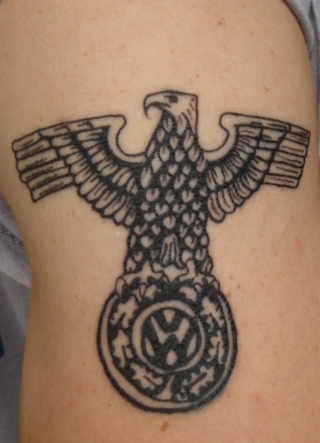
http://rexcurry.net/swastika-vw-volkswagen-tattoo-arm.jpg

http://rexcurry.net/swastika-vw-volkswagen-tattoos.jpg
German symbolism is related to swastika tattoos, swastika
fet!shism, and the "Socialist Slavery" symbolized by the overlapping
S-letters of the swastika under the National Socialist German
Workers Party.

Tattoos and symbols in the Ku Klux Klan ( KKK ) often
use religious images, swastikas (the hooked cross) and symbols from
the National Socialist German Workers Party or from Christian Socialism.
Learn more at http://rexcurry.net/kkk-ku-klux-klan-christian-socialism.html
The KKK
& swastikas
are related to Flag Tattos & Fet!shism. http://rexcurry.net/tattoos.html
VW VOLKSWAGEN & SWASTIKA BODY TATTOOS ? http://rexcurry.net/bookchapter4a1a2a1.html
Swastikas
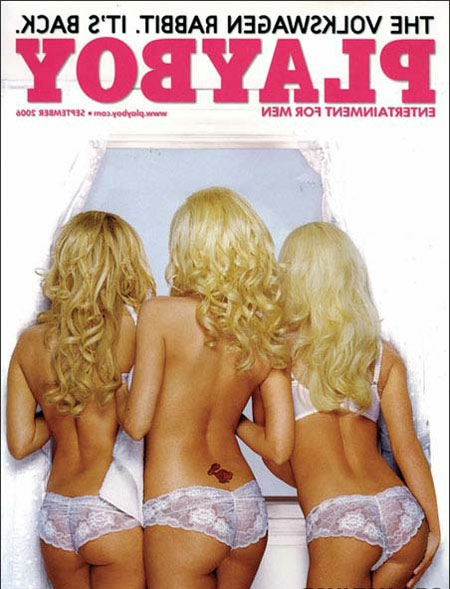
VW Rabbit Volkswagen tattoo Playboy Magazine http://rexcurry.net/swastika-vw-volkswagen-rabbit-bunny.jpg
SWASTIKA http://rexcurry.net/swastika3clear.jpg
SWASTIKA
If you have ever wondered about the origin of American
National Socialists just look below.
http://rexcurry.net/origin-of-the-world-gustave-courbet-mussee-dorsey.jpg
Trabant Logo Sachsenring
An amazing new historical discovery reveals
how the former Union of Soviet Socialist Republics adopted
the swastika's socialist symbolism from the National Socialist
German Workers' Party.
http://rexcurry.net/trabant-sachsenring-rex-curry.html
Image at http://rexcurry.net/fascism-third-reich-hitler-nazism-swastika456.jpg
Nazism image http://rexcurry.net/fascism-third-reich-hitler-nazism-swastika456.jpg
KdF Wagen "Kraft durch Freude" Strength through Joy http://rexcurry.net/pledge-allegiance-pledge-allegiance.jpg
THIRD REICH RITUALS
PLEDGE OF ALLEGIANCE http://rexcurry.net/edward%20bellamy.jpg
ADOLF HITLER RITUAL
http://devilgraphics.com/volkswagen/a-audi-logoJPG10.JPG
Hitler salute http://ftp.ij.net/rex/nazi%20salute%204.jpg
Edward Bellamy http://ftp.ij.net/rex/swastika3swastika.jpg
Francis Bellamy http://ftp.ij.net/rex/pledge-allegiance-pledge-allegiance2.jpg