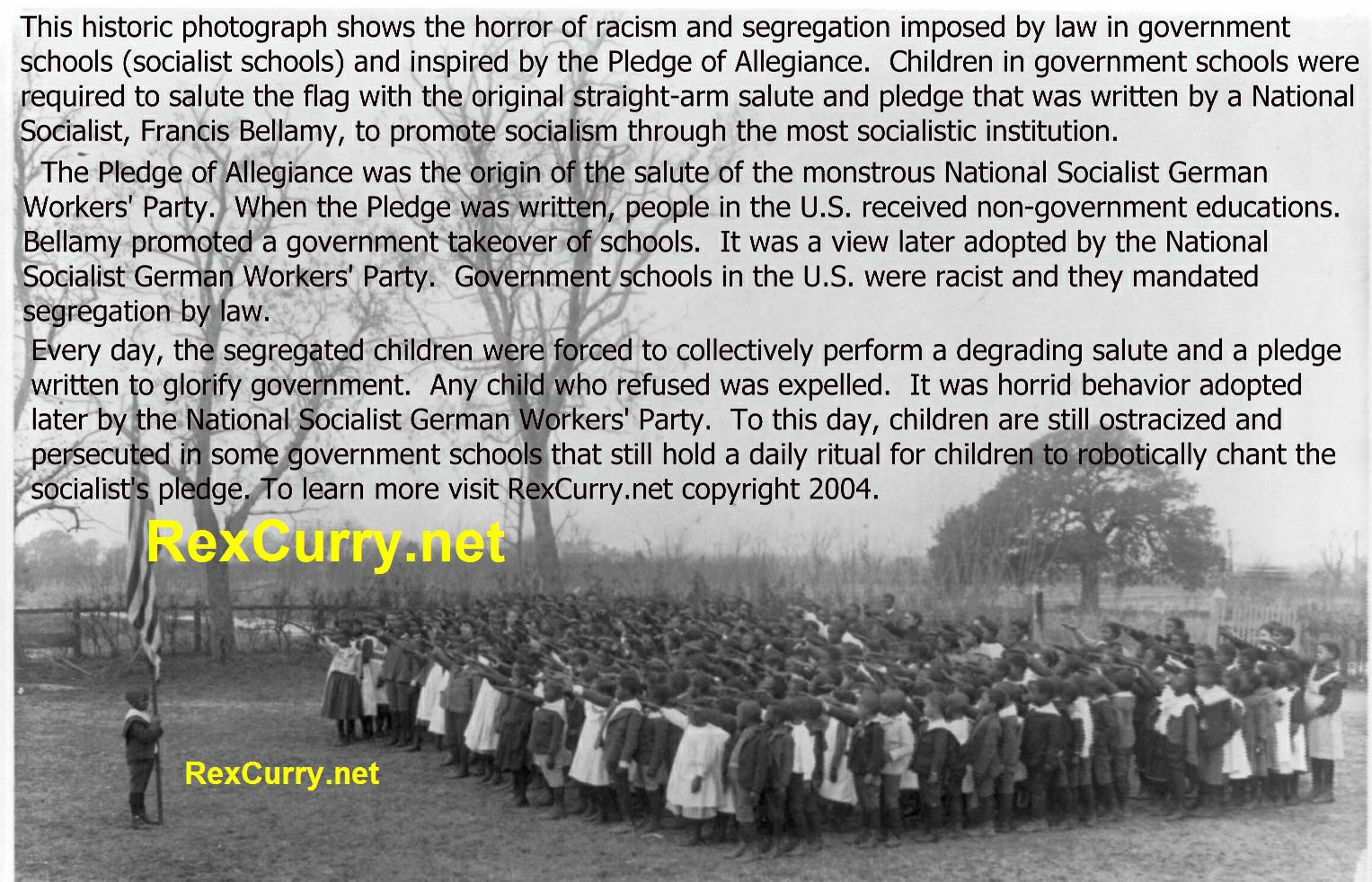
| Pledge of Allegiance info &
shocking photos & images at http://rexcurry.net/book1a1contents-pledge.html Symbology and fascinating discoveries http://rexcurry.net/book1a1contents-swastika.html |
The following is a response to an idiotic email from someone claiming to be a "Dr. Stephen E. Flowers": Are you really Stephen E. Flowers at a "Woodharrow Institute"? Because Stephen Flower's "research" is poor or non-existent on this topic, while Dr. Rex Curry's is voluminous (and Flowers does not dispute any of Dr. Curry's work with any citation at all). If you are Stephen Flowers, then you embarrassingly repeat the debunked commonplace myth that "The salute originates with the Romans..." for which you provide no research or support, of course, as you know there is none (and that is classic claptrap characterizing Wikipedia where Flowers is in the embarrassing position of being an "advocate" on Wikipedia's wikiproject of "Germanic Mysticism"). There is everything "sinister" about the salute's use to promote socialism and the worship of government. Because a symbol or sign is used at some point in its history for a purpose which is to your liking, does not make such a purpose (e.g. socialism and the socialist Wholecaust and the Holocaust which was a part of it) any less sinister. Your flawed logic lessens all your work. It is no wonder that you do not actually dispute any of Dr. Curry's work with any research that you can cite. |
| Pledge of Allegiance
in frightening images and articles at http://rexcurry.net/book1a1contents-pledge.html
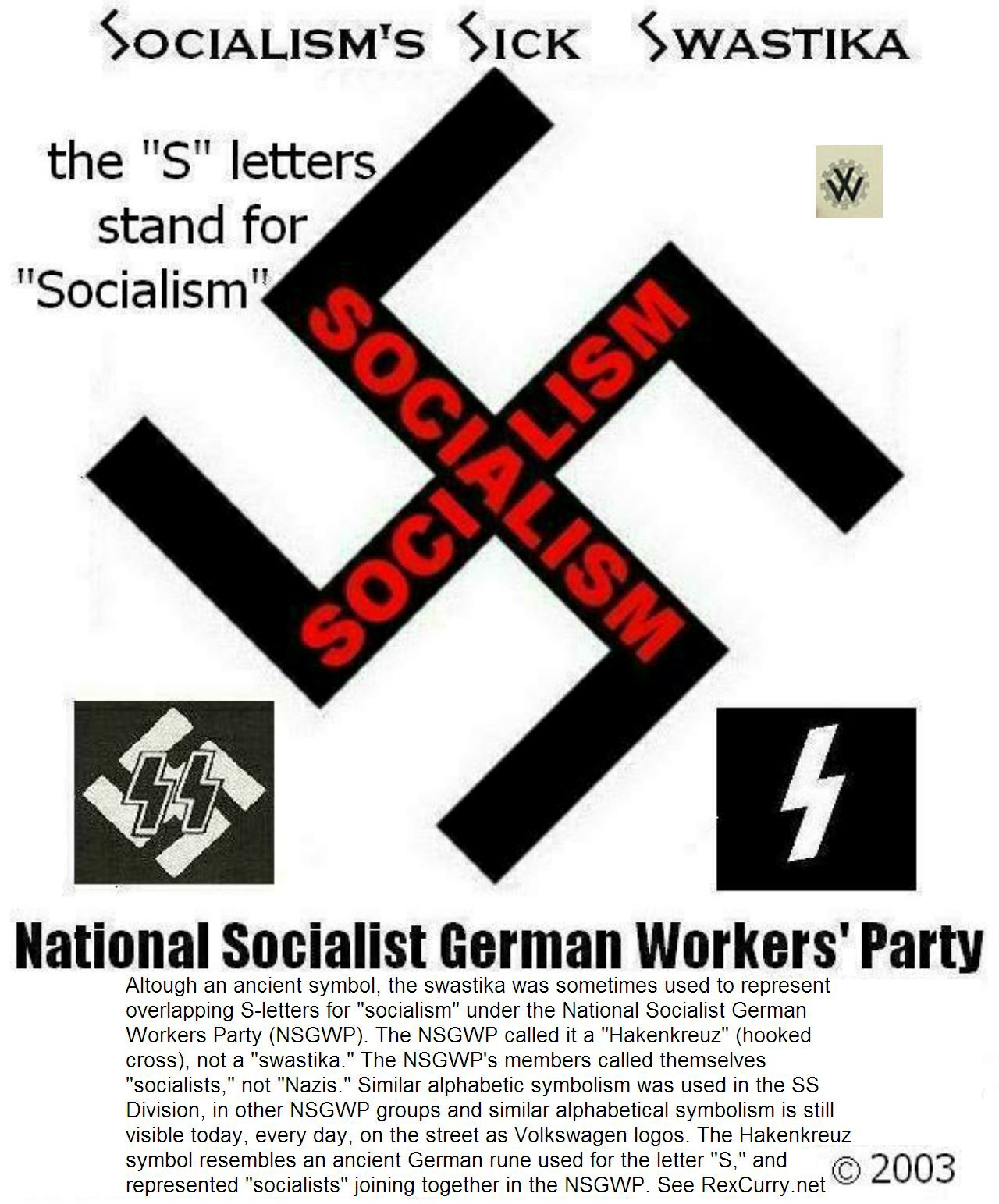
For fascinating information about symbolism see http://rexcurry.net/book1a1contents-swastika.html |
| The
Roman salute is a gesture in which the arm is held out forward
straight, with palms down. Sometimes the arm is raised upward
at an angle, sometimes it is held out parallel to the ground. Despite
the gesture's name, it is unclear whether the Romans used it in
the same context as understood in modern culture; the current
interpretation of a "salute" would seem to have evolved over time,
more substantially in recent periods. |
The wikipedia article
on the "Roman Salute" becomes more dishonest by the week. An
earlier version referenced the work of Professor Rex Curry and
started thusly: "The Roman salute is a gesture in which the arm is
held out forward straight, with palms down. Sometimes the arm is
raised upward at an angle, sometimes it is held out parallel to the
ground. The salute was supposed to have been used in the Roman republic,
but there is no clear evidence of this. Indeed it is not known whether
salutes in the military sense existed at all in Roman culture" (by Paul
Barlow). A more recent version of the same article is written as
if a wikiling writer is a neo-Nazi who is covering-up. A big initial problem is that no wiki writer will even attempt to discover the first use of the phrase "Roman salute" and thus the writers remain stuck in intellectually dishonest confusion about dates and origins. |
| Since the
strength of the Roman legions lay in their discipline, all Roman
legionaries right and left-handed were taught to hold their weapons
in their right hand. Since Roman society was highly militarized,
some historians presume that the Roman salute originated from a
greeting and a symbol meaning "I come in peace holding no weapons." |
The reference to the
"I come in peace holding no weapons" myth is at least labeled
a presumption. Wikiling writers have to support their
myths with other myths and speculations. |
| The
salute was supposed to have been used in the Roman republic,
but there is no clear evidence of this. Indeed it is not known
whether salutes in the military sense existed at all in Roman
culture. However, a number of images showing similar gestures exist
from the Imperial era. These depict Roman leaders addressing their
troops ("adlocutio" scenes). Usually the leader has his arm raised
in a rhetorical gesture. In some images a few troops are also depicted
with raised arms, possibly suggesting acclamation of the leader. Several
such scenes appear on Trajan's column. |
Eventually, the wiki
article reverts back to its earlier opening concessions to
the work of Dr. Curry, and the article concedes that there is
no clear evidence of the salute in the Roman Republic and it concedes
that there is no evidence of salutes in the military sense at all
in Roman culture. http://rexcurry.net/book1a1contents-pledge.html The wikiling writer then engages in speculation that people today misunderstood some images from ancient Rome. There is no support for the idea that the "Roman Salute" concept arose long ago from misinterpretations of Roman images. There is as much evidence that, after Dr. Curry's shocking discoveries about the salute's origin with the Pledge of Allegiance, modern writers (including wiki writers) deliberately looked for other explanations and then those writers misinterpreted Roman images in order to cover-up Professor Curry's discoveries. |
| The
association of the gesture with Roman republican culture seems
to have emerged in 18th century France with revolutionary and
anti-monarchist movements of the era. Several paintings in the
Neoclassical style depict Roman heroes adopting variants of the gesture.
The most famous and influential of these is Jacques-Louis David's
painting The Oath of the Horatii (1784), which illustrates a pledge
of loyalty to the Roman republic. After the French Revolution of 1789,
David was commissioned to depict the formation of the revolutionary
government in a similar style. In the Tennis Court Oath (1792) the National
Assembly are all depicted with their arms outstretched as they swear
to create a new constitution. After the republican government was replaced
by Napoleon's imperial regime, David further deployed the gesture in
images of Napoleon receiving the acclamation and loyalty of his soldiers.
These consciously imitated ancient Roman adlocutio scenes. The most important
of these paintings is The Distribution of the Eagle Standards (1810). As the founder of the French academic school of art, David was imitated by many painters during the nineteenth century, who regularly depicted the straight-arm gesture in scenes of Roman imperial history. |
The wiki writer then
engages in speculation that neoclassical artists misunderstood
some images from ancient Rome. There is no support for
the idea that the "Roman Salute" concept arose among neoclassical
artists from misinterpretations of Roman images. There is
as much evidence that, after Dr. Curry's shocking discoveries about
the salute's origin with the Pledge of Allegiance, modern writers
(including wiki writers) deliberately looked for other explanations and
then those writers seized upon neoclassical artists in order to cover-up
and suppress Professor Curry's discoveries. For example, there is no evidence that Jacques-Louis David actually thought that his painting "The Oath of the Horatii" represented an actual historical Roman salute. All of the evidence indicates that David created the scene out of whole cloth for drama. All of the speculating otherwise is actually the machinations of wiki writers and people of their ilk. The intellectual dishonesty is all the more evident in that the wiki writers deliberately fail to address those very points already made by Dr. Curry http://rexcurry.net/pledgehoratii.html Further, the Horatii painting depicts three people reaching for weapons. The Tennis Court Oath was painted by David later, and repeats David's use of the dramatic gesture that David concocted, but in a more modern setting. There is no evidence that it accurately depicts the event protrayed. David was not there. Further, the oath was written on paper (the paper being read by the central figure?) and the "oath was taken" by signing the document. David never stated that his scene was a roomful of people gesturing an oath and that is not shown in the painting. There is no evidence that anyone is taking an oath in the painting (the central figure might be swearing, or he might be reading his document) while those people about him waive hats, talk, holler, point, etc. Three figures on the left seem to be an inside reference to the Horatii painting. The Distribution of the Eagle Standards was painted by David even later, and repeats David's use of the dramatic gesture that David concocted, but in another modern setting. There is no evidence that it accurately depicts the event protrayed and there is no evidence that anyone is taking an oath in the painting at all. The wiki writer claims that this is the most important of these paintings. That painting shows no use of the salute in pledging or oath-taking at all and simply shows various people, with various gestures, grabbing for, and shouting for, the "Eagle Standards." Some gestures are toward the front, some gestures are toward the crowd. The wikiling writer misrepresents the paintings and reads into them. The wiki writer shows that he does not understand the historical events that actually occurred before the paintings. The wiki writer then claims that other painters during the nineteenth century regularly depicted the straight-arm gesture in scenes of Roman imperial history. The writer cites no support because there is no support. There is no support for the idea that the "Roman Salute" concept arose among neoclassical artists from misinterpretations of Roman images. There is as much evidence that, after Dr. Curry's shocking discoveries about the salute's origin with the Pledge of Allegiance, modern writers (including wiki writers) deliberately looked for other explanations and then those writers misrepresented neoclassical art to cover-up Professor Curry's discoveries. The cover-up is also supported by the fact that wiki writers know (or should know) that Francis Bellamy explained the origin of his salute and that it had nothing to do with imitating any painting, nor imitating any "Roman" salute myth. |
| These
early images of the gesture are not strictly speaking salutes,
since most actually depict the swearing of oaths. It was with
this function that the so-called Bellamy salute was adopted in
the United States in 1892 as part of the Pledge of Allegiance. This
required that participants should initially bend their right arm with
the hand held against the forehead, as in a conventional military
salute. The arm should then be "extended gracefully, palm upward,
toward the flag." Similar gestures were adopted elsewhere in the
late nineteenth century among both nationalist and socialist movements. |
At this paragraph the
intellectual dishonesty doubles. The writer is attempting
to imply that there is a relationship between the original Pledge
salute and the myth of the "Roman salute." No support is cited
because there is no support. The writer is not honest enough to clearly
state that the supposed Roman myth was not an influence upon Francis
Bellamy or Bellamy's cohorts. The writer will not reference Dr. Curry's
clear explanation of how the Pledge salute was selected by Bellamy and
Bellamy's cohorts, which is known because Bellamy explained its creation.
The writer knows that it does not support the myth that the writer
is trying to perpetuate. The writer will not mention Professor Curry's voluminous dissection of Bellamy's love of the military, national socialism, and the Bellamy term "military socialism." The writer is still covering-up for socialism. The writer is also completely evading the fact that the use of the military salute in the Pledge evolved into the classic hard stylized salute of the National Socialist German Workers' Party (Nazis). The writer is evading the point that the Nazi salute is an extended military salute, via the Pledge of Allegiance. All of those are discoveries by Professor Curry. |
| It
is unclear precisely when the oath gesture became transformed
into a quasi-military salute, but by the end of the 19th century
it was adopted in various forms as a sign of allegiance in several
mass movements. |
It is unclear because
the writer has knowingly refused to acknowledge Dr. Curry's
discovery that the use of the military salute by Bellamy, caused
the extended arm salute to change in use. Wikipedia articles
are so intellectually dishonest that they are comical. It
had nothing to do with the "Roman salute" myth, but the writer cannot
bear to give up his distortions. |
| A version
was adopted as the Olympic salute, with arms raised to the
side of the body, as in The Oath of the Horatii. |
The Wikipedia writer
implies that the Olympic salute came from a classical painting,
but the wiki writer knows that he has no support to cite. The
wiki writer is aware of Dr. Curry's voluminous and ground-breaking
work exposing the Olympic salute, but the writer is too intellectually
dishonest to even mention it. http://rexcurry.net/bookchapter1a1c.html
The writer evades Professor Curry's explanation that
the Olympic salute also derived ultimately from the Pledge of
Allegiance. |
| The
gesture was also portrayed as a salute in a number of early
films about ancient Rome, such as Ben Hur (1907), Nerone (1908),
Spartaco (1914) and Cabiria (1914). The Italian nationalist writer
and adventurer Gabriele D’Annunzio, who had scripted Cabiria, appropriated
the salute with a neo-Imperial meaning when he occupied Fiume in
1919. [3] It was later taken up by the Italian fascist party to symbolise
their claim to have revivified Italy on the model of ancient Rome.
Other fascist groups also used versions of the salute, including
the German Nazi party, in which the arm was raised smartly to the front,
at right angles to the chest with the palm turned downwards. Because of the similarity between the Bellamy salute and the Nazi salute, President Franklin Delano Roosevelt instituted the hand-over-the-heart gesture as the salute to be rendered by civilians during the Pledge of Allegiance and the national anthem in the United States, instead of the Bellamy salute. This was done when Congress officially adopted the Flag Code on June 22, 1942. The association with the Nazism has been so strong that it is rarely used by non-Nazi organizations since the end of World War II. There are several exceptions; one is the Republic of China (Taiwan), where the salute is still used during the swearing of oaths in inaugurations. The salute is also still used by some Palestinian militant groups, the Basij militia in Iran, and some Maronite movements in Lebanon. Some Charismatic Christian churches will use a hand motion similar to this salute in moments of passionate worship, reaching up to the Cross at the front of the Church, or towards the Heavens. |
The wiki writer references
how Dr. Curry exposed the work of Martin Winkler regarding
the use of the Roman salute in films. http://rexcurry.net/pledgesalute.html
Professor Curry pointed out that Martin Winkler did not realize
at the time of Winkler's article that the films were all pre-dated
by the use of the salute in the U.S. Pledge of Allegiance.
Martin Winkler, while discussing the old films, was unaware that
the salute had been the original salute of the Pledge of Allegiance.
Dr. Curry long ago challenged Martin Winkler to debate these issues
in public and Dr. Curry has maintained that standing debate challenge,
which has been met with complete silence. http://rexcurry.net/pledge-professor-martin-winkler.html The wiki writer adopts Martin Winkler's intellectually dishonest use of the term "fascist" to further aid the wiki writer in covering-up for the National Socialist German Workers' Party and for the National Socialism of the Bellamys. The wiki writer also mentions a chest variation of the salute but the writer is too intellectually dishonest to mention Dr. Curry's photographs and explanation that the same variation was used earlier in the Pledge of Allegiance to the U.S. flag. Franklin Delano Roosevelt did not institute the hand-over-the-heart, and the writer acknowledges the error in the next sentence when referencing the act by Congress. The writer fails to mention that through most of Roosevelt's time in office the straight arm salute was used and Professor Curry possesses photographic examples of Roosevelt himself being saluted with the notorious salute. It is interesting to note that Congress did not inject itself into the mess until after the U.S. entered World War II, December 7, 1941. The article uses four (or more) forms of the word "Nazi" and never gives the actual correct name of the horrid party: the National Socialist German Workers' Party. It is a classic example of the usual cover-up for socialism, and the cover-up of the philosophical relationship between the German National Socialists and U.S. National Socialists (e.g. the Bellamys). The wiki writer's behavior is comparable to that of neo-Nazis and Holocaust deniers (and Wholecaust deniers). It reinforces the hackneyed use of the shorthand "Nazi" and the myth that members of the National Socialist German Workers' Party referred to themselves as "Nazis" (they did not refer to themselves as "Nazis"). There are many people who use the word "Nazi" to avoid ever stating the actual name of the party. Technically speaking, there was no "Nazi Party" as that is simply shorthand slang that has been spread by people like the wiki writer. The writer makes constant use of the shorthand "Nazi" even when discussing the very topic at hand. Wiki writers evade the topic that Professor Curry has raised, which is that Francis Bellamy and Edward Bellamy were self-proclaimed National Socialists in the USA three decades before the National Socialist German Workers' Party, and Edward's book was an international bestseller, translated into every major language (including German, which Edward spoke and wrote, and where Edward had studied as a young man) and that Edward's dogma inspired "Nationalism" clubs worldwide including in Germany. The Bellamy salute was not originally the same as the salute of the National Socialist German Workers' Party, as noted by Professor Curry. However, as anyone who looks at Dr. Curry's historic photographs of the salute can see, it developed into the same salute as that of the National Socialist German Workers' Party. Even the writer above concedes Dr. Curry's point that the flag was saluted with a normal military-style salute and then the arm was straightened out toward the flag during the oath. The writer above tellingly evades the point that the use of the military salute led to the change in the salute to the U.S. flag. It is as if the writer above is conceding the point made by Professor Curry. The writers are thanked for conceding that the "Roman salute" page has contained inaccuracies, and for correcting some of those errors. The writers have "become wiser," by incorporating some of Professor Curry's discoveries. |
|
The history of the salute is detailed in the Roman salute article
(which had a visit from Mr Curry in the past - see its talk
page). The Nazi-Soviet pact is well known, and is covered widely
on Wikipedia, so it is hardly "covered up" by anyone. Everybody
uses the term "Nazi". It wasn't invented by Wikipedia editors to
conceal the word "socialism"! The Bellamy salute was not the same
as the Nazi salute, as anyone who looks at Bellamy's description can
see. The idea was that you saluted the flag with a normal military-style
salute and then straightened out your arm gracefully with palm upward
as you made the oath. It was supposed to represent the act of lifting
up the flag. Anyway, even if the gesture had been the same, so what? It's
just a gesture. The Soviets used conventional salutes, does that mean
that the US military are Communists because they use the same gesture
as the Soviet military! Yes, the "Roman salute" page did once contain innaccuracies, but that's not evidence of a conspiracy. It's just what you get when you have an open encyclopedia! The point is to correct error when you see it. addendum: Since I am the Wikipedia editor who "became wiser", by incorporating "Professor" Curry's discoveries, I guess I should note that the valuable information he provides is not his own discovery, though he is to be credited with making it more widely available. The material about the use of the Roman salute in films derives from an academic article by Martin Winkler. His "discovery" that the swastika/hakenkreuz includes S shapes standing for "Socialism" is, however, his own work. And he is right, we have excluded it from the Swastika article, because he just made it up. The real reasons why the Nazis chose the swastika are well documented. Paul Barlow |
Paul Barlow is a nutter
with an obsession (to repeat Barlow's crude insult). The history
of the salute is now improved in the Roman salute article (which
had many previous visits from Dr. Curry in the past - see its talk
page- as Dr. Curry attempted to correct the many errors). http://rexcurry.net/book1a1contents-pledge.html The pact between the National Socialist German Workers' Party and the Union of Soviet Socialist Republics is not well known, and is also not covered widely on Wikipedia, so it is "covered up" by people, and those people also often refer to it as the "Nazi-Soviet" pact (as the writer above does) which avoids ever using the actual name of the horrid Party (the National Socialist German Workers' Party) and reinforces the hackneyed use of the shorthand "Nazi" and the myth that members of the National Socialist German Workers' Party referred to themselves as "Nazis" (they did not refer to themselves as "Nazis"). Some people (note the writer above) try to evade the point with odd comments such as "It wasn't invented by Wikipedia editors to conceal the word 'socialism'!" That comment does not dispute the fact that there are people who use the word "Nazi" to avoid ever stating the actual name of the party: The National Socialist German Workers' Party. Not only is that done in the title of the page cited (the “Nazi-Soviet pact” page) it is done on that entire article where the actual name of the Party never appears nor even the phrase "National Socialist." The writer above also makes constant use of the shorthand "Nazi" even when discussing the very topic at hand. The Bellamy salute was not originally the same as the salute of the National Socialist German Workers' Party, as noted by Professor Curry. However, as anyone who looks at Dr. Curry's historic photographs of the salute can see, it developed into the same salute as that of the National Socialist German Workers' Party. Even the writer above concedes Dr. Curry's point that the flag was saluted with a normal military-style salute and then the arm was straightened out toward the flag during the oath. The writer above tellingly evades the point that the use of the military salute led to the change in the salute to the U.S. flag. It is as if the writer above is conceding the point made by Professor Curry. Indeed, the writer seems to concede it with the comment "Anyway, even if the gesture had been the same, so what? It's just a gesture. The Soviets used conventional salutes, does that mean that the US military are Communists because they use the same gesture as the Soviet military!" It is fascinating how the writer again avoids the actual name "Union of Soviet Socialist Republics" and also uses the term "Communist" instead of using the term "Socialist." The writer then attempts to avoid the issue, which is the origin of the straight-arm salute, and tries to turn the issue into an odd argument about whether salutes dictate particular dogmas. Nevertheless, the writer evades the topic that Professor Curry has raised, which is that Francis Bellamy and Edward Bellamy were self-proclaimed National Socialists in the USA three decades before the National Socialist German Workers' Party, and Edward's book was an international bestseller, translated into every major language (including German, which Edward spoke and wrote, and where Edward had studied as a young man) and that Edward's dogma inspired "Nationalism" clubs worldwide including in Germany. Yes, the "Roman salute" page did once contain inaccuracies, and the writer above is to be thanked for conceding that point. But that is no reason for the writer to blabber with his use of the term "conspiracy." It's just what you get when you have an open encyclopedia! The point is to correct error when you see it, and to not delete those corrections when they are made by people like Dr. Curry. The John Seigenthaler story from Brian Chase is another notorious example of Wikipedia’s untrustworthiness. On Wikipedia, the intellectually dishonest administrators block people who tell the truth, so it is specious to say that truth-tellers simply need to correct the articles. The writer above also concedes that he is the Wikipedia editor who "became wiser," by incorporating Professor Curry's discoveries. The writer is to be thanked for crediting Dr. Curry with making it more widely available. It should be noted that the valuable information that Professor Curry provides is his own discovery. Dr. Curry has also mentioned that the material about the use of the Roman salute in films derives from an academic article by Martin Winkler. Professor Curry pointed out that Martin Winkler did not realize at the time of Winkler's article that the films were all pre-dated by the use of the salute in the U.S. Pledge of Allegiance. Dr. Curry has also publicly challenged Martin Winkler to debate these issues. Professor Curry's discovery that the swastika/hakenkreuz, although an ancient symbol, was sometimes used by the National Socialist German Workers' Party as "S" shapes standing for its "Socialism" is also his own original work. And he is right that other writers have deliberately covered up the discovery (as the writer above admits) and have excluded it from the Swastika article. The writer above simply made up his denial and he knows that Dr. Curry is correct and he shows it because he does not dispute a word of it and can give no opposing citations or reference. Even when the writer above claimes "The real reasons why the Nazis chose the swastika are well documented" he cannot provide an citation, because he knows that it would either concede (or at least not dispute) Dr. Curry's discoveries. http://rexcurry.net/book1a1contents-swastika.html |



Matt Crypto http://rexcurry.net/matt-crypto-cuckoo-freaky-stalker-weirdo.jpg
Matt Crypto
Matt Crypto is a Freaky Stalker Weirdo http://rexcurry.net/wikipedia-matt-crypto-cryptography-british.html
| Pledge of Allegiance info &
shocking photos & images at http://rexcurry.net/book1a1contents-pledge.html Symbology and fascinating discoveries http://rexcurry.net/book1a1contents-swastika.html |