The government employs police-state tactics including surveillance patrols,
citations, fines, judicial proceedings and even criminal charges. http://rexcurry.net/waterdismiss.html
“Government Water Supply” bureaucracies produce water shortages in the
same way the former Union of Soviet Socialist Republics produced food shortages.
If bureaucrats were any stupider they would have to be watered weekly.
Every “Government Water Supply” would create the same shortages, rationing
and tyrannical tactics if it became the "Government Water, Food, Clothing
and Shelter Supply." http://rexcurry.net/waterlaws.html
It is fortunate that food is a free market compared to water, or the
Soviets could have broadcast pictures of Americans standing in line for
food rations. Instead, the Soviets could have broadcast water
rationing and police patrols, and private waters being emptied by government
bureaucracies.
Government rationing leaves extra water for wasteful uses while defeating
profit incentives to develop other sources and solutions.
People who altruistically conserve and who support watering restrictions
are chumps who promote waste by naively propping up the government's non-market
pricing. http://rexcurry.net/water.html
If the media want to solve water shortages, then they should advocate
privatization of all water sources and distribution. Then our
wealth of water will equal that of our food, clothing and shelter, without
soggy socialism, Soviet-style rationing and the police state.
The typical water commentary in television, radio or print is a constant
whine, "if only there were more regulations," "if only there were more
law enforcement officers." It is such a gestapo drone it is a comedy,
made funnier by the complete blindness to the only meaningful alternative:
private property rights and free market economics.
Of course, government officials never comprehend that they damage water,
just as no socialist government has ever conceded causing shortages of
any other food, clothing, housing or anything. http://rexcurry.net/tagturtle1a.jpg
The socialist dogma is the same dogma that was touted in the late 19th
century by National Socialists in the USA. Francis Bellamy (author of the
"Pledge of Allegiance") and his cousin and cohort Edward Bellamy (author
of the pathetic book "Looking Backward") wanted the government to take over
all food, clothing, shelter, goods and services and create an "industrial
army" to impose their "military socialism." See the video documentary at
http://www.youtube.com/watch?v=BssWWZ3XEe4
That was the motiviation behind Francis Bellamy's "Pledge of Allegiance"
to the flag, the origin of the stiff-armed salute adopted later by the National
Socialist German Workers Party (see the work of the historian Dr. Rex Curry,
author of "Pledge of Allegiance Secrets"). http://rexcurry.net/pledge-allegiance-pledge-allegiance2.jpg
It is the same dogma that led to the socialist Wholecaust (of which the
Holocaust was a part): ~60 million killed under the former Union of Soviet
Socialist Republics; ~50 million under the Peoples' Republic of China;
~20 million under the National Socialist German Workers' Party. http://rexcurry.net/socialists.html
Today, the flag symbolizes authoritarianism in the USA. The
historical facts above explain the enormous size and scope of government
today, and the USA's police state, and why it is growing so rapidly.
They are reasons for massive reductions in government, taxation, spending
and socialism.
The environment will be made safer by reducing government until soggy
socialism (and all socialism) ends. As Libertarians and Objectivists
say, there is no reason why free enterprise and private property rights
should end at the water's edge. The color of a healthy environment
and the color of money are the same. Capitalists are the true "greens"
of the environmental movement, and only private property rights make that
clear.
As Libertarians and Objectivists say, "Water is too precious to have the
government involved."
The section above (minus the urls) is a synopsis that
contains 250 words or less, and served as a popular letter to the editor.
The letter has also been published as a longer article by including the
additional information that is below.
One of the biggest, most economical water systems evolved from a company
founded in 1782 by the Perrier brothers that supplied piped water in Paris.
Steven Hanke, a former senior economist for the Council of Economic Advisers,
who has made a study of private water systems, states, "The success of
the Parisian system can be laid squarely at the feet of private ownership
and regulation through competition, rather than public regulatory bodies."
Capitalism provides the means to build cisterns, drip irrigation systems,
better commodes and showerheads, automatic faucets and other solutions.
Capitalism's desalination technology and waste-water recycling technology
will eventually circumvent the problems caused by government ownership and
control of water.
Meanwhile environmentalists lengthen shortages and delay innovation by
using conservation to hide the true cost of water and by diverting time
and money to government and self-defeating programs.
Bureaucratic efforts to encourage greater water conservation and regulation
will achieve the opposite of that intended.
People should not altruistically conserve water, and the media should
not encourage the practice.
Altruistic water conservation in a non-market system helps wasteful
people evade the true cost of wastefulness and it discourages use and development
of alternatives, which would eventually reduce the price of water. Perpetuating
the present non-market approaches will cause greater shortages and higher
water prices.
People who altruistically conserve water and who support watering restrictions
are rubes and patsies who promote waste by naively propping up the government's
pricing system, which would otherwise be levied in market prices among
private firms just like other goods. Watering restrictions are another
regulatory response to overuse of water caused by the government's own
bureaucratic water fees, which are not market prices (that would rise during
shortages or drought, based on supply and demand).
Malthusian
theory & THOMAS MALTHUS
Why price gouging is good!
The Malthusian theory was named after English economist the Reverend THOMAS
MALTHUS (1766-1834). A Malthusian catastrophe (or Malthusian check, crisis,
dilemma, disaster, trap, controls, or limit) is a return to subsistence-level
conditions.
A web search for “the Malthusian theory is manifested
only in socialist economies" reveals only 2 results on the web, and 1 result
on newsgroups and they are all to http://rexcurry.net/commentary/earthcharter.html
Web searches for similar phrases (listed at the end) suggest that
http://rexcurry.net may be the only website
revealed in web searches to point out that a socialist economy prevents
it’s population from being able to feed, clothe or shelter itself because
socialism destroys a free market economy. Socialists hide the truth by calling
the problem “overpopulation” and by blaming the poverty on the number of
people that exist, instead of blaming socialism. That also explains
why the socialist trio of the worst atrocities (the Union of Soviet Socialist
Republics, the People’s Republic of China, and the National Socialist German
Workers’ Party) caused shortages, poverty, misery, and mass slaughter.
To see more visit http://rexcurry.net/socialists.jpg
More information -
gas prices - the great economist Julian Simon (and his many followers
among free market economics professors) refute the tired Malthusian/socialist
claims. http://rexcurry.net/commentary/gasprices.html
water laws MALTHUSIAN THEORY - it is only in socialism's poverty and
atrocities. EXPOSING THE GREENS - they destroy the environment. http://rexcurry.net/waterlaws.html
LIBERTARIAN LAWYER, LECTURER, HISTORIAN & JOURNALIST. LIBERTARIAN
...
Sanger embraced Malthusian eugenics. The Civil War against Southern Independence
was another example of socialists addressing a problem with death. http://rexcurry.net/blog.html
EARTH CHARTER COMMUNITY SUMMIT VERSUS LIBERTARIAN ENVIRONMENTALISM Cuba,
eastern Europe, the former Soviet Union, China and other socialist messes
have demonstrated that the Malthusian theory is manifested only in socialist
http://rexcurry.net/commentary/earthcharter.html
LIBERTARIANZ & LIBERTARIAN RESOURCES DR. R. CURRY & REXISMS on
OVERPOPULATION - the Malthusian theory only exists in socialism. OVERPOPULATION:
A web search for “the Malthusian theory. http://rexcurry.net/full_blooded_tampan.html
socialismmalthus -A web search for “the Malthusian theory is manifested
only in socialist economies" ... “The Malthusian theory only exists in
non-capitalist societies.” http://rexcurry.net/socialismmalthus.html
Fight laws that ban "price gouging" - Laws against "price gouging"
cause shortages, poverty, misery and even starvation and mass-slaughter.
http://rexcurry.net/gouging-laws.html
PRICE GOUGING IS GOOD ! Repeal laws against Price Gouging. Price
Gouging is good, and Capitalism saves lives. The libertarian Attorney
Rex Curry shows how. http://rexcurry.net/gouging.html
PRICE GOUGING IS GOOD & ANTI GOUGING LAWS ARE BAD How to fight
laws against price gouging by libertarian Attorney Rex Curry. Dr. Curry
covers freedom, libertarianism http://rexcurry.net/gouginglaws.html
PRO PRICE GOUGING LEGAL DEFENSE FUND & EDUCATION FUND
Welcome to the Pro Price Gouging Legal Defense Fund. Explore our
website and see what you can do to provide a better life for everyone.
http://rexcurry.net/price-gouging-legal-defense-fund.html
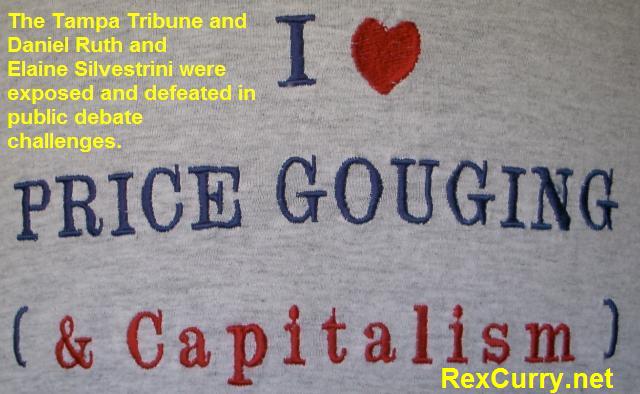
Daniel Ruth & Tampa Tribune defeated by Dr. Rex Curry, free-market
advocate, in public debate challenge about "Price Gouging" http://rexcurry.net/Ruth.html
Price Gouging in the Auburn Plainsman - Despite complaints about
paying extra for gas after Katrina, many people — not just gas station
owners — believe the illegal action of price gouging is good. http://rexcurry.net/price-gouging-auburn.html
price-gouging - The executive order activates a state law that
makes price-gouging illegal. It defines the practice as "unconscionable"
price increases for lodging etc http://rexcurry.net/price-gouging.html
quotes and searches from rexcurry.net
“The Malthusian theory only exists in socialism.”
“The Malthusian theory exists only in socialism.”
“The Malthusian theory is manifested only in socialism” (i.e. in non-capitalist
economies)
“The Malthusian theory only arises in socialism.”
“The Malthusian theory arises only in socialism.”
“The Malthusian theory only exists in non-capitalist societies.”
“The Malthusian theory exists only in non-capitalist economies.”
“The Malthusian theory is manifested only in a non-capitalist economy."
“The Malthusian theory only arises in a non-capitalist society.”
“The Malthusian theory arises only in anti-capitalist societies.”
More educational searches
"malthusian theory" socialism capitalism
“malthusian theory only”
“Malthusian theory arises”
“Malthusian theory exists”
“malthusian theory is” “free market”
"malthusian theory" socialism hayek
"malthusian theory" "julian simon" socialism
malthus "julian simon" socialism
Price gouging stops the Malthusian theory
Daniel Ruth http://rexcurry.net/ruthgouge.jpg
Tampa Tribune Daniel Ruth
DANIEL RUTH, TAMPA TRIBUNE, DEFEATED BY DR.
REX CURRY ON PRICE GOUGING