Dr. Rex Curry is the victor over Dr. Martin M. Winkler of George Mason
University in a debate challenge. http://rexcurry.net/roman-salute-martin-winkler.html
The announced debate topic was the origin of the "Roman Salute"
myth, and the spread of the socialist gesture / symbol. http://rexcurry.net/pledge-professor-martin-winkler.html
Professor Winkler did not dispute Dr. Curry's work exposing
the Roman Salute: Cinema, History, Ideology.
As the nation's leading authority on the pledge of allegiance
and on the "Roman Salute," Dr. Curry made the historic discovery that
the salute of the National Socialist German Workers' Party (Nazis) originated
from the military salute in the USA, and from the original flag pledge
(as written by a socialist), and not from ancient Rome. http://rexcurry.net/pledge-lawyer.html
Professor Winkler had previously written a piece in the American
Philological Association (APA) and it supports Dr. Curry's work.
That article is analyzed below and at http://rexcurry.net/roman-salute-martin-winkler.html
(at the url Professor Winkler's article appears in a left column
and the analysis appears in a right column for comparison purposes).
The raised-arm salute is one of the best-known symbols of
Fascism, supposedly based on a classical Roman custom. But no Roman
work of art displays this salute, nor does any Roman text describe it.
Professor Martin M. Winkler's article
begins strongly, and with only one big problem foreshadowed and that
is Winkler's hackeneyed use of the term "Fascism" which shows Winkler's
fixation and it might explain why Winkler was unable to make the discoveries
that were made by Dr. Rex Curry. See the Youtube video http://www.youtube.com/watch?v=NsZxRPdDQHo
There appears to be no example on the internet of Winkler ever
using the actual correct name of the "National Socialist German Workers'
Party." If he had, his research might have also led him to national
socialists in the USA who promoted the straight arm salute as part of
the early pledge of allegiance (to the USA's flag) going back as far as
1892, before the salute was used by German national socialists.
Well before Fascism, the
salute frequently occurs in films set in antiquity, such as the American
Ben-Hur (1907) or the Italian Nerone (1908),
although such films do not yet standardize it or make it exclusively
Roman. In Spartaco (1914), even Spartacus uses it. In imitation
of such historical films, self-styled “Consul” Gabriele D’Annunzio appropriated
the salute in its now familiar form as a propaganda tool for his political
aspirations upon his occupation of Fiume in 1919. Earlier, D’Annunzio
had been closely involved in Giovanni Pastrone’s colossal epic Cabiria
(1914), in which variations of the salute occur several times. Notable
other examples of the salute, by now a standard part of ancient iconography
in the cinema, appear in Ben-Hur (1925) and in Cecil B. DeMille’s
Sign of the Cross (1932) and Cleopatra (1934), although
the execution of the gesture is still variable.
It is unfortunate that Winkler
leads his second paragraph with the term "Fascism," reinforcing the
point made in the analytical paragraph of criticism above. Winkler is
implying a link to Benito Mussolini. Mussolini worked with D'Annunzio
and Mussolini was aware of the 1914 film Cabiria which used variations
of the straight-arm salute. But Winkler did not seem to be aware that
the use of the salute in the USA's pledge pre-dated the 1914 film.
http://rexcurry.net/book1a1contents-pledge.html
Mussolini was also aware of D'Annunzio's Charter of Carnaro
for his Regency of Carnaro in the city of Fiume. Yet Winkler's "fascism"
fixation prevents Winkler from realizing that from 1914 to 1919 (and
before) Mussolini was a self-described socialist, a well-known socialist
leader who was respected among socialists at that time (that time when
he found the socialist salute). Between 1912 and 1914, Mussolini was
the editor of the Socialist Party newspaper, "L'Avanti." In 1914
he started his own socialist newspaper "Il Popolo d'Italia" ("The people
of Italy"). He was a staunch proponent of revolutionary rather than reformist
socialism, and actually received Lenin's endorsement and support for expelling
reformists from the Socialist Party. He was first dubbed "Il Duce"
(the Leader) when he was a member of Italy's (Marxist) Socialist Party.
Later, Mussolini adopted a new label for his tired old socialist dogma.
The new label worked and from 1922 to 1945 (23 years) Mussolini ruled
Italy.
The salute was supposed
to have been used in the Roman republic, but there is no clear evidence
of this. Indeed it is not known whether salutes in the military sense
existed at all in Roman culture. However, a number of images showing
similar gestures exist from the Imperial era. These depict Roman leaders
addressing their troops ("adlocutio" scenes). Usually the leader has
his arm raised in a rhetorical gesture. In some images a few troops are
also depicted with raised arms, possibly suggesting acclamation of the
leader. Several such scenes appear on Trajan's column.
Winkler states that there is no
clear evidence that the salute was ever used in the Roman Republic.
http://rexcurry.net/book1a1contents-pledge.html
Different parts of Roman history are mentioned (the Roman Archaic
Period was a Devlopmental Era 1000 BC- 509 BC; the Roman Republic
Era is considered the True Character of Rome 509 BC - 27BC; the Roman
Imperial Era was an Expansive changing era and includes the Pax Romana
27 BC - 476 AD). He states that images that might be mistaken for
a type of salute are actually images of leaders gesturing during speeches
and sometimes listeners pointing or gesturing in response. They
are not salutes and were not called salutes.
Of particular importance for the visual record are two films by Leni
Riefenstahl, Triumph of the Will (1935) and Olympia (1938).
As is to be expected, the former regularly features the salute; the
latter shows Hitler, German spectators and officials in Berlin’s Olympic
stadium, and several victorious German and Italian athletes giving it.
So do a number of athletic teams entering the stadium. In Italy, Carmine
Gallone’s Scipione l’Africano (1937) uses the raised-arm
salute as one of its chief visual means to turn Mussolini into a new Scipio.
After the fall of Fascism, Hollywood made the Roman Empire familiar
to filmgoers by presenting it as a precursor of recent enemy empires.
A case in point is Mervyn LeRoy’s Quo Vadis (1951), whose triumph
sequence is modeled on Triumph of the Will, replete with the
Fascist salute. In his 1959 remake of Ben-Hur, William Wyler,
a Jewish émigré from Germany and a committed anti-Fascist,
also shows a totalitarian Roman Empire but takes care to have his actors
de-emphasize the all-too-obvious.
With the 1960s, the visual iconography of Roman films
begins to change. Stanley Kubrick’s Spartacus (1960) has less
use for the raised-arm salute than did its precursors. Anthony Mann’s
The Fall of the Roman Empire (1964), the only epic film that
attempts to do justice to the greatness of Rome, shows a triumphant Commodus
greeting the Roman people with a variation on the raised-arm salute from
which obvious Fascist overtones are gone. When a new Commodus triumphantly
enters Rome in Ridley Scott’s Gladiator
(2000), the salute no longer occurs.
Winkler states "Of particular importance
for the visual record are two films by Leni Riefenstahl, Triumph
of the Will (1935) and Olympia (1938)." He would do
well to note that the visual record in those films never shows the word
"fascist," nor does the audio record once state the word "fascist," and
that the word "socialist" occurs throughout, such as in Trumph of the
Will, where the speakers promote "socialism" by the very word ad nauseum.
Winklers inability to make such observations denied him the discoveries
made by Dr. Rex Curry.
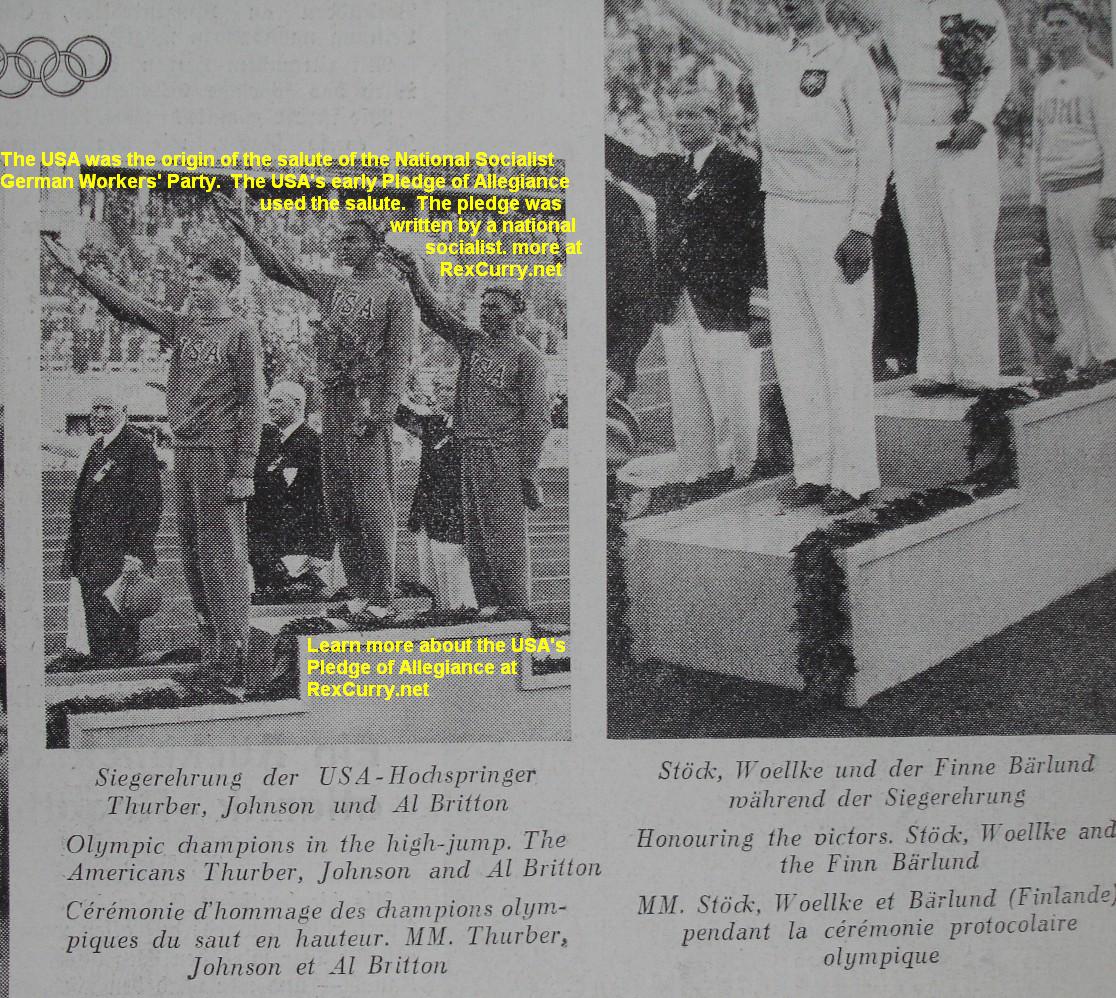
Dr. Curry discovered why the 1936 Olympic gold medalist Jesse
Owens (featured in the 1938 film Olympia) gave the military salute
from his victory stand. Winkler seems unaware that the military salute
was not the standard salute for civilians in the USA, and that the "civilian
salute" was the pledge of allegiance salute which merely began with a
military salute and then stretched outward to the flag into the straight-arm
salute. Mr. Owens did not want to do the entire USA salute because he
did not want it misinterpreted as a salute to the leader of the National
Socialist German Workers' Party. http://rexcurry.net/bookchapter1a1c1.html
Dr. Curry also discovered the almost universally forgotten
"Olympic salute" of which Winkler seems to be unaware. The Olympic
salute was also the straight-arm salute and it also originated from
the USA's pledge of allegiance. Winkler is unaware that one of
the reasons why so many of the athletes appear to be performing the salute
of the National Socialist German Workers' Party in the Olympia film is
because they are performing the "official Olympic salute." The
Olympic salute fell out of favor for the same reason as did the early
pledge of allegiance salute.
Winkler concludes his piece by even more repetitions of the
term "Fascist" as if to emphasize why he overlooked the discoveries
made by Dr. Rex Curry.
Finally, Winkler explains how modern films with fictional
Roman scenes are no longer showing the salute, as if to indicate that
everyone is wising up to the fact that it was not an ancient Roman
salute.
These are the historical discoveries made by Dr. Rex Curry:
1. Dr. Rex Curry showed that the USA's early Pledge of Allegiance (to
the flag) used a straight-arm salute and it was the origin of the salute
of the monstrous National Socialist German Workers' Party (Nazis). Dr.
Curry helped to establish that it was not an ancient Roman salute, and
that the "ancient Roman salute" is a myth. http://rexcurry.net/pledgesalute.html
The myth is still repeated in modern efforts to cover-up Dr. Curry's
discoveries about the Pledge's poisonous pedigree.
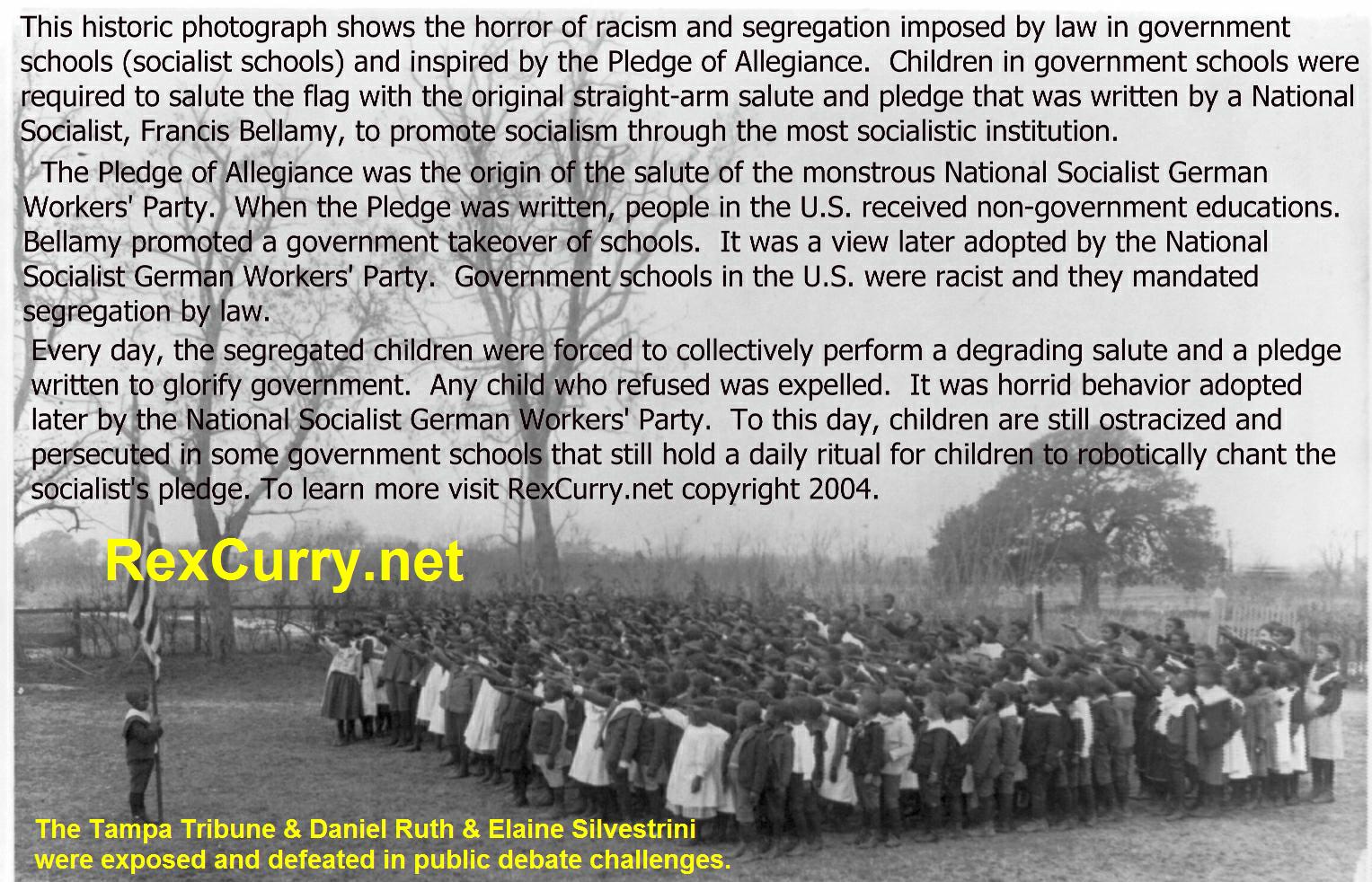
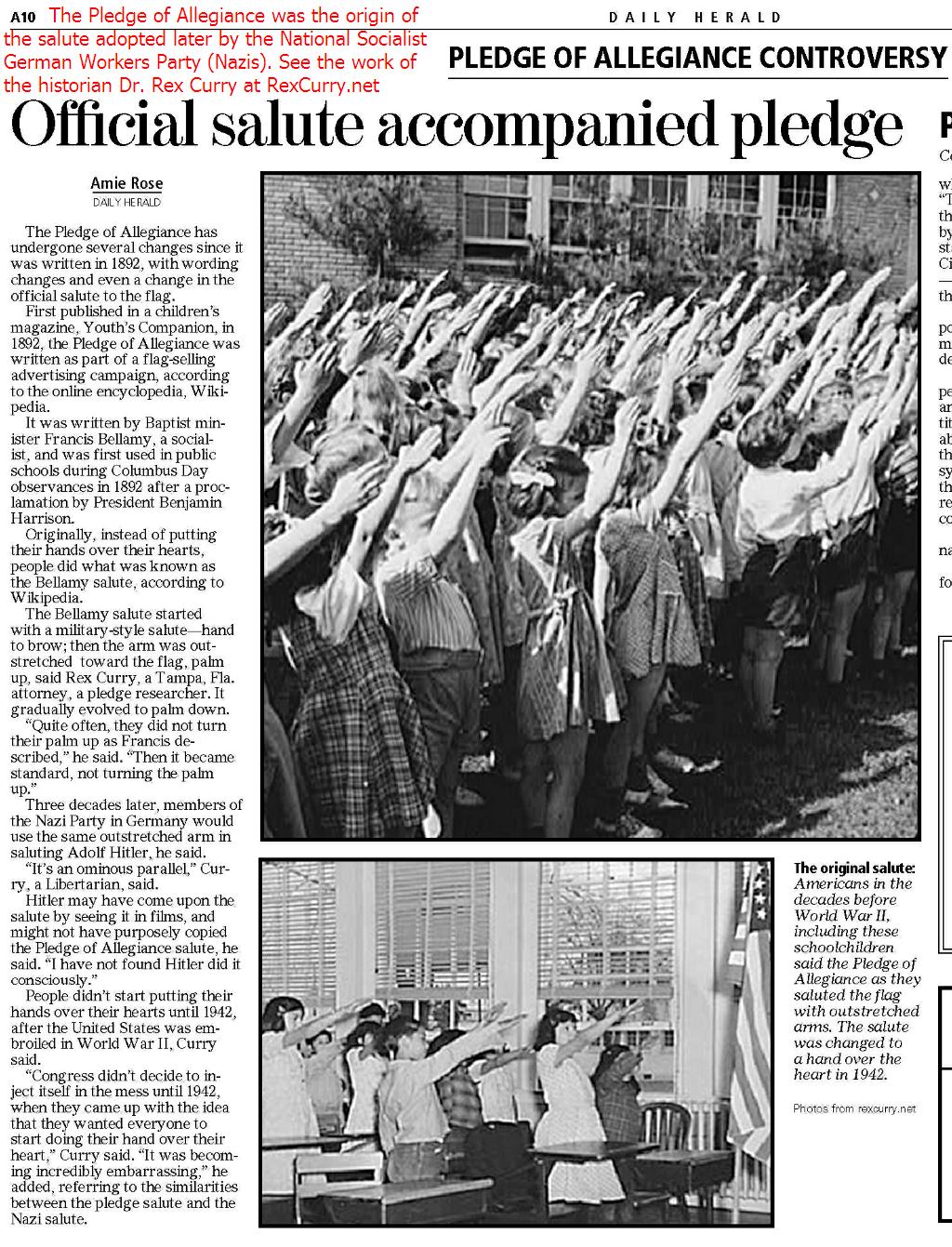
2. The original Pledge began with a military salute that
then stretched out toward the flag. Historic photographs are at http://rexcurry.net/pledge2.html
and at http://rexcurry.net/pledge_military.html
In actual use, the second part of the gesture was performed with a
straight arm and palm down by children extending the military salute
while perfunctorily performing the forced ritual chanting. Professor
Curry showed that, due to the way that both gestures were used sequentially
in the pledge, the military salute led to the Nazi salute. The Nazi salute
is an extended military salute via the pledge. http://rexcurry.net/book1a1contents-pledge.html
3. Francis Bellamy (author of the "Pledge of Allegiance")
and Edward Bellamy (author of the novel "Looking Backward") and Charles
Bellamy (author of "A Moment of Madness") and Frederick Bellamy (who
introduced Edward to socialistic "Fourierism") were socialists.
Edward, Charles and Frederick were brothers, and Francis was their cousin.
Francis and Edward were both self-proclaimed National Socialists and they
supported the "Nationalism" movement in the USA, the "Nationalist" magazine,
and the "Nationalist Educational Association." They wanted all of society
to ape the military and they touted "military socialism" and the "industrial
army." Edward’s book was an international bestseller, translated
into every major language (including German) and he inspired the "Nationalist
Party" (in the USA) and their dogma influenced socialists worldwide (including
Germany) via “Nationalist Clubs.” http://rexcurry.net/bellamy-edward-german-connections.html
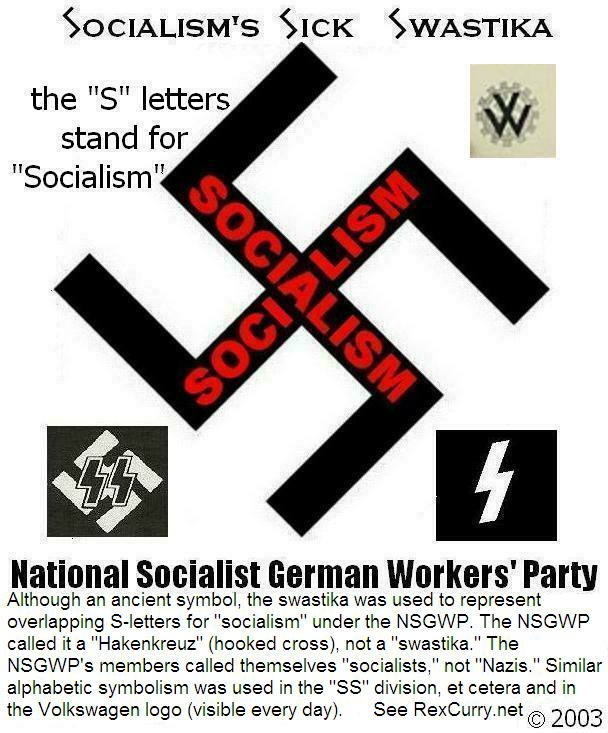
The Pledge was the origin of the Nazi salute. "Nazi" means "National
Socialist German Workers' Party." A mnemonic device is the swastika.
Although the swastika was an ancient symbol, Professor Curry discovered
that it was also used sometimes by German National Socialists to represent
"S" letters for their "socialism." Curry changed the way that people
view the symbol of the horrid National Socialist German Workers' Party.
Hitler altered his own signature to use the same stylized "S" letter
for "socialist" and similar alphabetic symbolism still shows on Volkswagens.
http://rexcurry.net/book1a1contents-swastika.html
Many Bellamy policies were followed in the USA and still are followed
in the USA and they helped to cause the USA’s big, expensive and oppressive
government.
The government in the USA and the government schools hide
those facts from people in the USA and from people in other countries.
As the nation's leading authority on the pledge of allegiance
and on the "Roman Salute," Dr. Curry made the historic discovery that
the salute of the National Socialist German Workers' Party (Nazis) originated
from the military salute in the USA, and from the original flag pledge
(as written by a socialist), and not from ancient Rome. http://rexcurry.net/pledge-lawyer.html
Professor Winkler had previously written a piece in the American
Philological Association (APA) and it supports Dr. Curry's
work. That article is analyzed below and at http://rexcurry.net/roman-salute-martin-winkler.html
(at the url Professor Winkler's article appears in a left column
and the analysis appears in a right column for comparison purposes).
Professor Winkler's article begins strongly, and with only
one big problem foreshadowed and that is Winkler's hackeneyed use of
the term "Fascism" which shows Winkler's fixation and it might explain
why Winkler was unable to make the discoveries that were made by Dr.
Rex Curry. http://rexcurry.net/pledge-lawyer.html
There appears to be no example on the internet of Winkler ever
using the actual correct name of the "National Socialist German Workers'
Party." If he had, his research might have also led him to national
socialists in the USA who promoted the straight arm salute as part of
the early pledge of allegiance (to the USA's flag) going back as far as
1892, before the salute was used by German national socialists.
It is unfortunate that Winkler leads his second paragraph
with the term "Fascism," reinforcing the point made in the analytical
paragraph of criticism above. Winkler is implying a link to Benito
Mussolini. Mussolini worked with D'Annunzio and Mussolini was aware
of the 1914 film Cabiria which used variations of the straight-arm salute.
But Winkler did not seem to be aware that the use of the salute in the
USA's pledge pre-dated the 1914 film.
Mussolini was also aware of D'Annunzio's Charter of Carnaro
for his Regency of Carnaro in the city of Fiume. Yet Winkler's "fascism"
fixation prevents Winkler from realizing that from 1914 to 1919 (and
before) Mussolini was a self-described socialist, a well-known socialist
leader who was respected among socialists at that time (that time when
he found his socialist salute). Between 1912 and 1914, Mussolini was
the editor of the Socialist Party newspaper, "L'Avanti." In 1914
he started his own socialist newspaper "Il Popolo d'Italia" ("The people
of Italy"). He was a staunch proponent of revolutionary rather than reformist
socialism, and actually received Lenin's endorsement and support for
expelling reformists from the Socialist Party. He was in fact first
dubbed "Il Duce" (the Leader) when he was a member of Italy's (Marxist)
Socialist Party. Later, Mussolini adopted a new label for his tired
old socialist dogma. The new label worked and from 1922 to 1945 (23 years)
Mussolini ruled Italy.
Winkler states that the is no clear evidence that the salute
was ever used in the Roman Republic. http://rexcurry.net/book1a1contents-pledge.html
Different parts of Roman history are mentioned (the Roman Archaic
Period was a Devlopmental Era 1000 BC- 509 BC; the Roman Republic
Era is considered the True Character of Rome 509 BC - 27BC; the Roman
Imperial Era was an Expansive changing era and includes the Pax Romana
27 BC - 476 AD). He states that images that might be mistaken for
a type of salute are actually images of leaders gesturing during speeches
and sometimes listeners pointing or gesturing in response. They
are not salutes and were not called salutes.
Winkler states "Of particular importance for the visual record
are two films by Leni Riefenstahl, Triumph of the Will (1935)
and Olympia (1938)." He would do well to note that the
visual record in those films never shows the word "fascist," nor does
the audio record once state the word "fascist," and that the word "socialist"
occurs throughout, with the characters extolling "socialism" by the very
word ad nauseum. Winklers inability to make such observations denied
him the discoveries made by Dr. Rex Curry.
Dr. Curry discovered why the 1936 Olympic gold medalist
Jesse Owens (featured in the 1938 film Olympia) gave the military
salute from his victory stand. Winkler seems unaware that the military
salute was not the standard salute for civilians, and that the "civilian
salute" was the pledge of allegiance salute which merely began with a
military salute and then stretched outward to the flag into the straight-arm
salute. Mr. Owens did not want to do the rest of the USA salute because
he did not want it to be misinterpreted as a salute to the leader of the
National Socialist German Workers' Party. http://rexcurry.net/bookchapter1a1c1.html
Dr. Curry also discovered the almost universally forgotten
"Olympic salute" of which Winkler seems to be unaware. The Olympic
salute was also the straight-arm salute and it also originated from the
USA's pledge of allegiance. Winkler is unaware that one of the
reasons why so many of the athletes appear to be performing the salute
of the National Socialist German Workers' Party in the Olympia film is
because they are performing the "official Olympic salute." The Olympic
salute fell out of favor for the same reason as did the early pledge of
allegiance salute.
Winkler concludes his piece by even more repetitions of
the term "Fascist" as if to emphasize why he overlooked the discoveries
made by Dr. Rex Curry.
Finally, Winkler explains how modern films with fictional
Roman scenes are no longer showing the salute, as if to indicate that
everyone is wising up to the fact that it was not an ancient Roman
salute.
These are the historical discoveries made by Dr. Rex Curry:
1. Dr. Rex Curry showed that the USA's early Pledge of Allegiance (to
the flag) used a straight-arm salute and it was the origin of the salute
of the monstrous National Socialist German Workers' Party (Nazis). Dr.
Curry helped to establish that it was not an ancient Roman salute, and
that the "ancient Roman salute" is a myth. http://rexcurry.net/pledgesalute.html
The myth is still repeated in modern efforts to cover-up Dr. Curry's
discoveries about the Pledge's poisonous pedigree.
2. The original Pledge began with a military salute that
then stretched out toward the flag. Historic photographs are at http://rexcurry.net/pledge2.html
and at http://rexcurry.net/pledge_military.html
In actual use, the second part of the gesture was performed with a
straight arm and palm down by children extending the military salute
while perfunctorily performing the forced ritual chanting. Professor
Curry showed that, due to the way that both gestures were used sequentially
in the pledge, the military salute led to the Nazi salute. The Nazi salute
is an extended military salute via the pledge. http://rexcurry.net/book1a1contents-pledge.html
3. Francis Bellamy (author of the "Pledge of Allegiance")
and Edward Bellamy (author of the novel "Looking Backward") and Charles
Bellamy (author of "A Moment of Madness") and Frederick Bellamy (who
introduced Edward to socialistic "Fourierism") were socialists.
Edward, Charles and Frederick were brothers, and Francis was their cousin.
Francis and Edward were both self-proclaimed National Socialists and they
supported the "Nationalism" movement in the USA, the "Nationalist" magazine,
and the "Nationalist Educational Association." They wanted all of society
to ape the military and they touted "military socialism" and the "industrial
army." Edward’s book was an international bestseller, translated
into every major language (including German) and he inspired the "Nationalist
Party" (in the USA) and their dogma influenced socialists worldwide (including
Germany) via “Nationalist Clubs.” http://rexcurry.net/bellamy-edward-german-connections.html
The Pledge was the origin of the Nazi salute. "Nazi" means "National
Socialist German Workers' Party." A mnemonic device is the swastika.
Although the swastika was an ancient symbol, Professor Curry discovered
that it was also used sometimes by German National Socialists to represent
"S" letters for their "socialism." Curry changed the way that people
view the symbol of the horrid National Socialist German Workers' Party.
Hitler altered his own signature to use the same stylized "S" letter
for "socialist" and similar alphabetic symbolism still shows on Volkswagens.
http://rexcurry.net/book1a1contents-swastika.html
Many Bellamy policies were followed in the USA and still are followed
in the USA and they helped to cause the USA’s big, expensive and oppressive
government.
The government in the USA and the government schools hide
those facts from people in the USA and from people in other countries.
*************************
Historia Numorum Dictionary of Roman Coin
ADLOCUTIO. Adlocution. The custom of haranguing the soldiers
was frequent with the Emperors, as is evidenced by a variety of their
coins. This ceremony was performed, either at the moment when an individual
obtained the imperial purple, or when the reigning prince adopted someone
with a view to the succession; or when he admitted another person into
immediate participation of the empire, of which examples are often recorded
by historians. Memorials of these military orations, which an emperor
delivered before some expeditionary force, at the time of its going out
on a campaign, or of its returning after a victory - in which the soldiers
were to be reminded of their duty; or rewarded for their good conduct and
success, with praises, and "not least in their dear love," with donatives
also - are preserved on many of the very finest coins of the Augusti.
On these reverses, a raised platform or tribune, more or less
lofty, called by the Romans suggestum, is exhibited, on which the Emperor,
habited either in the toga, or the paludamentum, is seen standing, with
his right arm elevated, as if appealing to the sentiments of the troops,
or beckoning for silence.
Frequently the Praetorian Prefect, in same cases two Praetorian
Prefects, appear standing behind the Emperor. In one example
is a group of the legionaries, from three to five or six generally in
number, with their faces turned towards their prince; some holding the
eagles, vexilla, and ensigns; others their bucklers and spears. With
regard to the customary attitude and gesture of the speaker in addressing
the troops, Cicero affords an illustrative passage, in his oration,
against Gabinius - "When (says he) the general (Imperator), openly, in
the presence of the army, stretched out his right hand, not to incit the
soldiers to glory, but to tell them that they might make their own market"
(Omnia sibi et empta et emenda esse. - Provinc. cons. c. 4.)
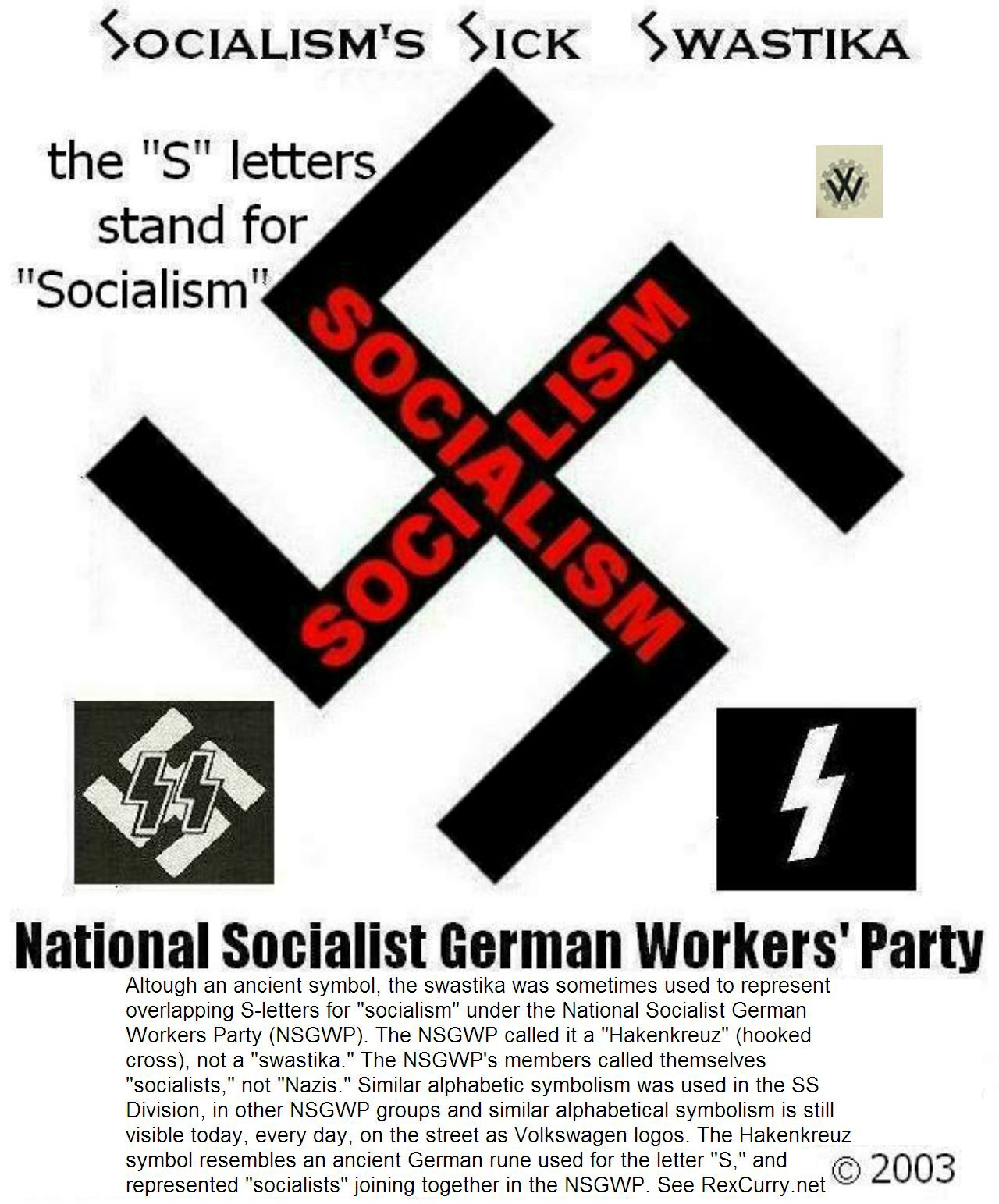 Swastikas
that symbolize overlapping S-letters for Socialism
Swastikas
that symbolize overlapping S-letters for Socialism