OATH OF THE HORATII ? OR THE PLEDGE OF ALLEGIANCE
OF THE HORATII ???
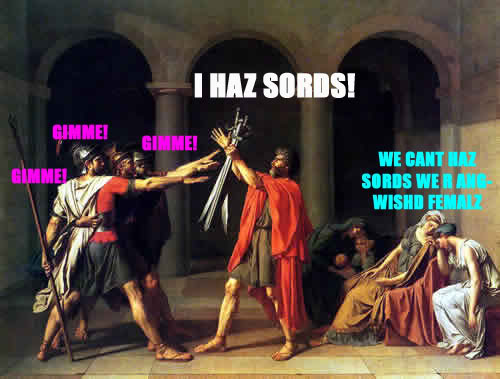
Jacques-Louis David (August 30, 1748 - December 29, 1825) The Oath of the Horatii 1784 Musée du Louvre at Paris
Jacques-Louis David (August 30, 1748 - December 29, 1825) The Oath of the Horatii 1784 Musée du Louvre at Paris

The myth that the straight-armed salute is an ancient Roman salute has been completely refuted. http://rexcurry.net/bookchapter1a1e.html
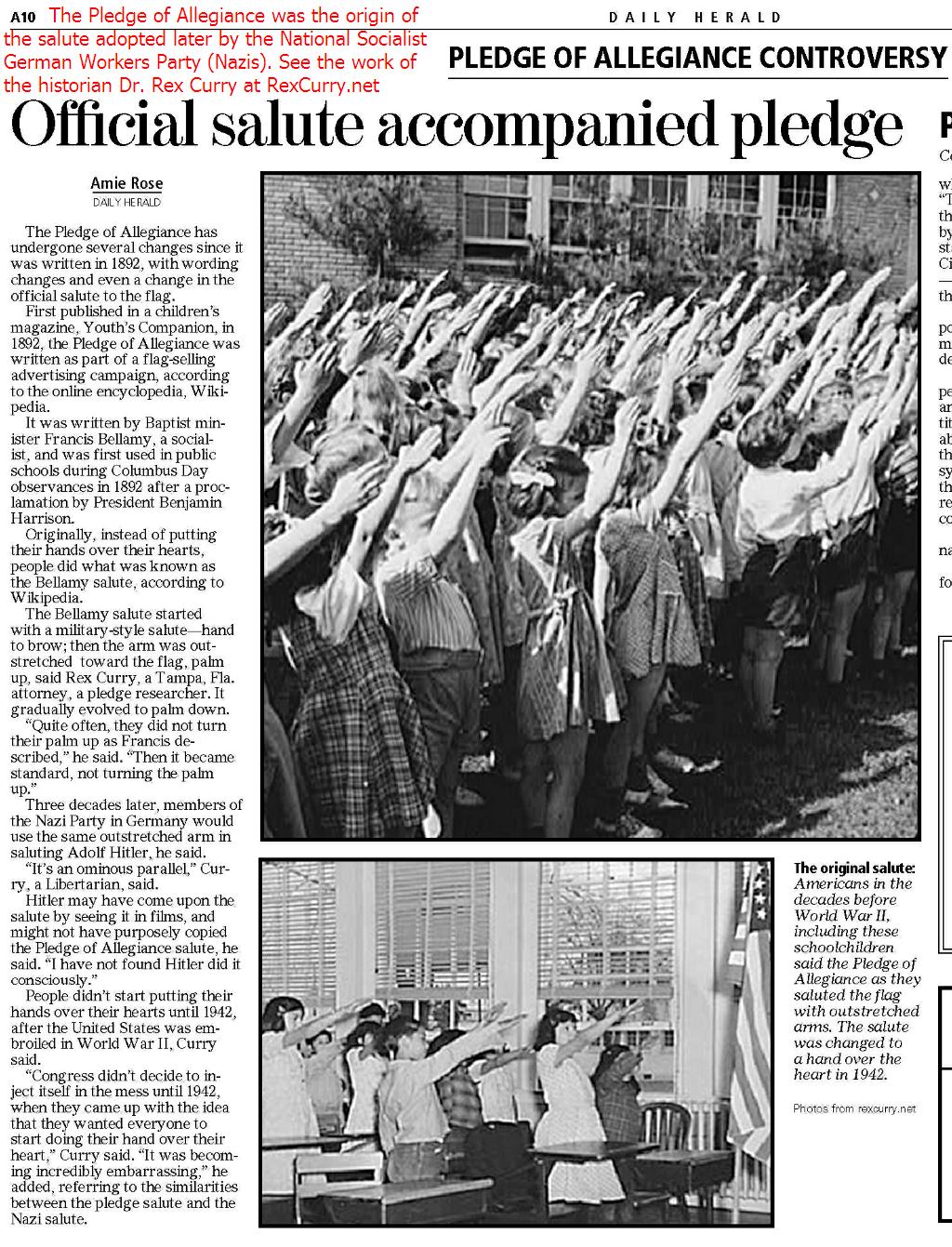
The so-called "Roman" salute (Nazi salute) was the American salute and it was made in the USA. http://rexcurry.net/pledgesalute.html
The infamous straight-armed salute of the National Socialist German Workers' Party (Nazis) came from the USA's military salute and from the original pledge of allegiance to the flag, and not from ancient Rome. See the Youtube video http://www.youtube.com/watch?v=NsZxRPdDQHo
The Roman salute myth was used (and still is used) to cover-up the fact that National Socialists in the USA inspired National Socialists in Germany (Nazis) in their salute and ideology. The pledge of allegiance (and its original straight-arm salute) was created by Francis Bellamy, a self-proclaimed National Socialist in the USA.
http://members.ij.net/rex/pledge-allegiance-pledge-allegiance2.jpg
There is no evidence that the painting "The Oath of the Horatii" (Jacques-Louis David) inspired the original straight-armed salute in the pledge of allegiance to the U.S. flag. http://rexcurry.net/oath_horatii_rexcurrydotnet.jpg
Jacques-Louis David never used the term Roman salute to describe his painting nor to describe anything.
No one else described Jacques-Louis David's work as a "Roman salute." That is because the term "Roman salute" developed in the late 1930's. The Oxford English Dictionary supports Dr. Rex Curry in this regard. http://rexcurry.net/roman-salute-oxford-english-dictionary.html
The term "Roman salute" developed decades after Jacques-Louis David's life. When the term "Roman salute" developed, the straight-arm salute was a decades-old ritual in government schools in the USA where the gesture was compelled with robotic chanting of the Pledge Of Allegiance. The gesture originated in the USA from the military salute extended outward in the early Pledge. http://rexcurry.net/book1a1contents-pledge.html
Even so, none of those sources of the modern term "Roman salute" said a thing about artwork by Jacques-Louis David.
The first time that Jacques-Louis David was concocted as an excuse for the "Roman salute" myth was circa 2006 on Wikipedia. It was done by a writer who was trying to cover-up work by the historian Dr. Rex Curry showing that the gesture originated in the USA's early Pledge Of Allegiance. It is more revisionist history air brushed at wakipedia.
In the past, people would repeat the myth that the gesture was an "ancient Roman salute." Most modern writers now concede the discoveries of the noted historian Dr. Rex Curry, establishing that the gesture was not an ancient Roman salute. http://rexcurry.net/roman_salute_roman_salute_roman_salute.jpg Roman Salutes from ancient Rome are a myth.
Wikipedia has helped to spread the news about Dr. Curry's news-making work. Recent articles at opinioneditorials.com report on the many references to Dr. Curry's research and discoveries on Wikipedia. Dr. Curry's work might be the most referenced historical research on Wikipedia. Even Wikipedia founder Jimmy "Jimbo" Wales has publicly noted Dr. Curry's influence on Wikipedia. Wikipedia writers have reviewed and verified the work. Some Wikipedia writers use Dr. Curry's work without attribution in apparent attempts to bolster their own credibility.
After Dr. Curry's discoveries became well known, some intellectually dishonest people took it upon themselves to concoct a new myth to cover-up for the socialist gesture. After Dr. Curry's shocking discoveries about the salute's origin with the Pledge of Allegiance, some writers deliberately looked for other explanations and then those writers misrepresented neoclassical art to fabricate an alternative explanation and to cover-up Professor Curry's work. http://rexcurry.net/wikipedia-lies.html
Francis Bellamy (the author of the pledge of allegiance) and James Upham (with whom Bellamy worked) discussed the process of creating the original flag salute and the painting was not part of the process and it did not even arise in their discussion. http://rexcurry.net/pledgesalute.html Further, Bellamy and Upham explicitly rejected the idea of an "oath" and specifically chose to use the word "pledge."
There is no evidence that the painting "The Oath of the Horatii" inspired the original straight-armed salute in the pledge of allegiance to the U.S. flag. One would have to wildly speculate that if the painting inspired the flag salute at all, then it was subliminally.
The Roman salute myth came after the Pledge of Allegiance and was inspired by the pledge, as shown by Dr. Rex Curry (author of "Pledge of Allegiance Secrets"). http://rexcurry.net/roman-salute-oxford-english-dictionary.html
The painting "The Oath of the Horatii" http://rexcurry.net/pledgehoratii.html might have inspired (or enlarged) the myth of the Roman salute, not only by modern writers who use it to deliberately cover-up the truth, but also among ignorant people who do not understand the actual origins. The myth was also inspired by early movies that showed fictional Roman scenes using a straight-arm salute. Those movies were inspired by the original straight-arm salute of the pledge of allegiance to the U.S. flag (from 1892).
The "Roman salute" myth was reinforced when the salute was adopted as the "Olympic salute" used at Olympic games on or before 1924.